What is a noise decibel monitor? Enforcing “no party” policies with privacy-safe monitoring
This article explains what noise decibel monitors are, how they work, and how hotels, serviced apartments, and short-term rental operators are using them to, protect guest experience and reputation, resolve noise disputes quickly and fairly, and keep corporate clients and neighbors happy.
“No party” policies are common across hotels, serviced apartments, multifamily communities, and short-term rentals. Yet policies on paper only work when you can enforce them in practice. Traditionally, teams have relied on neighbor complaints, ad hoc patrols, or late-night callouts. By the time a report reaches the front desk or property team, the damage is often done, and the guest experience has already suffered.
Noise decibel monitoring changes the equation. It gives you real-time visibility into loudness trends inside a room or common area without recording audio or invading privacy, so you can prevent disturbances before they turn into complaints, refunds, or contract breaches.
In this guide, we’ll explain what a noise decibel monitor is, how it works, and how forward-thinking operators use it to enforce quiet hours, resolve disputes fairly, and keep guests and neighbors happy.
What is a noise decibel monitor?
A noise decibel monitor is a small device that continually measures how loud an environment is. It reports those measurements in decibels, often displayed as dB or dBA, where dBA reflects how the human ear hears different frequencies. Think of the device as a privacy-safe barometer of sound. It measures loudness and duration, not conversations or content. In other words, it cannot listen in, it only quantifies how loud it is and for how long.
For hospitality and residential operations, the distinction between a general sound level meter and a smart noise decibel monitor matters. Traditional sound level meters are industrial tools used for engineering or code enforcement. Smart noise decibel monitors are built for properties: they track sustained noise patterns, average levels over time windows, and integrate with your PMS and guest messaging. For example, a hotel or aparthotel might set daytime and nighttime thresholds and be alerted when the average noise exceeds 75 dB for 10 minutes. The system can then send a polite automated message to the guest and notify staff only if the noise persists.
Crucially, major booking platforms draw a clear privacy line. Airbnb bans indoor cameras but allows interior noise monitors that don't record audio, provided they're fully disclosed to guests. This distinction is a win for guest privacy and for operators who need objective, real-time insight without surveillance.
What decibels and thresholds mean in plain language
Decibels are simply a unit for loudness. Normal conversation is around 60–70 dB. A lawn mower can range from 80–100 dB. Big sports events can reach upward of 100 dB. For a friendly reference list of everyday sound levels and what counts as safe exposure, the U.S. National Institute on Deafness and Other Communication Disorders notes that sounds around 70 dB are generally safe, while long or repeated exposure at or above 85 dB can lead to hearing damage.
When we talk about thresholds operationally, we mean setting a decibel level and a duration that reflect your house rules. For example, you might choose 75 dB over 10 minutes as an alert trigger for living areas, and a lower level for nighttime. This allows you to filter out clinks and cheers while catching sustained gatherings. In fact, in the Minut x Airbnb Prague program, hosts were advised to set 75 dB during the day and 70 dB at night, a policy that helped resolve noise events quickly and reassure neighbors.
Why properties are adopting decibel monitoring
Preventing parties and protecting brand reputation
Uncontrolled gatherings can lead to property damage, neighbor complaints, and lost bookings. The cost to your brand can be even higher. J.D. Power finds that when guests encounter a problem such as excessive noise, overall satisfaction drops dramatically. That sensitivity underlines how important it is to prevent issues before they reach the front desk or review page.
Decibel monitoring helps you intervene early. A guest-friendly reminder delivered automatically when a threshold is crossed often resolves the situation quietly, without any confrontation or escalation.
Protecting corporate and group contracts
Corporate housing, extended-stay guests, sports teams, and group bookings expect consistent, quiet environments. Decibel monitoring supports compliance with building rules and brand standards by providing objective, timestamped records of noise levels. This is especially helpful in mixed-use buildings where neighbors and office tenants need predictable quiet hours.
Reducing staff stress and after-hours callouts
Without real-time, objective data, teams rely on subjective reports that arrive too late and require disruptive follow-ups. Smart alerts route to the right team member with context, including how long the noise has persisted. That means fewer middle-of-the-night visits and faster, calmer resolutions.
Resolving disputes with evidence
With timestamped noise logs, you can resolve objections fairly. Whether a neighbor complains about a specific unit or a guest challenges a charge, objective decibel data reduces friction and helps you apply policies consistently.
How noise decibel monitors work in practice
Setting thresholds for day and night
Quiet hours are common across student housing, multifamily, and hotels. University residence life policies often define quiet hours from around 10–11 p.m. to 7–9 a.m., which is a useful guidepost for operators.
These examples point to a practical approach: create sustained-level thresholds by time of day and room type. That ensures your team is only alerted when there is a real, ongoing disturbance, and not a brief cheer when a game ends.
Integrations that close the loop
Decibel monitoring is most powerful when it connects to your core systems. Minut integrates with Airbnb, dozens of PMS platforms, and messaging tools so alerts link automatically to active bookings and guests receive a polite reminder without manual work.
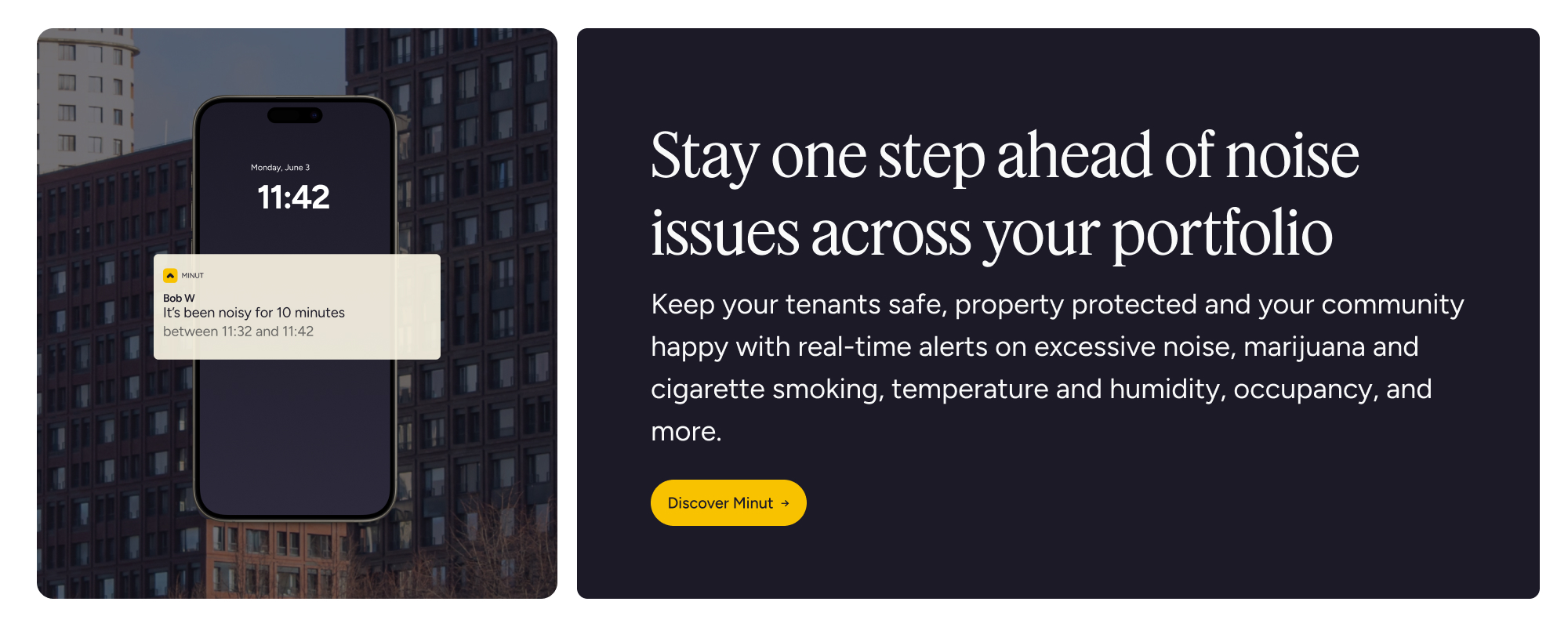
A typical workflow looks like this. Noise exceeds 75 dB for 10 minutes in a living room during quiet hours. The system sends a friendly reminder to the guest via SMS or the booking platform messenger, then checks for a return to normal. If the noise persists, the case escalates to a team member or to our Call Assist service. Our latest Guest Connect upgrade even adds automated phone calls, with configurable timelines and messaging tone as the situation escalates.
Privacy and guest trust
The most common question we hear is simple: does decibel monitoring record conversations? The answer is no. Smart noise decibel monitors measure how loud it is and for how long. They do not capture or transmit audio content. That is a critical boundary for guest trust and platform policies.
We recommend disclosing monitoring in listings and pre-arrival communications with plain, transparent language such as: “Smart sensors monitor noise levels, not conversations, to help ensure a peaceful stay.” This reassurance, combined with a light-touch, automated approach to reminders, fosters trust while keeping your property standards intact.
Implementing decibel monitoring in your property
Start by writing down the quiet-hour policy you already follow. Then set acceptable thresholds that reflect your building’s construction and your brand promise. For mixed-use buildings or sensitive locations, you might adopt conservative nighttime thresholds. For busy urban hotels during peak seasons, you might refine daytime thresholds to concentrate on sustained noise.
Placement matters too. Install devices in shared or high-risk areas such as living rooms, kitchens, corridors, and balconies. Avoid private spaces, and disclose device locations clearly. Train your team to interpret alerts and to communicate in a friendly, supportive tone. Polite reminders resolve most issues quickly, without any need for confrontation.
For maximum efficiency, pair decibel monitoring with occupancy risk signals and automated messaging.
Real-world results: how smart operators use noise monitoring
Decibel monitoring delivers the biggest impact when it's automated and guest friendly. In the Minut x Airbnb Prague pilot, hosts resolved 100% of noise events in 20 minutes or less, and neighbor concerns dropped significantly during the program.
Across our customer base, most noise incidents never escalate and one friendly reminder is enough to quiet things down within 15 minutes in 94% of cases. That frees your team from late-night callouts and allows you to handle exceptions thoughtfully.
The results add up. Fewer refunds, fewer neighbor complaints, and stronger reviews, especially from corporate and extended-stay guests who value a reliable, quiet environment.
The wider context: why now
Noise is one of the most common and emotionally charged complaints in cities. New York City processed more than 610,000 noise complaints through 311 in 2024, a 19% year-over-year increase after de-duplication. Cities are also piloting automated tools like roadside “noise cameras” to enforce vehicle limits around 85 dB, signaling a broader shift toward objective, measured thresholds as the basis for enforcement. NYC’s program pairs calibrated meters and imaging to enforce an 85-dB rule with escalating fines.
Health guidance reinforces the rationale for quiet hours and sustained-level triggers. NIOSH recommends an average exposure limit of 85 dBA over 8 hours, with risk defined by both level and duration.
Finally, platform policies now clearly favor privacy-first monitoring. For example, Airbnb’s global ban on indoor cameras and allowance for disclosed, non-recording noise monitors has clarified acceptable practice across the STR ecosystem.
The future of property noise management
Smart noise technology is becoming standard rather than optional. Expect more predictive alerts and tighter integrations with building systems, so your team can pre-empt issues rather than react to them. Environmental analytics will continue to evolve, giving operators even better context about how loudness trends relate to occupancy risk, time of day, and nearby events.
A “no party” policy sends a clear signal, but enforcement is where reputations are made. Decibel monitoring adds the missing piece: real-time, privacy-safe insight so you can act early, document fairly, and protect your brand. With sustained-level thresholds, automated guest messaging, and integrations that link alerts to bookings, you can prevent disturbances without micromanaging every stay.
Operators that adopt early enjoy smoother operations, stronger reviews, and fewer risks. The bottom line is simple: noise control is not about surveillance. It's about professionalism, prevention, and peace of mind.
FAQs
What is a noise decibel monitor?
A noise decibel monitor is a device that measures how loud an environment is and reports that loudness in decibels. It does not record or transmit audio. Instead, it summarizes sound levels over time to detect sustained noise that could indicate a party or disturbance.
How do noise decibel monitors work?
They track sound levels continuously and compute simple metrics like the average level over a defined period. By focusing on sustained levels instead of momentary peaks, they filter out normal, brief sounds and catch genuine disturbances.
Do noise decibel monitors record conversations?
No. Smart property monitors measure loudness, not content.
Why should hotels or STRs use decibel monitoring?
Noise is one of the fastest ways to sink guest satisfaction and trigger neighbor complaints. It's also one of the most common types of complaint, and a feature of regulations in certain cities around the world. By actively monitoring noise levels, you will provide more pleasant stays for guests and demonstrate respect and commitment to the community.
Is decibel monitoring legal for guest stays?
In most markets, yes, so long as you do not record audio and you disclose the device. Always check local laws and building rules, set devices only in non-private areas, and use transparent language in your listings and pre-arrival communications.






.png)


.jpg)