Short-term rental in Arizona: 2026 laws, permits, TPT tax & city rules
Arizona permits short-term rentals statewide under a preemption framework that stops cities from banning them outright, but operators must navigate a layered compliance picture covering state TPT registration, county assessor filing, city licensing, and strict conduct rules around noise, occupancy, and safety.
This article was originally published in March 2026 and updated in August 2026
Running a short-term rental in Arizona means working inside a layered set of rules: statewide preemption that keeps rentals legal, state Transaction Privilege Tax (TPT) registration, County Assessor filing, and city-by-city licensing with strict conduct standards around noise, occupancy, and safety.
Arizona has been at the center of the national conversation on vacation rentals for nearly a decade, thanks to a statewide "preemption" model that keeps short-term rentals legal but tightly governed by conduct rules. If you manage homes in Phoenix, Scottsdale, Sedona, Tucson, or Flagstaff, the big picture is this: Arizona allows short-term rentals (STRs) statewide, but you operate successfully only when your licensing, tax registration, safety standards, and nuisance controls are airtight.
This guide covers Arizona's short-term rental rules in 2026, what separates Arizona from other states, a city-by-city breakdown for the major markets, and a step-by-step walkthrough of TPT registration and licensing so you can get compliant and stay that way.
Are short-term rentals legal in Arizona?
Yes. State law classifies short-term rentals as a lawful residential use and generally prevents cities from banning them outright. Arizona's short-term rental regulations focus on licensing, tax registration, and conduct enforcement (think noise, safety, and occupancy), so compliance hinges on Transaction Privilege Tax (TPT) registration and meeting local operating standards rather than working around zoning bans.
Why Arizona is different: the preemption model in practice
This framework applies equally to individual hosts and professional property managers.
Arizona is one of the strongest short-term rental preemption states in the U.S. In 2016, lawmakers enacted a landmark framework, widely known as SB 1350, that prevents cities and towns from prohibiting STRs solely on the basis of being short-term rentals. The measure is codified at A.R.S. § 9-500.39. The goal was to allow home sharing across the state while pushing cities to manage neighborhood impacts through targeted conduct rules, rather than exclusionary zoning.
Over time, the Legislature refined that balance. Lawmakers passed SB 1168 in 2022, giving local governments clearer authority to require local licenses, designate emergency contacts, enforce public health and safety standards, and escalate penalties for repeat violations. The Arizona Department of Revenue notes that SB 1168 restructures civil penalties for verified violations, strengthening the enforcement teeth behind local rules. The core preemption principle still stands, i.e. cities generally cannot ban STRs outright, but practical compliance is increasingly local and behavioral.
What counts as a short-term rental in Arizona?
Most Arizona short-term rental regulations use a 30-day threshold. Stays of fewer than 30 consecutive days are treated as transient lodging and subject to Arizona's Transaction Privilege Tax (TPT). Income is subject to TPT under A.R.S. § 42-5070, as outlined in Arizona Department of Revenue's short-term lodging guidance.
Stays of 30 days or more are generally treated as traditional rentals governed by landlord-tenant law rather than vacation rental rules. If you operate around the 28–31 day window, be precise about how you market and contract stays.
The state-law framework: preemption and its limits
State preemption (the core concept)
Arizona's preemption model does three big things:
Classifies vacation rentals as a permitted residential use.
Prohibits municipalities from banning or capping STRs solely because they're STRs.
Channels city authority toward enforcing health, safety, and nuisance standards.
This framework is one of the most protective of STR operations nationwide.
What cities can regulate (and increasingly do)
SB 1168 clarified that cities can regulate the conduct and operation of STRs. That includes:
public safety and health standards
business licensing
emergency contact requirements, and
enforcement against nuisance activity, with escalating penalties for repeat violations.
In practice, most Arizona cities now require a local STR license or registration, a designated 24/7 contact able to respond to complaints, and proof of compliance with safety and neighborhood standards.
A bill to watch: HB 2429 (not law)
HB 2429 is not law as of publication. The bill passed the Arizona House in March 2026 but died in the Senate, where it received no committee hearing, and the sponsor has said they plan to refile it. As reported when it cleared a House committee, if it had become law it would have set overnight occupancy standards (generally framed as no more than two adults per sleeping area, plus up to two additional persons not including minors) and would have kept verified permit violations on record for 24 months instead of 12, doubling the enforcement lookback window. For now, none of that is in effect, but it's worth tracking in case a future version advances.
Licensing and registration: what every operator needs
Arizona Transaction Privilege Tax (TPT) license
Every STR operator must register with the Arizona Department of Revenue for a TPT license before collecting lodging income. Key requirements include:
Including your TPT license number on all advertising for the rental property.
Filing returns even when a period's liability is $0.
Keeping the license active until you cancel it; it renews annually.
In addition, all Arizona counties require residential rental properties to be registered with the County Assessor.
Local licenses, permits, and emergency contacts
Because Arizona lets cities license and enforce operations, plan for a municipal layer of compliance. Typical requirements include:
A local STR license or permit, with a unique number you must display on listings.
A 24/7 emergency contact who can respond promptly to complaints.
Proof of safety compliance, occupancy limits, parking plans, and trash protocols.
The specifics vary widely by city, and fees and rules change often. The next section breaks down the major markets, but always confirm the current requirements on the official city website before you list.
City-by-city short-term rental rules in Arizona
Arizona's statewide framework sets the floor, but the day-to-day rules that get operators fined live at the city level. Here's how the biggest markets handle permitting, fees, occupancy, taxes, emergency contacts, and enforcement. However, rules and fees change and vary by address, so always confirm the details on each city's official page before listing.
Phoenix short-term rental rules
Permit/registration: Phoenix moved from registration to a permit system in 2023. Apply through the SHAPE PHX portal.
Licensing and fees: $250 per year, for both the initial permit and renewal.
Occupancy and use: Non-residential uses are prohibited; the property must be used as a residence, not an event or commercial venue.
Emergency contact: Owners must provide a 24/7 contact with authority to resolve issues.
Notable rules: Certified-mail neighbor notification is required to adjacent, across-the-street, and diagonal parcels, plus HOAs and neighborhood associations within 600 feet. You must display the permit number on every ad. ADU STRs with a certificate of occupancy issued on or after September 14, 2024 require a notarized owner-occupancy attestation, effective April 4, 2026.
Enforcement: Penalties escalate at $500 (first), $1,000 (second), and $3,500 (third), or one, two, and three nights' fee. A permit is suspended for 12 months after three court-adjudicated violations within 12 months, or after one felony or serious crime.
Permit/registration: A city license is required per property under Ordinance 4566, only for rentals of fewer than 30 days.
Licensing and fees: $250 per year, per property.
Occupancy and use: Scottsdale bans commercial event use, such as weddings and large parties, at short-term rentals.
Emergency contact and insurance: Within 30 days you must notify adjacent and diagonal neighbors and attest to at least $500,000 in liability insurance.
Notable rules: Get your TPT license (region code "SC") first, then apply for the city license. Register each property with the Maricopa County Assessor before occupancy — it's illegal to rent before the property is registered. You must generate and display an in-unit STR notice, and display the license number on all advertising.
Local tax: State TPT plus city and county transient taxes apply. Confirm the current combined rate for your specific address using the ADOR tax rate table.
Permit/registration: A permit is required per unit, and each advertised unit, including casitas and ADUs, needs its own permit.
Licensing and fees: An annual per-unit permit fee (around $210 per unit as of 2025 — confirm the current amount on the city's fee schedule). There are late renewal fees.
Occupancy and use: No special events are allowed under Code 5.25.050; violations can mean the permit is revoked for one year.
Emergency contact: Sedona runs a 24/7 complaint hotline at 928-203-5110.
Notable rules: You must hold a valid TPT license to apply and to renew. Since October 23, 2025, applications with missing or invalid information are denied. ADUs with a certificate of occupancy issued on or after September 14, 2024 are subject to the owner-occupancy rule.
Local tax: State TPT plus city and county transient taxes apply. Check the current combined rate for your address on the ADOR tax rate table.
Permit/registration: Tucson has no dedicated STR permit program. The requirement is a city business license plus a state TPT license.
Licensing and fees: Confirm current business-license fees directly with Tucson Business Services, since published figures vary.
Local tax: Effective March 1, 2026, Tucson set a new "transient – non hotel" STR tax rate of 10% (Ordinance 12215), and the hotel rate rose to 9% (Ordinance 12218). This is on top of state TPT and county transient taxes.
Notable rules: Because there's no dedicated STR permit, focus on the business license, TPT registration, and the March 2026 tax changes.
Permit/registration: An annual license is required under City Code Chapter 3-12.
Licensing and fees: The fee started at $175 in 2023 and rises by $5 each year.
Emergency contact: The emergency contact must respond within 60 minutes of a police request.
Insurance: At least $500,000 in liability insurance is required.
Notable rules: A sex-offender background check on the booking guest is required within 24 hours before each stay (this is satisfied if the listing platform performs it). Flagstaff also has a wildfire rule: during Stage 2 or higher fire restrictions, the owner must remove, disable, or lock fire pits and open-flame grills.
Local tax: State TPT plus city and county transient taxes apply. Confirm the current combined rate for your address on the ADOR tax rate table.
Enforcement: Penalties escalate at $500, $1,000, and $3,500, with a 12-month suspension after three violations within 12 months.
One constant across every city: HOA and other private restrictions can limit or ban short-term rentals regardless of whether the city permits them. Confirm both layers before you list.
How to get compliant: Arizona TPT registration and licensing, step by step
Register for TPT at AZTaxes.gov. Create an account and register your business for a Transaction Privilege Tax license through the Arizona Department of Revenue. The state license fee is $12 per location.
Gather your documentation. Have your legal business name, ownership details, physical property address, and mailing information ready. You'll also select the business codes that apply to lodging.
Apply the correct business codes. Use business code 025 for state and county transient lodging, 044 for city, and 144 for the additional hotel cities. If a platform remits some tax on your behalf, Online Lodging Marketplace revenue is deducted using code 775.
Get your local city license or permit. Most cities require their own STR license or permit on top of TPT. Apply through the city's portal and complete any neighbor notification, insurance attestation, or in-unit notice requirements.
Pay the fees. Budget for both the state fee and the city fee. Confirm current amounts on each official site.
Display your TPT and license numbers. Your TPT license number must appear on all advertising, and most cities require the local license or permit number on every listing too.
Register with the County Assessor. All Arizona counties require residential rental properties to be registered with the County Assessor. In some cities, such as Scottsdale, you must complete this before the property is occupied.
File and renew on schedule. File your TPT returns on time, including $0 returns for periods with no revenue. The TPT license stays active until you cancel it and renews annually, and city licenses generally renew each year as well.
For current tax rates, check the ADOR tax rate table for your specific address, since combined state, county, and city rates vary by location.
Taxes: the layered structure you must get right
Arizona's STR tax regime combines state TPT with county and city lodging taxes. At the state level, income from lodging stays under 30 days is subject to TPT. Depending on your location, you'll also collect and remit transient lodging or hospitality taxes to the city and county. Combined rates vary by address, so check the ADOR tax rate table for your property rather than relying on a citywide estimate.
Many platforms collect and remit certain taxes automatically, but that doesn't replace your state obligations. Per the Department of Revenue, operators still must register for TPT and may still need to file returns even if a platform handles some remittance. Think of platform collections as a partial assist, not a shield against audit risk. When in doubt, file.
HOAs, condos, and private restrictions still apply
State preemption doesn't override private agreements. Homeowners' associations may prohibit or restrict STRs, condo declarations often impose minimum stays, and lease, mortgage, or insurance terms can limit short-term use. Always review governing documents and policy language to stay up to date.
The practical playbook for operators
Running a compliant STR in Arizona comes down to four pillars executed precisely:
Register for an Arizona TPT license, include your TPT number on all ads and listings, and file required returns.
Register the property with the County Assessor as a residential rental and keep records current.
Obtain required city licenses or permits, display your local registration number on listings, and designate a 24/7 emergency contact who can respond in real time.
Enforce strict house rules on noise, occupancy, parking, trash, and events, and document your "good neighbor" approach through clear guest messaging and technology.
Beyond the pillars, tighten your day-to-day operations by:
Collecting and remitting all applicable state, county, and city lodging taxes, then filing required returns.
Verifying HOA, condo, lease, mortgage, and insurance restrictions for each property before listing.
Meeting conduct rules without cameras
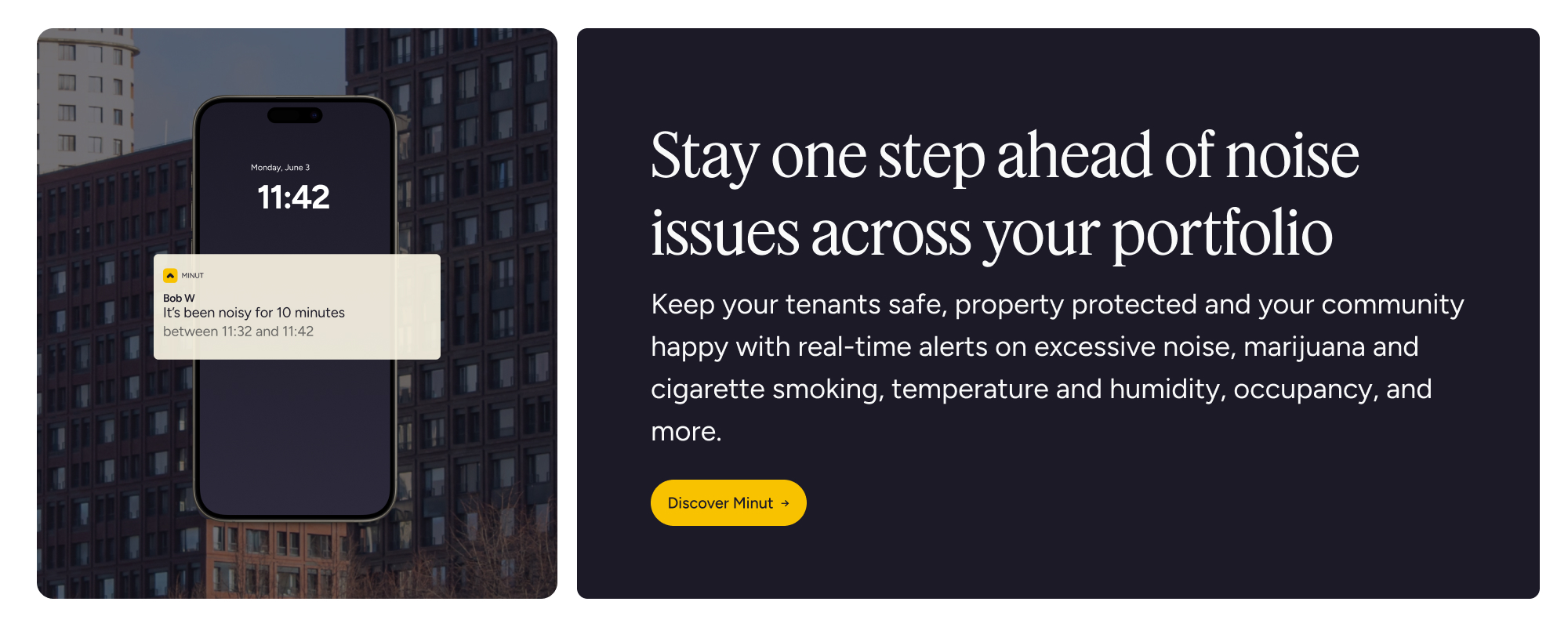
The conduct rules that trigger fines in Arizona are consistent: noise, occupancy, and a contact who can respond fast. That's where a privacy-first sensor helps. Minut monitors the environment rather than your guests, and it records no audio and uses no cameras. It also detects cigarette smoke and estimates occupancy from nearby signals, so you know not just that something is happening, but what and when.
Every event is timestamped, so if a neighbor complaint or a dispute lands in front of a city, an HOA, or Airbnb, you have an objective record instead of a he-said-she-said. Listing "this property has a noise monitor" also deters party-seekers before they book.
Summary
Arizona keeps short-term rentals legal across the map, but it doesn't operate on an "anything goes" basis. It's particularly important that operators account for regional variation across the state, too.
Taxes are layered, enforcement escalates, and private restrictions still rule the day. For property managers and hospitality brands, professional operations and neighbor-friendly practices are what keep you listed. Pair clear house rules and in-stay guest communication with privacy-safe monitoring so you can stop issues before they escalate.
FAQs: Arizona short-term rental regulations
Are short-term rentals legal in Arizona?
Yes. Under Arizona's preemption framework, STRs are a lawful residential use statewide. Cities cannot ban them solely for being STRs, but they can license, tax, and enforce conduct rules such as noise, occupancy, and safety.
Do I need a license for a short-term rental in Arizona?
In most cases, yes. You need a state TPT license, and most cities also require a local STR license or permit. You must also register the property with the County Assessor as a rental. Tucson is a partial exception, as it has no dedicated STR permit but it requires a city business license plus TPT.
How much tax do short-term rentals pay in Arizona?
It depends on the property's location. State TPT applies to lodging revenue on stays under 30 days, and cities and counties add transient lodging or hospitality taxes on top. Combined rates vary by address, so check the ADOR tax rate table for your property.
Can an HOA ban short-term rentals in Arizona?
Yes. Private restrictions can prohibit or limit short-term rentals despite state preemption. This includes HOA covenants, condo declarations, lease terms, mortgages, and insurance policies, so review your governing documents before listing.
Disclaimer
This article is provided for informational purposes only and does not constitute legal, tax, or accounting advice. Regulations change and may vary by jurisdiction and property. Always consult official city and state sources and seek advice from qualified counsel or tax professionals before making decisions about your short-term rental operations.






.png)


.jpeg)