Airbnb noise monitor policy: What hosts are allowed to use in 2026
This article shares Airbnb's 2026 rules for noise decibel monitors, including disclosure, placement, privacy, audio recording, and what hosts can and cannot use.
Noise complaints can cost you reviews, ratings, and sometimes the booking itself, so it’s no surprise that hosts want ways to get ahead of the problem. Airbnb does allow hosts to monitor noise, but only with disclosed, privacy‑safe decibel monitors placed outside sleeping and bathroom areas.
The practical question for hosts isn’t “Can I monitor noise?” It’s “What kind of device does Airbnb allow, where can I put it, and what do I need to tell guests?”
That’s what this article covers, using Airbnb's latest policy details.
Does Airbnb allow indoor noise monitors in 2026?
Yes. At the time this article was published in 2026, Airbnb allows indoor noise decibel monitors that measure sound levels and duration without recording audio. Hosts must disclose the monitor on the listing and keep them out of bedrooms, bathrooms, and sleeping areas.
What Airbnb says about cameras and recording devices
Under current policy, Airbnb bans indoor security cameras and any indoor recording devices, and here’s the crucial bit: they’re banned even if they’re switched off or disconnected. That means you can’t have an indoor camera that gets turned off during a stay.
Hidden cameras are, of course, strictly prohibited. Outdoors, cameras are allowed when you disclose their presence and general location, and you avoid areas where people have a heightened expectation of privacy, like enclosed outdoor showers.
Quick policy snapshot
Device / practice
Allowed?
Key requirement (Airbnb platform rules)
Indoor noise decibel monitor
Yes
Disclose on the listing; don't place in bedrooms, bathrooms, or sleeping areas; must not record audio.
Indoor security camera or indoor audio recorder
No (banned indoors even if switched off or disconnected)
Prohibited indoors even if switched off or disconnected.
Hidden camera
No
Strictly prohibited.
Outdoor security camera
Yes (with conditions; must not monitor indoor spaces)
Disclose presence and general location; avoid areas with heightened privacy expectations (e.g., enclosed outdoor showers).
"Noise monitor" that records conversations
No
Doesn't meet Airbnb's definition of a noise decibel monitor.
What does Airbnb require for an indoor noise monitor?
Airbnb breaks compliance into three parts: the device type, the disclosure, and the placement.
Device type: The device must measure decibel levels and duration only. No audio recording.
Disclosure: You must disclose that an indoor noise decibel monitor is present on your listing.
Placement: You may not place a noise monitor in bedrooms, bathrooms, or any designated sleeping areas.
Where can Airbnb hosts place a noise monitor?
Airbnb draws a bright line between general living areas and places intended for privacy or sleep.
Excluded areas: bedrooms, bathrooms, and sleeping areas are off‑limits.
Common areas: living rooms, kitchens, hallways, and similar shared interior spaces are generally acceptable when disclosed.
Remember, this article explains Airbnb’s platform rules, but always check applicable regulations before you decide on final placement.
Noise monitoring vs. audio recording: what’s the difference?
A noise decibel monitor measures how loud it is and for how long. It doesn’t know what anyone said, can’t identify anyone, and doesn’t capture content. An audio recorder captures sounds, including spoken words and identifiable noises.
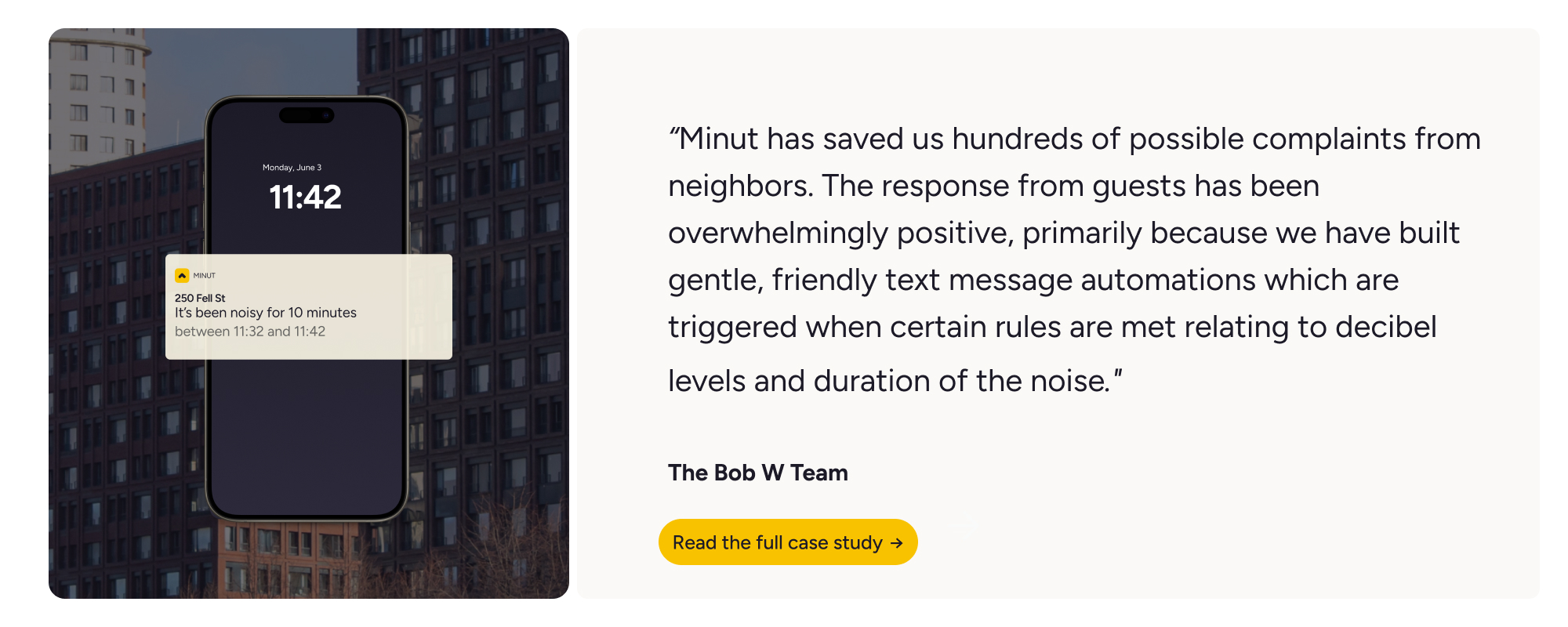
A compliant scenario looks like this: your listing has a disclosed noise monitor in the living room. It detects sustained levels above your threshold for 10 minutes, prompting you to send a friendly reminder. You don’t know whether the noise is people shouting, or the television volume being set too loud.
A non‑compliant scenario: a device that captures audio clips after a threshold breach. Even if you only “listen” when there’s a spike, recording conversations crosses the line Airbnb draws between environmental monitoring and surveillance.
How should hosts disclose a noise monitor to guests?
Airbnb requires disclosure of indoor noise decibel monitors on the listing page, although you don’t have to reveal the exact spot where the device sits. Airbnb expects your listing to accurately reflect what’s on the property, so make sure you update it if you add or remove devices.
What compliant and non‑compliant monitoring look like
Scenario
Compliant under Airbnb policy?
Why
Disclosed indoor noise decibel monitor in the living room measuring sound levels only
Yes
Assesses decibel levels and duration only; disclosed; placed in a common area.
Noise decibel monitor installed inside a bedroom
No
Bedrooms, bathrooms, and sleeping areas are off‑limits.
Device that records conversations after a threshold breach
No
Airbnb's definition prohibits audio recording.
Hidden camera inside the unit
No
Hidden cameras are strictly prohibited.
Indoor camera "switched off during stays"
No
Indoor cameras are not allowed regardless of power state.
Disclosed outdoor camera aimed at the front door
Yes (with conditions)
Allowed outdoors when disclosed and not aimed at privacy‑sensitive areas.
What should hosts check before installing a noise monitor?
Compliance isn’t one checkbox. You need the right device, the right placement, and the right disclosure. Use this quick pre‑install check.
Check
Action
1
Confirm the device measures sound levels and duration only. No audio recording.
2
Keep it out of bedrooms, bathrooms, and sleeping areas.
3
Disclose the presence of the noise decibel monitor on your Airbnb listing.
4
Re‑read Airbnb's current device policy before installation.
5
Check applicable local privacy rules and building policies.
6
Review the manufacturer's privacy and data‑handling documentation.
7
Make sure your thresholds and guest messaging match your house rules.
For Airbnb’s own reminder that local rules are a separate layer, see the platform’s responsible hosting pages.
Which noise monitoring devices can hosts consider?
Airbnb doesn’t publish a list of “approved” noise monitors. Your job is to pick a device that fits Airbnb’s definition of a noise decibel monitor and use it as the policy requires.
Minut: Measures decibel levels without recording audio, and monitors other factors such as indoor climate, guest smoking, and occupancy.
NoiseAware: A well‑known decibel monitoring option that focuses on sound level alerts.
Alertify: Another decibel monitoring option that emphasizes incident reports and data export.
Airbnb policy vs. local privacy requirements
Airbnb’s rules are one layer. Local laws and building rules are another. Platform compliance doesn’t replace your responsibility to follow city, state, or HOA requirements around recording, disclosure, or permitted devices.
Conclusion
Airbnb’s noise monitor policy gives hosts clear room to protect their properties without recording conversations. Indoor noise decibel monitors are allowed when they measure sound levels and duration only, are disclosed in the listing, and are kept out of bedrooms, bathrooms, and sleeping areas. Cameras and audio recorders are banned inside listings under current rules. Before you install or move a device, re‑read the official policy and check any local privacy requirements.
If you want a monitor that measures noise levels without recording audio or using cameras, Minut monitors the environment, not the guest, and gives you a timestamped alert you can share through Airbnb messaging when noise runs long.
Airbnb noise monitor policy FAQs
Does Airbnb require hosts to disclose noise monitors?
Yes. You must disclose the presence of indoor noise decibel monitors on your listing. Airbnb does not require you to disclose the exact location of an indoor noise monitor.
Can an Airbnb host put a noise monitor in the living room?
Yes, noise monitors are allowed in common areas if it measures decibel levels only, is disclosed, and isn’t recording audio. Living rooms are common areas, not sleeping areas.
Can a host use a noise monitor without recording sound?
Yes. That’s exactly what Airbnb allows. Devices must measure sound levels and duration without audio recording.
Can Airbnb hosts use noise monitors outside the property?
Airbnb’s policy focuses on disclosure and privacy expectations. Noise monitors are permitted indoors and outdoors, but devices like cameras must only be used outside, avoid privacy-sensitive areas, and be disclosed in your listing.
Can a noise monitor be hidden from Airbnb guests?
No. You must disclose indoor noise decibel monitors on your listing. Hiding any device is a serious violation.


.png)





.jpeg)