How to create a hotel noise policy that works well
Noise is one of the top drivers of negative reviews in hospitality, but strict “no-noise” rules can feel cold and unwelcoming. This post explains how leading hotels and aparthotels are building guest-friendly noise policies that balance comfort, communication, and technology.
Excessive noise affects more than comfort: it can shape your brand.
Across hospitality, even a single disturbance can ripple through satisfaction scores and review sites. That’s why the top-performing properties don’t wait for hotel noise complaints to show up at the front desk. Instead, they design guest-friendly, preventive policies that start before check-in and pair clear communication with privacy-safe technology.
Done well, a hotel noise policy protects the peace without dampening the welcome, underlining the promise your brand makes to every guest.
This article will explore traditional hotel noise policies, how to write your own, and the best way to handle customer complaints if they occur.
Why traditional hotel noise policies don’t work
Many hotel noise policies still lean on punishments and vague warnings. That approach feels adversarial and inconsistent in practice, which is why it often backfires in reviews.
When policies threaten fees if “we get a complaint,” guests read it as a lack of trust. The tone is punitive, not protective. Add to that the all-too-common problem of unclear quiet hours tucked away in small print, and guests only learn about expectations after someone has been disturbed. Inconsistent enforcement compounds the issue, breeding frustration on both sides of the door and creating a sense of unfairness that bleeds into ratings.
Contrast that with the property-level clarity that some hotel brands already publish, where quiet hours and consequences are spelled out with a calm, even-handed tone. For example, some Hyatt properties explicitly state quiet hours and outline a policy of one warning followed by potential eviction to protect other guests’ quiet enjoyment.
This is a step in the right direction. The next step is making those policies feel guest-centric: clear, empathetic, and supported by technology that helps resolve issues before they become complaints.
What effective hotel quiet hours look like
Quiet hours are the backbone of any hotel noise policy. Guests understand and accept them when they’re clear, consistent, and matched to the property’s guest mix and location. If you need the legal side — how municipal noise ordinances and local quiet-hours rules work — we go deep on that in our guide to quiet hours rules. This page stays focused on the policy your property writes and communicates."
Communicate quiet hours across the guest journey
Define quiet hours in plain language and reinforce them across multiple touchpoints so they never come as a surprise. Include them in pre-arrival messages, at check-in, on in-room or in-suite signage, and in your guest app or digital guide. Repetition creates clarity and reduces the need for confrontation later. Many operators also find success pairing quiet hours with a brief note about how the hotel protects peaceful stays for everyone, which shifts the tone from rules to reassurance.
Choose fixed or flexible hours based on your segment
Hotels serving families, leisure travelers, or business guests often tune quiet hours to match typical rhythms:
Urban business hotel: 10 p.m.–7 a.m. suits early risers and weekday stays.
Leisure resort: Extend to 11 p.m. on weekends when programming tends to run later, while keeping weekdays to 10 p.m.
For multi-residential or student accommodation contexts, quiet hours of roughly 10 p.m.–8/9 a.m. are common, with courtesy hours enforced at all times. This is a useful reference point for aparthotel operators serving longer stays or mixed-use buildings.
Local regulations may also inform your approach. In New York City, for instance, the code caps “commercial music” at 42 dB(A) when measured inside a dwelling, with additional criteria for low-frequency bass. Las Vegas defines a violation when outside music or excessive noise is audible 50 feet from the source, which makes expectations simple to explain to guests and staff. These examples show that quiet hours can align with enforceable municipal standards when needed.
Turning noise monitoring into a guest amenity
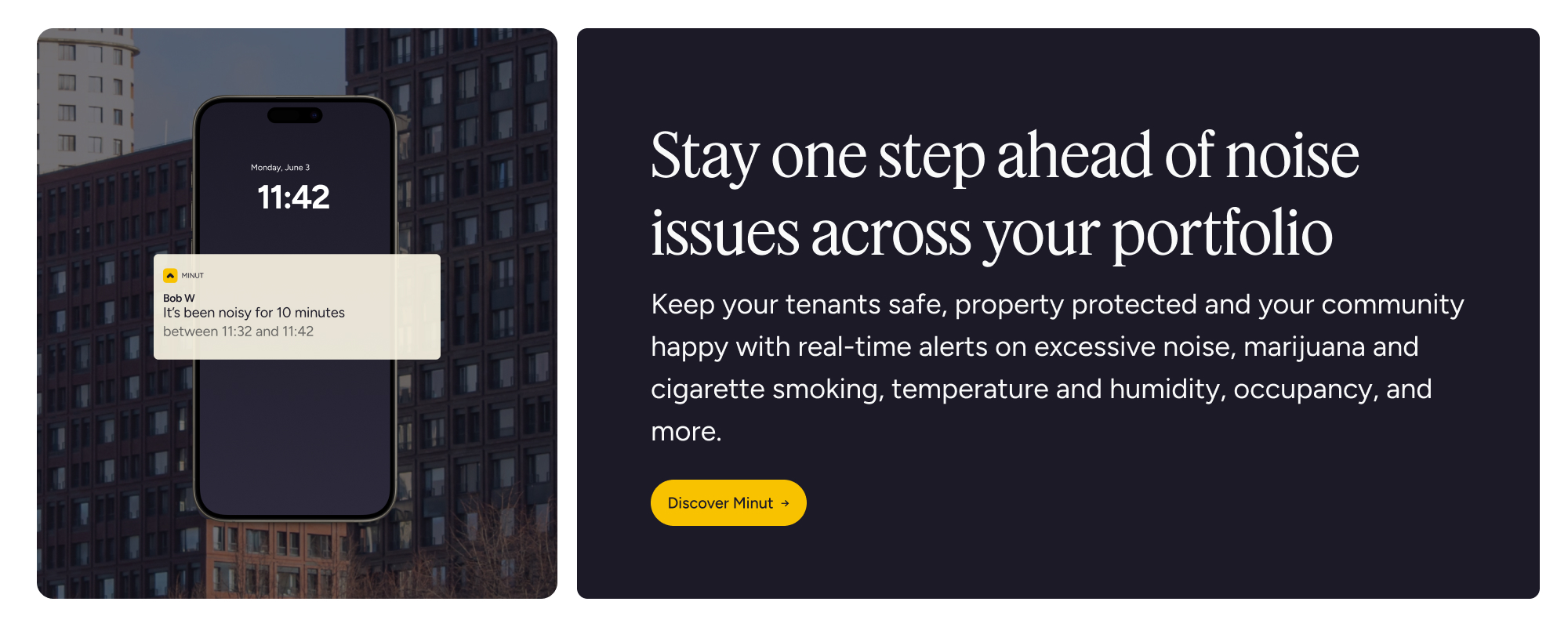
The most successful hotel noise policies pair clear expectations with supportive technology. Privacy-safe noise sensors make this possible by measuring sound levels rather than recording audio, so teams can detect sustained, excessive noise and resolve it gently, often before neighbors are disturbed.
Crucially, you can use privacy-first monitoring, so there’s no need to use invasive recording to know if any guests are being too loud. Not only is this important for guest privacy, but for staying compliant — platforms like Airbnb ban all indoor cameras, yet allow noise decibel monitors that don’t record audio when disclosed and not placed in sleeping or bathroom areas. Vrbo follows a similar standard, permitting noise monitors that only measure sound levels with disclosure.
Framing matters, too. When hotels present monitoring as a guest amenity with a simple promise like “We safeguard a peaceful stay for everyone,” sensors become part of the brand experience. They enable your team to respond early with a kind, automated reminder instead of waiting for a neighbor to complain. And when platforms amplify party-prevention efforts, the message resonates — as shown with Airbnb’s report of more than a 60% reduction in New Year’s Eve party reports where its defenses run.
For operators evaluating solutions, privacy should sit at the center. Minut’s approach is privacy-first by design. Camera-free devices track sound levels not conversations, and focus on duration and thresholds so teams act only when noise is both loud and sustained. If you want a deeper look at how and why hotels are adopting this approach, we break it down in our overview of industry adoption: Why the hospitality industry is adopting smart noise technology. This section only summarizes the essentials; for a step-by-step look at choosing hardware, placing devices, and setting thresholds, see our deep how-to on noise decibel monitoring for hotels.
How to write a hotel noise policy that guests appreciate
Guest-friendly policies read like a promise, not a warning. The tone is warm, the expectations are clear, and the reasoning is honest.
Use plain, friendly language. “We want everyone to sleep well” is more persuasive than “violators will be charged.” Begin with the “why,” then the “what,” then the “how” of enforcement.
Here are short examples you can adapt for in-room guides, QR code frames, or your guest app:
Welcome message: “We’re proud to host a mix of business and leisure travelers who value a good night’s sleep. To ensure everyone rests well, our hotel quiet hours are from 10 p.m. to 7 a.m.”
Monitoring disclosure: “To protect your privacy and comfort, we use a sensor that measures sound levels so our team can gently remind guests if noise gets too loud for too long.”
Gentle enforcement note: “If noise exceeds our limits during quiet hours, we’ll start with a friendly text. If it continues, a team member may stop by to help resolve the issue. Our goal is always a peaceful night for everyone.”
This calmer, explanatory tone works because it centers guest wellbeing. It also outlines a clear path: a warning followed by potential removal if a disturbance persists and impacts the safety or quiet enjoyment of others.
Use our free hotel quiet hours template
Ready to put this into practice? Copy the template below into your guest app, in-room guide, or house rules, then adjust the times and wording to fit your property.
Quiet hours block
Quiet hours: 10 p.m. to 7 a.m. daily (11 p.m. to 8 a.m. on Fridays and Saturdays). Courtesy hours apply at all times — please keep noise at a level that won't carry into neighboring rooms.
House-rules / welcome wording
Welcome! We host a mix of guests who all value a good night's sleep. During quiet hours (10 p.m.–7 a.m.), please keep music, TV, and voices low, and take calls or gatherings to shared spaces where noise won't disturb your neighbors. Thanks for helping everyone rest well.
Monitoring disclosure wording
To protect a quiet stay for everyone, we use a privacy-first sensor that measures sound (decibel) levels only. It does not record audio or conversations, and there are no cameras. If noise stays loud for an extended period during quiet hours, our team receives an alert and may send a friendly text reminder.
Complaint-escalation note
If noise is disturbing your stay, contact the front desk any time — day or night. We will send a courteous text to the room causing the disturbance, follow up with a knock if it continues, and, if needed, a team member visits in person. Persistent disturbances may result in a warning and, ultimately, removal to protect other guests.
Handling hotel noise complaints the right way
The best response pairs empathy with action. When a complaint comes in, acknowledge the guest’s experience, thank them for letting you know, and reassure them you’re on it. Then follow a clear escalation path designed to resolve issues quickly with the least intrusion possible.
A common timeline includes a gentle, automated text to the room that’s causing the disturbance, a courtesy knock if noise continues, and, if necessary, a call or in-person visit by security. For persistent or severe disturbances, a “one warning and out” policy is standard in many security playbooks to protect the quiet enjoyment of the majority.
Document the event in your PMS or guest relations system, including timing, messaging, and resolution. This keeps your team aligned and helps identify recurring patterns by room, floor, or guest segment. In turn, it supports fair and consistent enforcement across stays.
Using technology and data to refine your policy
Noise data becomes operational intelligence when you analyze it over time. Look at alert frequency, day-of-week patterns, and hour-of-night spikes. If you see repeated peaks at 11 p.m. on weekends, consider extending weekend quiet hours from 10 p.m. to 11 p.m. or adjusting guest placement so families or early risers sit away from lively areas.
Integrating noise insights with your PMS accelerates response. Automated guest messaging means a polite reminder is sent the moment noise crosses your threshold for a defined duration. With the right connection, your team doesn’t have to hunt for contact details or copy and paste templates. Messages go out automatically, and most guests self-correct.
As you refine thresholds, timelines, and escalation rules, keep the guest experience front and center. Every automation should feel like an extension of your hospitality, not a replacement for it.
Final thoughts: a modern noise policy protects peace and your reputation
Noise is both a social and commercial challenge, but the answer isn’t a harsher rulebook. It’s a guest-friendly hotel noise policy that sets clear quiet hours, communicates expectations across channels, and uses privacy-safe smart monitoring to resolve issues early and politely.
When you combine transparent communication with technology built for hospitality, everyone wins: guests rest easier, staff act with confidence, and your brand earns trust.
FAQs
What are typical hotel quiet hours?
Many hotels publish quiet hours around 10 p.m.–7 a.m., and some adjust for weekends or property type. For longer-stay or multi-residential settings, quiet hours around 10 p.m.–8/9 a.m. are common as well.
How can hotels detect noise without invading privacy?
Privacy-safe noise sensors measure sound levels over time rather than recording audio. This allows teams to act when noise is both loud and sustained without capturing conversations or personal content. Industry standards reflect this distinction, for example Airbnb bans all indoor cameras but allows noise decibel monitors that don’t record audio when properly disclosed, and Vrbo similarly permits monitors that measure only sound levels with disclosure. Minut’s sensors follow this privacy-first approach, too.
Can hotels charge guests for noise disturbances?
Policies vary by brand and jurisdiction. Some properties publish fines for noise violations in house rules, particularly in serviced or vacation rental contexts. Traditional hotels more commonly follow a “warning then potential eviction” approach to protect other guests’ quiet enjoyment, as reflected on several property policy pages and security best practices. Always verify with local law and your brand’s standards before assessing any fees.
How do smart sensors handle false positives (for example, TV vs. party noise)?
Modern, hospitality-focused sensors rely on a combination of decibel thresholds and duration, so your team is alerted only when noise is both loud and sustained. That means a brief cheer at a sports game won’t trigger an alert, while prolonged loud music at midnight will. Operators can tailor thresholds by time of day and customize escalation steps, such as sending a friendly text first, so responses feel proportionate and guest-centric.
Who do you call for a noise complaint at night?
At night, call or message the front desk first. They're staffed to respond and can act quickly with the least disruption. Many properties also monitor sound levels with a privacy-first sensor, so the team may already be sending a gentle text to the noisy room before a complaint even reaches you. If a disturbance feels unsafe, contact hotel security or local authorities.
Can you make a noise complaint during the day?
Yes. Quiet hours carry stricter expectations, but excessive daytime noise — loud music, shouting, or ongoing disruption — is still worth reporting to the front desk. Courtesy hours typically apply at all times, so staff can step in whenever noise crosses a reasonable level.









.png)