Learn how to calculate ROI on aparthotels using clear formulas. Compare returns with traditional rentals and optimize your property management strategy.
Every property operator knows that Return on Investment (ROI) is one of the first metrics investors look at. But when it comes to aparthotels, the calculation isn’t always straightforward.
These hybrid assets sit somewhere between traditional rentals and hospitality businesses. Revenue is higher, but so are costs. Occupancy fluctuates. Maintenance is more intensive. And many of the standard ROI calculators don’t capture the real picture.
Recent market data shows that short-term rentals can outperform long-term leases by as much as 30% in comparable areas. That upside is driving more operators to explore aparthotels, but it also raises the stakes for calculating ROI accurately.
This guide walks through a practical, operator-focused approach to ROI. It outlines the right formula, key variables to include, and how to benchmark returns more realistically in this fast-moving segment of the market.
Why traditional ROI calculations don’t always work
Most operators have a handle on ROI. You take your profit, divide it by your total investment, and that gives you a percentage return. But with aparthotels, the numbers aren’t always that simple.
These properties don’t behave like buy-to-lets. They behave like businesses. Revenue changes week to week, costs rise with every booking, and occupancy doesn’t follow a straight line. It moves with seasons, events, weather, and even local school holidays.
It’s not that ROI stops being useful, but the way you calculate it needs to reflect how the property actually runs. A fixed monthly income figure won’t cut it. You need to account for peaks, lulls, and the operational costs that come with high guest turnover: cleaning, laundry, consumables, tech subscriptions, booking platform fees, insurance. These aren’t edge cases, they’re part of the day-to-day.
This is also where language can get messy. Traditional property investors talk about ROI, yield, and capital growth. But when you’re running an aparthotel, you’re also dealing with hospitality metrics: occupancy rate, average daily rate (APR), revenue per available room (RevPAR), and gross operating profit (GOP). These numbers help explain how the return is being generated.
If you’re running an aparthotel and only using a static ROI figure, you’re not seeing the full picture. And if you’re comparing different units or locations, it’s critical that you’re comparing like-for-like, using the same cost assumptions and occupancy models across the board. Otherwise, the numbers can lead you in the wrong direction.
There’s no shortage of ROI calculators online, but most of them are built for long-term rentals. They assume stable income, low turnover, and predictable costs. That’s not the world aparthotel operators live in.
To get an ROI figure that actually means something, you need to reflect how the property performs week to week, not just month to month. That means starting with your annual net income — and being honest about what’s going out, not just what’s coming in.
Here’s what to include:
1. Gross rental income
Look at seasonal pricing, not just an average nightly rate. Factor in event spikes, off-season dips, and expected shoulder periods. Don’t assume 100% occupancy, use your actual or forecasted rate.
2. Operating costs
Cleaning, linen, consumables, platform fees, Wi-Fi, insurance, guest communication tools, maintenance. If it scales with occupancy, it belongs here.
3. Occupancy rate
Use a 12-month weighted average based on local demand patterns. If you don’t have that data, start with 55–65% as a base, depending on location.
4. CapEx
Aparthotels aren’t set-and-forget. Furnishings wear out, tech gets upgraded, properties need redecoration. Make sure you set aside annual reserves or model a realistic refresh cycle.
5. Total acquisition cost
This includes purchase price, stamp duty, legal fees, fit-out, setup, and any costs you incur before the first guest walks through the door.
Once you’ve got all that in, here’s a simplified version of the formula:
ROI (%) = (Annual Net Income / Total Acquisition Cost) × 100
Example
Let’s say your aparthotel unit generates £65,000 in gross income annually. Operating costs (cleaning, utilities, fees, maintenance) come to £28,000. You’ve set aside £3,000 per year for capital reserves. That leaves £34,000 in net income.
Your total acquisition cost (including purchase, setup, and fit-out) was £410,000.
ROI = (£34,000 / £410,000) × 100 = 8.29%
That’s a clean number that reflects how the property operates, not just how it looks on paper.
How aparthotel ROI compares to traditional rentals
Aparthotels often outperform traditional rentals when you look at returns, but the picture behind the numbers is more complex. Higher revenue potential comes with higher effort, and the two models operate in very different ways.
With a long-term let, income is stable, costs are predictable, and tenant turnover is minimal. You're managing an asset, not running a business. Aparthotels are more active: the income can be stronger (but it fluctuates), costs rise as bookings increase, and guest turnover is a constant part of the operation.
Revenue
Short-term stays have the potential to earn significantly more, especially in urban or seasonal markets. A well-run aparthotel unit might bring in double what a traditional rental earns. But that only happens with the right pricing strategy, strong occupancy, and tight cost control.
Occupancy
Long-term rentals aim for consistent, year-round occupancy. Aparthotel occupancy moves in cycles. It responds to events, travel patterns, and even weather. You might run at 85 percent in the summer and 40 percent in January. What matters is what you’re earning across the year, not just in peak season.
Costs
Traditional lets come with a mostly fixed cost base. Mortgage, tax, basic maintenance. Aparthotels carry more variable costs that move with demand. More bookings mean more cleaning, laundry, consumables, guest communication, and general wear and tear. This is why net income, not gross, tells the real story.
Operations
Letting a property long-term is relatively hands-off. Running an aparthotel is operational. You need systems for guest messaging, maintenance, access, cleaning schedules, and pricing. Without the right tools or partners, this can quickly become overwhelming. But for operators with the right setup, the control is often worth it.
The ROI on aparthotels is usually higher than on traditional rentals, that’s true, but the return comes with more complexity, and it rewards those who are prepared to manage the details. It’s not better or worse, it’s just a different model, and one that puts the operator at the centre of the result.
How to increase ROI on aparthotel properties without adding more work
More revenue doesn’t always mean better ROI. In aparthotel operations, it’s often about keeping more of what you earn without burning yourself out in the process.
Here are a few ways operators are improving ROI in smarter, more sustainable ways.
1 Use dynamic pricing that responds to local demand
Static rates are easy, but they leave money on the table. Good pricing tools can adjust rates daily based on seasonality, local events, and competitor behaviour. That doesn't just push revenue up, it smooths out occupancy and reduces gaps.
If you're doing this manually, it's probably not accurate. If you're not doing it at all, it's almost certainly costing you.
2. Encourage direct bookings
Every booking that comes through a major platform carries a fee. That’s often 15–20 percent gone before you even start calculating margin. Building a direct booking channel (even just a basic site with a clear path to book) can improve profitability without adding much operational weight.
It’s not about replacing OTAs entirely, but about owning a small slice of your own demand.
3. Automate wherever possible
Labour is one of the biggest drains on margin. If you’re still handling guest comms manually or relying on on-call staff for things like check-in, noise control, or late check-outs, you’re giving away time and profit.
Smart tech can help here. Solutions like Minut allow you to automate occupancy alerts, noise monitoring, water leaks, and guest communication, so you stay lean without sacrificing the guest experience.
Minut’s device sits quietly in the background, providing property managers with real-time insights to prevent damage and respond quickly to guest issues before they become poor reviews, all contributing to greater ROI.
How Kasa Living uses Minut to centralize and automate operations
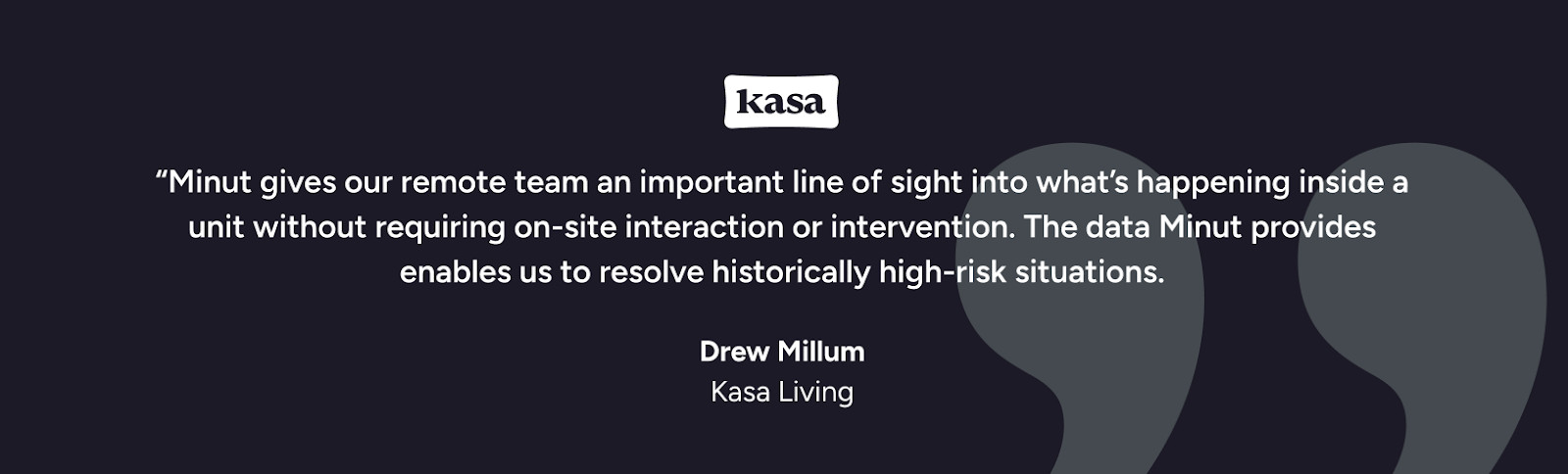
Kasa Living has nearly 2000 properties, including a number of aparthotels where on-site housekeeping and guest management staff are intentionally minimal. To maintain quality at scale, the team needed a way to keep up with fast turnovers and manage guest behavior without being physically present around the clock.
Minut provides centralized insight into guest activity, helping Kasa reduce both maintenance and operational costs. For instance, if a guest fails to check out on time, the team can remotely review motion data to confirm whether the unit is still occupied before taking further action.
Small issues turn into expensive problems quickly. A leaky tap becomes water damage. A broken remote becomes a guest refund. Preventive maintenance doesn’t just protect the property, it protects revenue. Regular inspections, proper documentation, and a clear process for guests to report issues can save you thousands over time.
ROI pitfalls to avoid
Even experienced operators can overestimate returns if the wrong assumptions go into the model. Here are some of the most common mistakes that distort ROI — and how to avoid them.
Ignoring the off-season
It’s easy to model ROI using peak rates and summer occupancy. But those numbers only tell half the story. The quieter months: January, February, late autumn, can pull your annual return down fast if you’re not accounting for them properly.
Make sure your ROI model reflects real booking trends over 12 months, not just the best ones. Look at year-round occupancy, not monthly averages, and pressure-test your margins with off-season numbers. If the model doesn’t hold up then, it won’t hold up at scale.
Overlooking local regulations and tax exposure
Short-term rentals are under increasing scrutiny in many markets. Local rules around STR licenses, tax rates, zoning, and minimum-night stays can shift quickly — and if you’re not on top of them, the cost hits your bottom line.
Depending on the location, you might also be liable for city taxes, lodging taxes, or mandatory insurance coverage. These costs can creep in quietly, but they add up. Factor them into your operating model from the start, not as an afterthought.
Underestimating setup costs
An aparthotel isn’t plug-and-play. Before your first guest arrives, you’ll need to invest in furnishings, appliances, access systems, cleaning kits, guest supplies, insurance, Wi-Fi, and probably a tech stack to handle pricing, messaging, and monitoring. Skipping these in your ROI calculation creates a misleading view of profitability.
Good operators treat setup as CapEx and spread the cost over its expected life. That keeps the model grounded and helps avoid cash flow shocks when things need replacing.
What it really takes to improve aparthotel ROI
Aparthotels can deliver strong returns, but only when the numbers reflect how the property operates. ROI isn’t just income vs cost — it’s knowing what’s happening on the ground and building systems that scale with you.
The most successful operators are the ones who think like hoteliers and act like asset managers. They track performance in real time and automate where it counts. And they plan for the things that don’t show up in the first version of the spreadsheet.
If you’re serious about protecting margin while growing your portfolio, operational visibility is key. That’s where Minut can help. It gives you the data, alerts, and automation tools you need to run a tighter, smarter operation, without adding complexity.









.jpg)