Rental property tax deductions (2026): the complete landlord checklist + depreciation & Schedule E
Learn which rental property expenses are tax-deductible, from mortgage interest to repairs. With smart tax strategies, you can reduce your taxable income and maximize profits.
Are you taking advantage of every tax deduction available for your rental property?
Many property owners overlook key deductible expenses, leading to higher tax bills and reduced profits. The IRS allows landlords to write off various expenses related to their rental activities each year, helping reduce taxable income and lower tax liability. Depending on how you classify certain deductions, you may also receive tax benefits.
To claim deductions, you must first understand which expenses are tax-deductible, how to report rental property income, and what costs are associated with managing your rental business.
Understanding how to file your tax return properly is important, whether you need to deduct mortgage interest, calculate property depreciation, or determine what qualifies as personal property (such as appliances or furniture used in your rental).
This guide explains how to classify expenses related to your rental property, when to write off repairs during the year, and how to maximize deductions while remaining compliant with tax law.
No matter if this is your first year managing a residential rental property or you're an experienced investor, you can use these strategies to help you save money, reduce taxable income, and keep your property a profitable investment year after year.
Tax disclaimer: Tax laws are complex and change frequently. The information in this guide is for educational purposes only and shouldn't be considered legal or tax advice. Confirm all figures and strategies with a licensed tax professional or CPA before filing.
Is rent tax deductible? Landlord vs. tenant
This is one of the most common tax questions, and the answer depends on which side of the rental agreement you're on.
Landlords can deduct the ordinary and necessary expenses of running a rental business. This includes mortgage interest, property taxes, insurance, repairs, depreciation, and more (see the full checklist below). These deductions reduce your rental income before it's taxed.
Tenants generally can't deduct personal rent payments on their federal tax return because rent for your primary residence isn't a deductible expense. The limited exception is for self-employed individuals who qualify for the home office deduction; if you use part of your rented home exclusively and regularly for business, you may be able to deduct that portion of your rent as a business expense.
Understanding rental property income and expenses
What is considered rental income?
Rental income includes more than just monthly rent payments. The IRS requires you to report all rental-related income, such as:
Advance rent: Any rent received for a future period must be reported in the year received, even if it applies to a future tax year.
Cleaning fees or other service charges: Payments for additional services provided to tenants are considered taxable rental income.
Security deposits: If you keep part of a security deposit for repairs, that amount is classified as rental income unless refunded.
Tenant-paid expenses: If a tenant pays utilities or property taxes on your behalf, you must report the amount as rental income.
IRS Topic No. 414 states that all rental income must be reported in the year received, regardless of which tax year it applies to.
Why proper income reporting matters
Misclassifying rental income can result in IRS penalties and interest charges. Properly reporting rental property income keeps you compliant with tax law and helps establish clear records for deductible expenses.
Deductible vs. non-deductible rental expenses
Understanding whether an item is classified as a repair or an improvement can affect whether the cost is deductible in the year you pay for it or if it must be depreciated over time. The IRS has general guidelines for determining when expenses for your rental property are tax-deductible and when they're not.
Deductible rental expenses include:
Maintenance and repairs: Painting, plumbing fixes, and replacing appliances.
Advertising costs: Listing fees, professional photography, and marketing expenses.
Property management fees: The cost of hiring a management company or using tenant screening services.
Mortgage interest: Often one of the largest expenses for property owners, potentially saving thousands on taxes annually.
Non-deductible rental expenses include:
Personal property expenses: If you personally use your own rental property for more than 14 days per year, some deductions might be limited.
Capital improvements: Major renovations (e.g. adding a new room) must be depreciated over time rather than deducted immediately.
Specificities of short-term rentals
Short-term rental properties generally incur more frequent expenses than long-term rentals. Regular cleaning, restocking essentials, and marketing are all necessary expenses because of the frequent guest turnover, but they must be properly documented to qualify as deductions.
Net investment income tax (NIIT) considerations
Some rental property owners may be subject to the Net Investment Income Tax (NIIT), which is an additional 3.8% tax on investment income for high earners. This tax applies to those with incomes exceeding specific thresholds:
Single filers: $200,000
Married, filing jointly: $250,000
How NIIT affects rental property owners
Passive rental income may be subject to NIIT if you don't actively manage the property.
However, if you provide substantial services (for example: daily cleaning, meals, guest experiences), your rental may be treated as an active trade or business reported on Schedule C rather than passive rental activity. That shifts the income from passive income (which can be exposed to the NIIT) to active business income that's generally subject to self-employment tax instead of the NIIT.
Minimizing NIIT: what you need to do
If your rental income is near the NIIT threshold, consult a tax professional to determine if your income qualifies as passive activity or self-employment income, helping you minimize tax liability while staying IRS-compliant.
Key deductions every rental property owner should know about
Once you understand what qualifies as rental income, the next step is recognizing the deductions that lower taxable income. Many rental property expenses are tax deductible, but knowing exactly which expenses to claim and how to report them can help you reduce tax liability and maximize profits.
Here's a numbered checklist of the most common rental property tax deductions, with whether each is expensed (deducted in the year paid) or depreciated (recovered over time):
The complete rental property deductions checklist
Mortgage interest: The interest portion of your mortgage payments. Often the largest deduction, especially in early loan years. [Expensed]
Property taxes: State and local property taxes paid on your rental. If a tenant pays these directly, report that amount as rental income. [Expensed]
Insurance premiums: Hazard, liability, flood, and landlord insurance policies are fully deductible in the year paid. [Expensed]
Repairs and maintenance: Painting, plumbing fixes, patching drywall, replacing door handles, HVAC servicing, pest control, and other routine upkeep to keep the property in good working condition. [Expensed]
Property management fees: Fees paid to a management company or co-host to run your rental. [Expensed]
Utilities: Electricity, water, gas, Wi-Fi, trash collection, and streaming services you provide. [Expensed]
Advertising and marketing: Listing fees, professional photography, online ads, and signage. [Expensed]
Professional and legal fees: CPA fees for tax preparation, attorney fees for lease drafting or disputes, and bookkeeping services. [Expensed]
Travel and transportation: Mileage (at the IRS standard rate) or actual vehicle expenses for property visits, contractor meetings, and inspections. Keep a log of dates, destinations, and trip purposes. If you combine personal and rental travel, only the business portion is deductible. [Expensed]
Depreciation of the building: The cost of the residential structure (excluding land) recovered over 27.5 years using the straight-line method. See the depreciation section below. [Depreciated — 27.5 years]
Appliances, furniture, and carpeting: Personal property used in your rental has a five-year recovery period under MACRS. May qualify for 100% bonus depreciation or Section 179 expensing (see depreciation section). [Depreciated — five years; bonus/179 may allow full first-year deduction]
Home office: If you use a dedicated space in your home exclusively and regularly for rental management, you may deduct that portion of your home expenses. [Expensed, if qualifying]
Supplies and operating costs: Cleaning supplies, linens, toiletries, light bulbs, batteries, and other consumables. Also includes subscriptions to smart monitoring solutions like Minut's monitoring platform. [Expensed]
Loan costs and points: Points paid to obtain a mortgage are generally amortized over the loan term. Some closing costs are added to your cost basis. [Amortized or added to basis]
HOA fees: Homeowners association dues for rental properties. [Expensed]
Qualified business income (QBI) deduction: Up to 20% of your qualified rental income under Section 199A if your rental qualifies as a trade or business. [Special — see Schedule E and QBI section below]
More on key deductions
Mortgage interest
As one of the largest deductible expenses, mortgage interest provides a significant opportunity for landlords to reduce their tax liability because interest payments typically make up the majority of early mortgage installments. This deduction is particularly beneficial in the first year of the loan.
Property taxes
The IRS allows landlords to deduct property taxes from rental income, reducing taxable income. However, if a tenant pays these taxes directly to the state or local authorities, that amount must be reported as rental income.
Because rental property taxes are a business expense reported on Schedule E, they aren't subject to the SALT cap that limits personal state-and-local tax deductions on Schedule A. You can deduct the full amount against your rental income.
Property tax rates vary based on location and property value. Checking local tax assessments can help you plan for future expenses.
Insurance premiums
All rental-related insurance policies, including hazard, liability, and flood insurance, are deductible expenses. If you pay annually, you can deduct the full cost in the year you pay it.
Repairs vs. improvements
Repairs and maintenance are considered ordinary and necessary expenses that help keep the property in service and in good condition.
Repairs: Fixing a leaking faucet, replacing door handles, or patching drywall are fully deductible in the year they occur.
Maintenance: Routine work (like painting, HVAC servicing, and pest control) is also a deductible expense.
Some expenses aren't immediately deductible. Major improvements, such as adding a new room or upgrading electrical systems, must be depreciated over time.
Example: Installing a new HVAC system will need to be depreciated over 27.5 years for residential rental properties, rather than deducted all at once. A permanently installed, central HVAC system counts as a structural component of the building, so it's depreciated over 27.5 years; only window or portable units are treated as shorter-lived personal property (five-year recovery).
Travel and transportation expenses
Landlords can deduct travel expenses related to managing rental properties, including:
Visiting a rental property for inspections.
Meeting with contractors or tenants.
Supervising repairs or new projects.
Best practices for travel deductions:
Log mileage for vehicle expenses.
Keep receipts for gas, tolls, and parking fees.
Document each trip's purpose, e.g. "Inspection after plumbing repair."
If you combine personal travel with rental-related activities, only the business portion is deductible.
Professional fees and other overlooked costs
As a landlord or property manager, don't forget about deductible professional services, including:
Your CPA fees for tax preparation and filing your tax return.
Your legal expenses for drafting leases or handling disputes.
Your advertising expenses, including online listings and photography.
Many rental property owners fail to deduct the cost of professional services, including accounting fees, real estate attorneys, and tax professionals, even though these expenses incurred can significantly reduce their taxable income. Even small costs, like tenant screening services, can add up over the year. Keeping detailed records helps you claim every deduction available.
Depreciation essentials for short-term rental properties
Rental property asset depreciation is one of the most valuable tax deductions available to real estate investors and landlords. It allows you to recover the cost of your property over time, reducing your taxable income each year.
What is rental property depreciation?
Under IRS tax law, landlords can depreciate the cost of a rental property over its useful life. For residential rental property, the standard depreciation period is 27.5 years.
To qualify, your rental property must be placed in service, meaning it's available for rent, before you can start claiming depreciation deductions. The value of the property is based on its purchase price, excluding land. You also must own the property and expect it to be used for rental income purposes for more than one year.
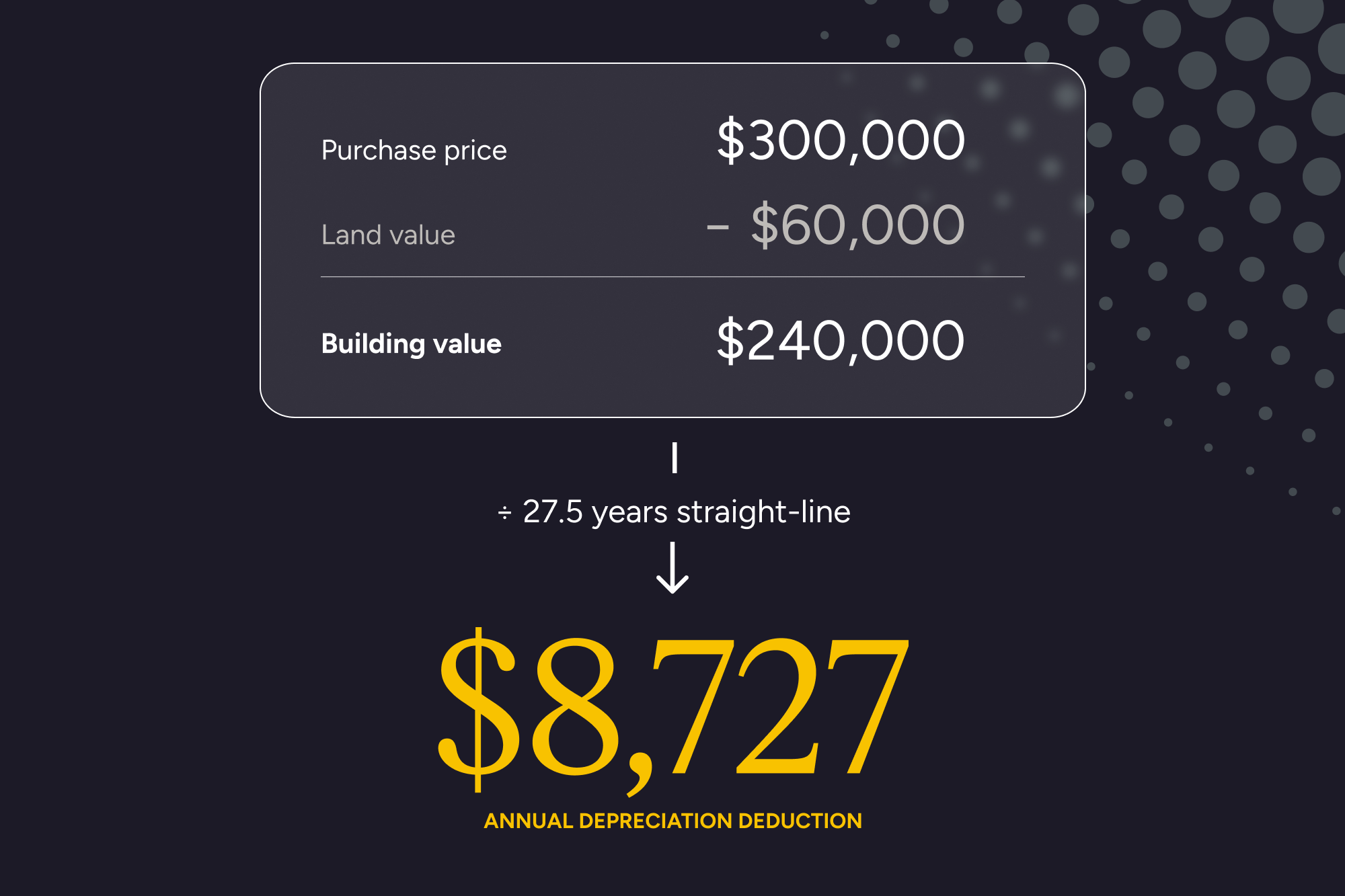
Example: Suppose you own a short-term rental property purchased for $300,000, with land valued at $60,000. Since land isn't depreciable, your cost basis for depreciation is $240,000. Using the straight-line method, you can deduct $8,727 per year ($240,000 ÷ 27.5 years) for the house.
Methods used to depreciate residential rental property
The IRS requires landlords to use the Modified Accelerated Cost Recovery System (MACRS) for residential rental properties placed in service after 1986. Under MACRS, most properties are depreciated using the General Depreciation System (GDS) over 27.5 years at a fixed 3.636% annual rate, similar to straight-line depreciation.
Additionally, if you make capital improvements, such as a new roof or HVAC system, these costs must be depreciated over time, separate from the building's original cost basis. Some improvements may qualify for bonus depreciation or Section 179 expensing, allowing you to deduct a larger portion upfront.
2026 bonus depreciation update: 100% restored and permanent
The One Big Beautiful Bill Act (OBBBA) restored 100% bonus depreciation and made it permanent. Per IRS Notice 2026-11 / IR-2026-06, landlords can now take a full first-year deduction on qualifying personal property.
What qualifies for 100% bonus depreciation:
Appliances (five-year property)
Furniture (five-year property)
Carpeting (five-year property)
Land improvements such as fences, driveways, and landscaping (15-year property)
What does NOT qualify:
The residential rental building itself (27.5-year real property is excluded)
The key trigger is the acquisition date, not the placed-in-service date. Property must be acquired after January 19, 2025 to qualify for 100% bonus. Property acquired before that date or placed in service between January 1–19, 2025 follows the prior phase-down schedule (40% in 2025, 20% in 2026).
Section 179 allows you to expense the full cost of qualifying personal property (appliances, furniture, equipment) in the year you place it in service, rather than depreciating it over multiple years.
Phase-out threshold: approximately $4,090,000 in total property placed in service
Important limitations:
Section 179 does not apply to the building, only personal property.
Your rental must be a trade or business to use Section 179.
Section 179 deductions can't create a loss — you can only deduct up to your taxable income from the business. Unused amounts carry forward.
Confirm the exact 2026 thresholds with a tax professional, as these are inflation-adjusted annually.
Improvements vs. repairs
Repairs and capital improvements are treated differently for tax purposes:
Repairs: Fixes that maintain the property's normal condition, such as patching drywall, replacing broken appliances, or plumbing repairs, are deductible expenses in the year you pay them.
Improvements: If you upgrade or expand the property (e.g., adding a new bathroom, renovating the kitchen), these costs must be capitalized and depreciated over time.
When does depreciation end?
Depreciation deductions stop when you:
Have fully depreciated the property meaning you've claimed deductions equal to the property's cost basis.
Sell, gift, or convert the property to personal use, at which point depreciation is no longer allowed.
Depreciation recapture when you sell
When you sell a depreciated rental property, the IRS recaptures depreciation, taxing the previously deducted amounts at special rates. There are two types to understand:
Unrecaptured Section 1250 gain (building depreciation): Straight-line depreciation taken on the building is taxed at a maximum federal rate of 25%, not ordinary income rates. This applies to depreciation "allowed or allowable" even if you didn't claim it.
Section 1245 recapture (personal property): If you took bonus depreciation or accelerated depreciation on personal property like appliances, furniture, or carpeting, that depreciation is recaptured at ordinary income rates when you sell. This can result in a higher tax bill than you might expect, so plan accordingly.
Reporting rental income on Schedule E (and the QBI deduction)
Understanding where and how to report rental income helps you stay compliant and claim all eligible deductions.
Schedule E (Form 1040)
Most landlords report rental income and expenses on Schedule E (Form 1040), Part I. You'll list each rental property separately with its income, expenses, and depreciation. The net result flows to your Form 1040.
When Schedule C applies instead
If you provide substantial services to tenants, such as regular cleaning, daily linen service, meals, or concierge assistance (hotel-like services), the IRS may classify your rental as an active business rather than passive rental activity. In that case, you'd report on Schedule C instead of Schedule E, and your net profit would be subject to self-employment tax (15.3%, made up of 12.4% for Social Security plus 2.9% for Medicare). See IRS Topic No. 554.
The 14-day / 10% personal-use rule
Your deductions may be limited if you personally use the rental property for more than:
14 days per year, or
10% of the total days it's rented (whichever is greater)
Track personal-use days carefully to avoid IRS issues.
Special case of less than 15 days of rental: If you rent out your property for fewer than 15 days in a year, you don't have to report that rental income at all. However, you also can't deduct any rental expenses for those days (beyond what you'd normally deduct as a homeowner).
The 20% QBI deduction (Section 199A)
The qualified business income (QBI) deduction allows eligible taxpayers to deduct up to 20% of their qualified business income from pass-through entities, including rental real estate if it qualifies as a trade or business.
Key updates for 2026:
The One Big Beautiful Bill Act extended the QBI deduction and removed its previous expiration date (it had been scheduled to expire after 2025). The 20% rate remains unchanged. Confirm current rules with a tax professional.
Does your rental qualify?
Rental income isn't automatically qualified business income. Your rental must rise to the level of a trade or business under IRS rules, either through a facts-and-circumstances test or by meeting the IRS safe harbor.
Per Rev. Proc. 2019-38 safe harbor requirements, your rental can qualify if you meet all of the following:
250+ hours of rental services performed per year (or in three of the past five tax years for established rentals)
Maintain separate books and records for the rental activity
Keep contemporaneous logs of time, dates, and services performed
Note: Time spent on financing or investment review doesn't count toward the 250 hours.
Phase-in begins at approximately $201,750 (single) / $403,500 (married filing jointly)
Above these thresholds, specified service trades or businesses (SSTBs) face limitations
Confirm exact 2026 thresholds with your tax professional, as these are adjusted annually for inflation.
Recordkeeping and documentation made easy
A well-organized recordkeeping system can be the difference between a smooth tax filing and a stressful audit. Whether you manage a single rental property or multiple real estate investments, maintaining accurate records helps you deduct expenses, track rental income, and comply with tax laws.
Organizing receipts and statements
Keep detailed records for every payment, repair, and utility bill.
Save invoices, receipts, and tax statements by date or vendor.
Digitally track expenses using accounting software or spreadsheets.
Maintain separate folders for each property.
The ultimate rental property deduction checklist
To make sure you're capturing all deductible expenses, review this rental tax checklist:
Mortgage interest (Form 1098)
Property taxes and transfer tax payments
Insurance premiums for hazard, liability, and rental property coverage
Maintenance and repairs (painting, landscaping, plumbing fixes)
Travel expenses for property visits and inspections
Professional fees (CPA, attorney, tenant screening services)
Advertising and marketing costs (online listings, photography)
Depreciation (building, appliances, furniture)
HOA fees
Home office (if qualifying)
Supplies and consumables
Tip: Go through this checklist monthly to avoid missing deductions and stay on top of tax return requirements.
Data privacy and compliance
Managing tenant data responsibly is critical for rental property owners. If you handle tenant applications, deposits, or credit card payments, keep data secure to prevent legal issues.
Common data security risks include:
Credit card transactions for rental payments
Personal information in tenant applications
Background check data
Solution: Use secure property management software to safeguard client records, financial data, and rental agreements.
Optimizing tax strategy for greater profitability
Understanding rental property tax deductions is just one part of the equation. To maximize savings and minimize tax liability, you need a forward-looking tax strategy. Properly classifying rental income, tracking deductible expenses, and knowing when to claim losses helps you keep more of your business income while staying IRS-compliant.
Tax treatment of income and losses
For most rental property owners, income is considered passive under IRS rules. This means losses can only offset passive income, unless you meet specific criteria. If your rental expenses exceed your income, you may report a loss, which can be carried forward to offset future taxable income.
Passive activity rules
To qualify as a real estate professional, you must:
Log over 750 hours per year actively managing rental properties.
Devote more than 50% of your total working hours to these activities.
If you meet these requirements, your rental losses may be classified as non-passive, allowing you to offset taxable income from other sources.
Business income
If your short-term rental business operates like a hotel, offering daily cleaning, meal services, concierge assistance, or guided experiences, the IRS may classify your rental income as business income rather than passive rental income. As noted previously, this means your profits are subject to self-employment taxes of 15.3%. This classification may also affect how much you receive in tax deductions each year.
Tips for maximizing deductions
Segregate personal vs. rental usage
If you stay in your rental property, document personal-use days carefully.
You can only deduct costs proportional to business use. Any personal stay reduces deductible expenses.
Schedule major improvements
Plan renovations strategically to maximize asset depreciation.
Bonus depreciation or Section 179 expensing may allow you to deduct more upfront instead of spreading costs over multiple years.
Aligning improvements with high-income years can help offset tax liability more effectively.
Document travel expenses thoroughly
Record mileage, dates, and reasons for property-related travel.
Use technology to stay organized
Preventative maintenance reduces the need for large-scale repairs, which may be harder to deduct in full.
For tax compliance, always review tax statements and consult a professional. Proper tax planning helps you recover eligible deductions and optimize the financial performance of your rental property investments.
From tax compliance to financial growth
Mastering rental property tax deductions can seem complex, but taking it step by step allows you to maximize savings while staying IRS compliant. By accurately classifying rental income, tracking deductible expenses, and properly applying depreciation, you can significantly reduce tax liability and increase profitability. A well-planned tax strategy, combined with smart property management, helps rental property owners protect their investment and build business income over time.
If you're unsure about depreciation rules, classification of rental income, or how to deduct certain expenses, consulting a tax professional is a smart investment. A CPA specializing in real estate tax law can help you:
Determine whether your rental income is passive or active.
Optimize deductions for home office expenses, repairs, and capital improvements.
Work through depreciation rules.
Since tax laws change annually, staying informed matters. Regularly reviewing IRS updates, working with tax professionals, and adopting property management tools will keep your rental business compliant, efficient, and profitable for years to come. By combining smart tax planning with technology, you help make sure every deduction is maximized and your rental property continues to thrive.
Frequently asked questions
Is rent tax deductible?
For landlords: Yes, rental property expenses (mortgage interest, repairs, depreciation, etc.) are deductible against your rental income. For tenants: Generally no, personal rent payments aren't deductible on your federal tax return. The exception is for self-employed individuals who qualify for the home office deduction.
Can property taxes be deducted?
Yes. Property taxes you pay on a rental property are fully deductible as a rental expense in the year paid. Report them on Schedule E. If a tenant pays property taxes on your behalf, you must include that amount as rental income.
What are the tax benefits of rental property?
Key benefits include deducting operating expenses (mortgage interest, repairs, insurance, property taxes, management fees), claiming depreciation on the building and personal property, potentially qualifying for the 20% QBI deduction, and using passive losses to offset passive income. Over time, these deductions can significantly reduce your tax liability.
How does depreciation recapture work?
When you sell a rental property, the IRS "recaptures" the depreciation you claimed by taxing it at special rates. Building depreciation (Section 1250) is taxed at up to 25%. Personal property depreciation (Section 1245), especially if you took bonus depreciation, is recaptured at ordinary income rates. See IRS Publication 544 for more details.







.jpg)