Platform dependency is killing your short-term rental business (and you might not even know it)
Having built a career on the trust that makes short stays work, Humphrey Bowles, founder of Truvi and former head of new business at One Fine Stay, explains why platform dependency is the industry's most under-priced risk, why guest screening isn't designed to protect hosts, and the three steps property managers should take now.
Most property managers think they're running a business. But if 90% of your bookings come from one platform, you're not an entrepreneur, a single algorithm change, policy update, or account suspension means your entire revenue stream can disappear overnight.
Humphrey Bowles, founder of Truvi and former head of new business at One Fine Stay, has spent years watching operators build impressive portfolios on foundations they don't control. In this conversation, he breaks down the uncomfortable truth about platform dependency, explains why the industry's trust infrastructure is quietly eroding, and shares exactly what property managers need to do to protect themselves.
The blind spot most operators don't see until it's too late
Property managers obsess over the obvious risks. Damage. Noise complaints. Bad reviews. These are real problems, and they're manageable with the right tools and processes.
But Humphrey thinks there's a bigger risk that most operators completely miss: building your entire business on a platform you don't control.
"I've seen operators who've built 50-property portfolios, invested hundreds of thousands into a business and employee teams, all dependent on Airbnb for 90% of their bookings," he explains. "If Airbnb suspended their account tomorrow — which happens way more often than you think — that puts them out of business. That's not risk management. That's a single point of failure."
The problem isn't using platforms. The problem is dependency. When your business only works because of how a platform currently operates, you're not running a business, you're working for the platform.
The three steps to reduce platform dependency
If you've had that first bad experience with a platform and suddenly understand your exposure, here's what you need to do:
1. Build direct booking capability and own your guest relationships
This doesn't mean abandoning platforms. It means creating optionality. Set up a simple direct booking website, start collecting guest emails, and offer past guests a direct booking option.
If only 20% of your bookings come direct, that's 20% that isn't vulnerable to platform policy changes. It's not about going all-in on direct bookings, but not having all your eggs in one basket.
2. Diversify your distribution
Don't put 90% of your bookings through one platform. Spread across Airbnb, Vrbo, Booking.com, direct bookings, and niche OTAs.
Yes, it's more operationally complex. But single-channel dependency is an existential risk to your business.
3. Screen your guests properly and have robust damage protection
Most damage and problems in short-term rentals are preventable if you know who you're hosting. Proper screening and clear damage protection policies protect both your property and your relationship with property owners.
The theme across all three: reduce single points of failure. Don't build a business that collapses if one thing changes.
Why platform screening isn't designed to protect you
Platforms verify guests, but their screening serves a fundamentally different purpose than what property managers actually need.
What platforms optimize for
Platforms want to avoid headlines like "Airbnb used for sex trafficking" or "criminal booked through our platform." Their screening is about regulatory compliance and brand protection. It's broad, automated, and designed to catch the very worst actors, while maintaining low friction for booking flow.
While this is important, it doesn't answer the question property managers actually care about: is this person going to respect my property and be a good guest?
What property managers need to know
Hosts care about different risks:
Will they damage the property?
Will they throw a party?
Will they violate house rules?
Are they booking for someone else?
Is there potential for misuse?
"Short-term rentals offer privacy for crimes like sex trafficking," Bowles notes. "It's easy to change locations. There's less scrutiny than hotels. This is a real risk that platform broad screening doesn't come anywhere near to addressing."
Automated systems looking for known criminals won't catch these situations. Property managers need the ability to screen more granularly: looking at booking patterns, asking questions, verifying identity more thoroughly.
The digital sharecropping problem nobody wants to talk about
The term "digital sharecropping" makes some people uncomfortable. But it captures something important about where the industry is heading.
Historically, sharecroppers worked land they didn't own. They'd plant, tend, and harvest, but the landowner controlled the terms, took a cut, and could evict them at will.
Humphrey argues that's what platform-dependent businesses are. You build the inventory. You manage the operations. You take the risk. But the platform owns the customer, controls your visibility, and can change the terms whenever they want.
When dependency becomes a problem
Humphrey started questioning this around 2021-2022, watching his daughters grow up in a world where kids aspire to be influencers and YouTubers.
"We've somehow created a generation who aspire to work for a digital platform, which gives them the illusion of running a business. But they actually own nothing — no assets, no intangible property, just renting a revenue stream."
The hop from aspiring YouTuber to Airbnb co-host is incredibly small. You can build up an Airbnb business where you own nothing. And it can be taken away with an algorithm update.
Where's the line between using and depending?
Here's how to know if you've crossed from using platforms to depending on them:
Quantitatively:
If more than 70% of your bookings come from one platform, you're getting dependent
If it's over 85%, you're definitely dependent
If it's over 95%, you're one policy change away from catastrophe
Strategically:
If your business model only works because of how a platform currently operates, you're fully dependent
If they change their fee structure and it hits you, you're dependent
If they change an algorithm and you lose visibility, you're dependent
Operationally:
If you don't own your guest relationships — can't reach them directly, don't have their contact information, can't offer direct rebooking — you're dependent
The test: If the platform suspended your account tomorrow, would your business survive? If the answer is no or "I don't know," you're too dependent.
The goal isn't zero platform usage. Platforms are useful distribution channels. But they should be one channel among several, not the only thing keeping your lights on.
What platforms get right (and where they've undermined trust)
Platforms aren't evil. They've built genuinely useful infrastructure. But they've also created systems that undermine the very trust they claim to enable.
What they got right
Bilateral accountability: The idea that hosts review guests and guests review hosts creates mutual incentive to behave well. That bi-directional feedback was innovative and it did work, for a while.
Lower transaction costs: Pre-platform, booking a stranger's property required significant trust building. Platforms made that easier and faster.
Payment intermediation: Platforms hold payments and release them at the right time to the right parties. This protects both sides from fraud and is genuinely useful infrastructure, especially in markets where payment orchestration is complex.
Where they've undermined trust
Reviews as weapons: By tying reviews directly to algorithms and visibility, platforms turned them from useful feedback into existential threats. This created review coaching, review extortion, and destroyed the signal quality.
Removing accountability for bad guests: Guests can threaten, extort, and lie in reviews with little consequence. They can stay for a day, disappear, and get their money back. Platforms don't police this because conflict keeps people engaged, but it erodes trust for everyone.
Optimizing for volume over quality: Platforms optimize for transaction volume rather than the quality of individual bookings. This means keeping barriers low (good for growth, bad for trust) and being permissive with bad actors (good for growth, bad for hosts).
Creating power imbalances: By making hosts completely dependent on platform distribution while giving guests consequence-free ability to damage hosts, platforms create an environment that breeds abuse.
"Platforms insert themselves between hosts and guests at almost every interaction now," Humphrey observes. "It removes communication between the two most important parties. That stops them building real relationships. And that undermines the whole aspect of hospitality in a way that unless we actively take it back, you literally just have hosts cleaning the toilets whilst the guests stay in an Airbnb rather than at their home.”
Real entrepreneurs don't define themselves by the tools they use
Too many people in this industry identify as "Airbnb hosts" instead of hospitality entrepreneurs.
The tool you use doesn't define the business you're building. “You don't call Jeffrey Archer ‘a Microsoft Word author.’ That would be utter nonsense. Airbnb is a distribution channel. It's not your business model.”
Real entrepreneurs understand they're building a hospitality business that happens to use platforms as one method of customer acquisition. The platform is a tool, not the foundation.
But look at LinkedIn bios. People say "Airbnb host" or "Airbnb Superhost." They optimize everything for Airbnb's algorithm. They speak Airbnb's language. They think in Airbnb's categories and labels.
Then Airbnb changes something — Superhost is no longer the goal, now you need to be in the top 1% of guest favorites — and they're lost.
Introducing the Truvisionaries List
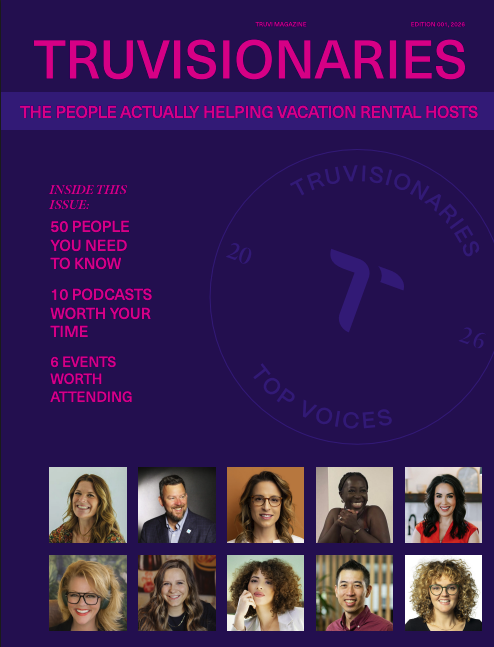
Earlier this year, Truvi launched the first Truvisionaries List; a community-nominated guide to 50 people who are running their own operations and helping others do the same.
Why it was needed
There's a pattern in this industry: the people on conference stages and the people actually doing the best work are often two completely different groups.
Conference speakers tend to be platform representatives, large tech companies, people selling courses, or people with their own agenda. The educators who are actually helping hosts day-to-day — showing up in podcasts, answering questions in Facebook groups, sharing real experiences in blog posts — don't get recognized.
"I'd be in conversations with operators asking who should I be learning from, and I just didn't have an answer," Humphrey explains. "There was no curated list. It was all just noise."
How it works
The Truvisionaries List is:
Community-nominated
Free and accessible
No gatekeeping or commercial angle
Focused on people who genuinely help hosts succeed
The name captures both the vision (these people see where the industry is going) and the Truvi connection (facilitating recognition, even though it's community-driven).
The response
The reception has been overwhelming, with thousands of downloads in the first month and people sharing it because they found it useful, not because they were asked to.
"The best part has been watching the Truvisionaries share it with their audiences," Humphrey says. "These are people who have worked for years without recognition. Seeing the industry celebrate them has been genuinely moving."
Two standout examples:
Dana Lubner has been in the trenches for years, helping hosts navigate the messy reality of regulation and pressure from governments and town halls. She helps them take actual steps to be better. If everyone tried to be just a little bit better at what they're doing, the industry would be in a much stronger position.
Lisa Rhodes has worked tirelessly under the radar, focused on helping women property managers improve their systems and processes, get more recognition, and be heard.
There were hundreds of nominations, but only 50 spots. That means there are many more voices the industry needs to hear from. The 2027 list is already in the works.
Key takeaways
Platform dependency is an existential risk. If more than 70% of your bookings come from one platform, you're getting dependent. If it's over 85%, you're definitely dependent. If it's over 95%, you're one policy change away from catastrophe.
The test is simple: If the platform suspended your account tomorrow, would your business survive? If the answer is no or "I don't know," you're too dependent.
Three steps to reduce dependency:
Build direct booking capability and own your guest relationships
Diversify your distribution across multiple platforms
Screen your guests properly and have robust damage protection
Platform screening isn't designed to protect you. Platforms optimize for their own liability and brand protection. Property managers need to screen for different risks: damage, parties, house rule violations, and potential misuse.
Real entrepreneurs don't define themselves by the tools they use. Airbnb is a distribution channel, not your business model. If the platform went away tomorrow, would you still have a business?
Diversification protects you. Even if you choose to rely on platforms for your bookings, being active on multiple sites helps to protect you from being too dependent on a single one.
The uncomfortable truth
Building a sustainable short-term rental business requires accepting an uncomfortable truth: the platforms that brought you growth are not designed to protect your long-term interests.
They're not evil. They're just optimizing for different outcomes than you are: they want transaction volume, you want a stable, profitable business you control.
The solution isn't abandoning platforms. It's refusing to be dependent on them. It's building real relationships with guests. It's owning your distribution. It's screening properly. It's treating your operation like a hospitality business, not a platform side hustle.
Because at the end of the day, you're not an Airbnb host. You're a hospitality entrepreneur who happens to use Airbnb as one distribution channel among many.
The question is: does your business reflect that reality?
💡 Want to learn more about how technology can support safety and operational efficiency in property management? Discover Minut’s privacy-first sensor.







.png)