Short-term rental noise rules: What hosts are legally responsible for
Learn what short-term rental noise rules mean for hosts, who is legally responsible for noise complaints, and how to stay compliant without violating guest privacy.
Across cities and host platforms, short-term rental noise rules have become enforceable obligations with fines, permit suspensions, and even platform delistings. If you manage properties at scale, your risk isn’t just handling a one-off party, but the compliance record that your listings build over time.
Short-term rental noise rules require hosts to prevent and respond to excessive noise, especially during quiet hours, and certain places also require a 24/7 responsible contact who can intervene quickly when issues arise. In practice, enforcement targets the listing owner or operator — not the guest — through fines, HOA actions, permit suspensions, and platform penalties.
Cities, HOAs, and booking platforms expect proactive prevention, fast response, and documented resolution, without surveillance. Let's take a closer look at what the rules are, your obligations, and how to stay compliant.
What are short-term rental noise rules?
Short-term rental noise rules define “how loud is too loud” in a transient accommodation, and the host’s obligations when noise crosses that line.
Most frameworks regulate three things: overall volume, quiet hours, and repeat disturbances. Rather than solely relying on hard-to-prove decibel tests, many jurisdictions use standards such as Palm Springs’ “no amplified sound audible beyond the property line” rule. You’ll also see activity-based limits, from late-night pool use to backyard speakers, because these create predictable night-time disruptions.
Vacation rental noise regulations differ by location, but there are enforcement patterns around permits or registrations, good-neighbor standards, and rapid-response requirements.
Who is responsible for noise violations: host or guest?
Enforcement agencies typically hold the host accountable. When a listing disturbs the neighborhood, “my guest caused it” is rarely a defense. Cities fine the property owner or permit-holder, HOA notices go to the host of record, platforms assign penalties to the listing.
Cities are formalizing this shared-but-enforceable responsibility into obligations around response time — specifically, many ordinances require a local contact who must respond when a complaint comes in, often within an hour. Some cities go further, requiring physical availability within city limits. Other jurisdictions, such as Santa Rosa, require remedial action within 45 minutes once notified.
Quiet hours rules and enforcement
Quiet hours rules are a consistent feature for noise ordinance vacation rentals frameworks, because nighttime noise has an outsized impact on neighbors. Although the specific hours vary, many jurisdictions define quiet time roughly from late evening to mid-morning, and overnight offenses are treated more seriously than daytime ones.
Enforcement usually starts with a neighbor complaint, with penalties escalating for repeat issues or documented patterns of noncompliance. Many cities have tried to streamline this process by operating 24/7 nuisance hotlines that contact the listed local responsible party and track outcomes in a central system. Hilton Head Island’s Short‑Term Rental Nuisance Hotline, for example, requires the responsible contact to respond within one hour of a complaint and logs each incident for potential follow‑up enforcement.
What counts as a noise violation in short-term rentals?
Not all noise is equal. Occasional bursts, like a door slam or a short cheer, rarely trigger enforcement on their own. Sustained noise is what gets hosts into trouble. Typical violations include loud conversations that carry outdoors late at night, music or TV at levels audible beyond property lines, and gatherings that exceed occupancy norms and spill onto outdoor areas.
Many operators underestimate how little it can take to wake a neighbor at 1 a.m., especially in dense urban buildings or echo-prone courtyards. That’s why some cities have begun regulating noisy amenities directly during quiet time, restricting hot tubs, pools, fire pits, barbecues, and outdoor parties, as seen in Chula Vista’s quiet time provisions.
Noise complaints: what happens after the first one?
Most enforcement follows an escalation path: warning, then fine, then steeper penalties, up to permit suspension or revocation. Repeat complaints are especially risky because they create an official compliance record. A single high-impact stay can trigger intense neighbor pressure and city scrutiny. Cities are also making it easier to submit and track complaints, as in Houston’s planned 24-hour complaint hotline and public STR registry.
In short: don’t wait for the second call. The most cost-effective plan is to prevent the first complaint, or at least to resolve the first incident quickly and document the steps you took.
Legal consequences hosts should be aware of
Penalties for violating short-term rental noise rules vary by city. Monetary fines are now just one part of the picture, as many jurisdictions tie repeat noise issues to licensing outcomes such as suspension, non-renewal, or permanent revocation. Platforms themselves can also become an enforcement lever: some cities require them to remove non-compliant listings, as in Houston, where platforms must delist a flagged STR within 10 days of city notice. On top of that, HOAs and condo associations can impose their own penalties under community covenants and, in some cases, restrict or ban STR operations entirely for chronic nuisance properties.
Enforcement pressure is rising globally because noise is treated as a core quality-of-life issue. New York City alone logged more than 610,000 noise-related 311 complaints in 2024, a rise of 19% year-over-year. Faced with that volume, cities are increasingly using complaint history, rather than a single incident, as evidence that an operator lacks adequate controls, and as a trigger for stronger sanctions.
How hosts can stay compliant without violating guest privacy
There’s a crucial distinction between audio recording and measuring sound levels:
Recording conversations is invasive and often illegal without consent.
Monitoring decibel levels doesn't listen to or capture any audio, so is a privacy-safe option.
Platforms reflect this difference. Airbnb’s policy prohibits indoor security cameras but allows disclosed indoor noise decibel monitors in shared areas. Vrbo takes a similar stance, allowing devices that measure sound levels without recording conversations and requiring upfront disclosure on the listing.
That’s why privacy-safe noise monitoring matters. It aligns with the host responsibility noise complaints obligations, while still protecting guest trust.
How Minut helps hosts meet noise rule obligations
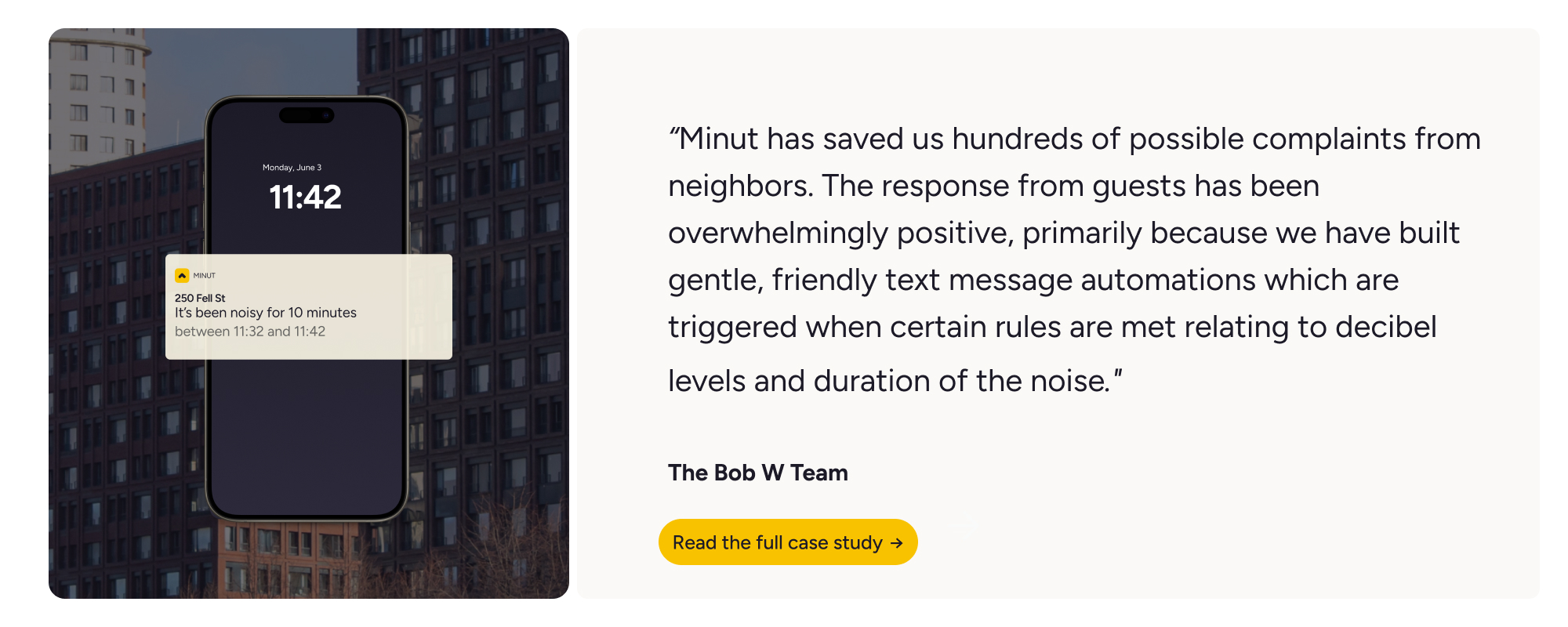
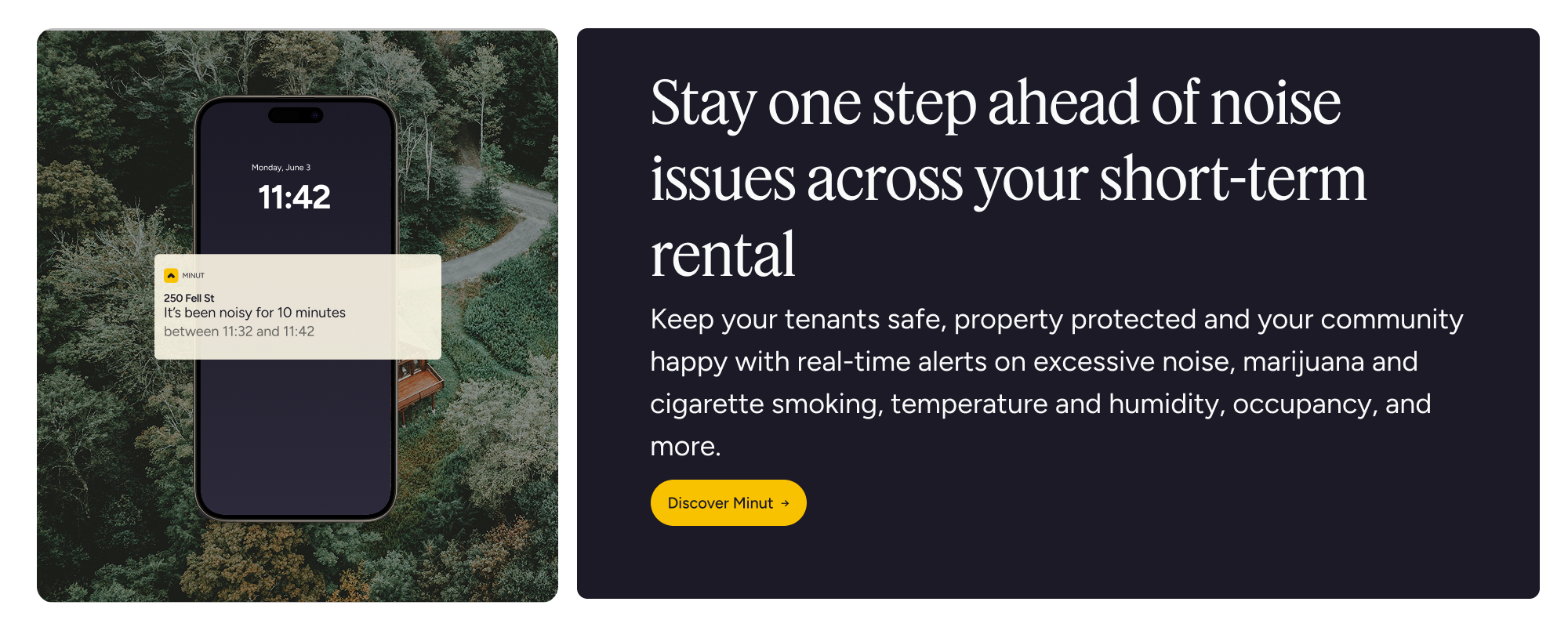
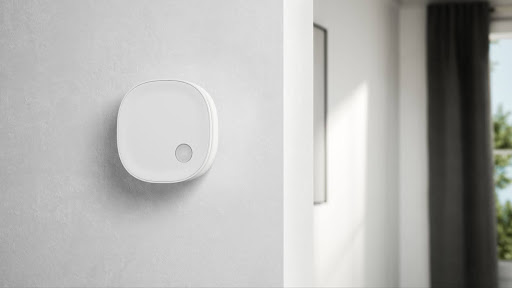
Minut helps you comply with short-term rental noise rules without crossing privacy lines. Our noise monitor detects sustained sound levels and increased occupancy risk without recording conversations or capturing audio. When thresholds are exceeded, hosts can receive real-time notifications or trigger automated guest nudges, so incidents can be resolved within minutes. That means you can intervene early, remind guests of house rules, and prevent violations before they turn into neighborhood noise complaints or enforcement actions.
Hosts can configure time-of-day thresholds to align with quiet hours rules, document incident resolution, and, when needed, activate additional outreach. This supports compliance, and it serves everyone’s interests: hosts, guests, and neighbors alike.
Turning noise rules into clear, enforceable house rules
Vague rules don’t work, because they don’t provide guests with context. “Please be respectful” is well-intentioned but unenforceable. Instead, start by aligning house rules with local quiet hours and activity-specific expectations, including pools, hot tubs, speakers, and outdoor gatherings.
Keep language simple and specific, post rules inside the property, and include them in digital guides and pre-arrival messages. Then reinforce your policy with privacy-safe tools. When monitoring detects a sustained event, a polite, timely reminder is often all it takes for the incident to stop. This lets you avoid confrontation at the door, maintain a courteous tone, and still meet your obligations under short-term rental noise rules.
A brief checklist helps to:
Mirror local quiet hours and property-line audibility standards in your guest noise rules.
Explain how monitoring works, that no audio is recorded, and where devices are located.
With that foundation, noise monitoring for rentals becomes a guest experience tool as much as a compliance tool.
Common misconceptions about host responsibility
“Guests are legally responsible, not me.” In practice, enforcement targets the listing owner or permit-holder. Cities and HOAs cite operators because they can take systemic action to prevent recurrence. Response-time obligations and administrative penalties make this explicit, as seen in municipal codes in places like Escondido and Placentia.
“One complaint doesn’t matter.” It does. The first complaint sets the foundation that makes you a “repeat offender” if another complaint occurs in the future.
“If I don’t hear it, it’s not a problem.” In certain jurisdictions, noise that carries beyond the property line can be an infraction of local rules, even without a decibel reading.
Conclusion: Compliance is about prevention, not punishment
Understanding short-term rental noise rules is now a necessity. They define your operating standard, your response times, and the documentation you need to keep listings active and neighbors supportive.
The best strategy is prevention, which the following steps can help with:
align house rules with local expectations
disclose privacy-safe monitoring to guests
set up automated, courteous nudge workflows to stop small issues becoming enforcement cases
Short-term rental noise rules FAQs
What are short-term rental noise rules?
They are local, HOA, building, and platform requirements that regulate factors such as noise, quiet hours, and repeat disturbances in STRs. Specific rules can vary from one city to another, with some mandating decibel levels and others implementing “audible beyond the property line” standards. Operators should always check the rules in their area.
What are typical quiet hours for vacation rentals?
Hours vary by jurisdiction, but typically quiet hours are set from late evening through morning, such as 10 p.m. - 7 a.m..
Can hosts be fined for noise complaints?
Yes. Fines are common, and failure to respond within mandated windows can itself be a violation, as outlined in Escondido and Placentia codes.
How do cities enforce rental noise regulations?
Cities use STR registration and good-neighbor standards with rapid-response requirements, plus administrative penalties. Some require platforms to remove non-compliant listings, such as Houston.
How can hosts prevent noise violations proactively?
Publish clear house rules that mirror local standards, disclose monitoring, and automate guest nudges for sustained noise. Tools like Minut help operators meet short-term rental noise rules by detecting sustained noise early and documenting swift, courteous resolution.








.jpeg)