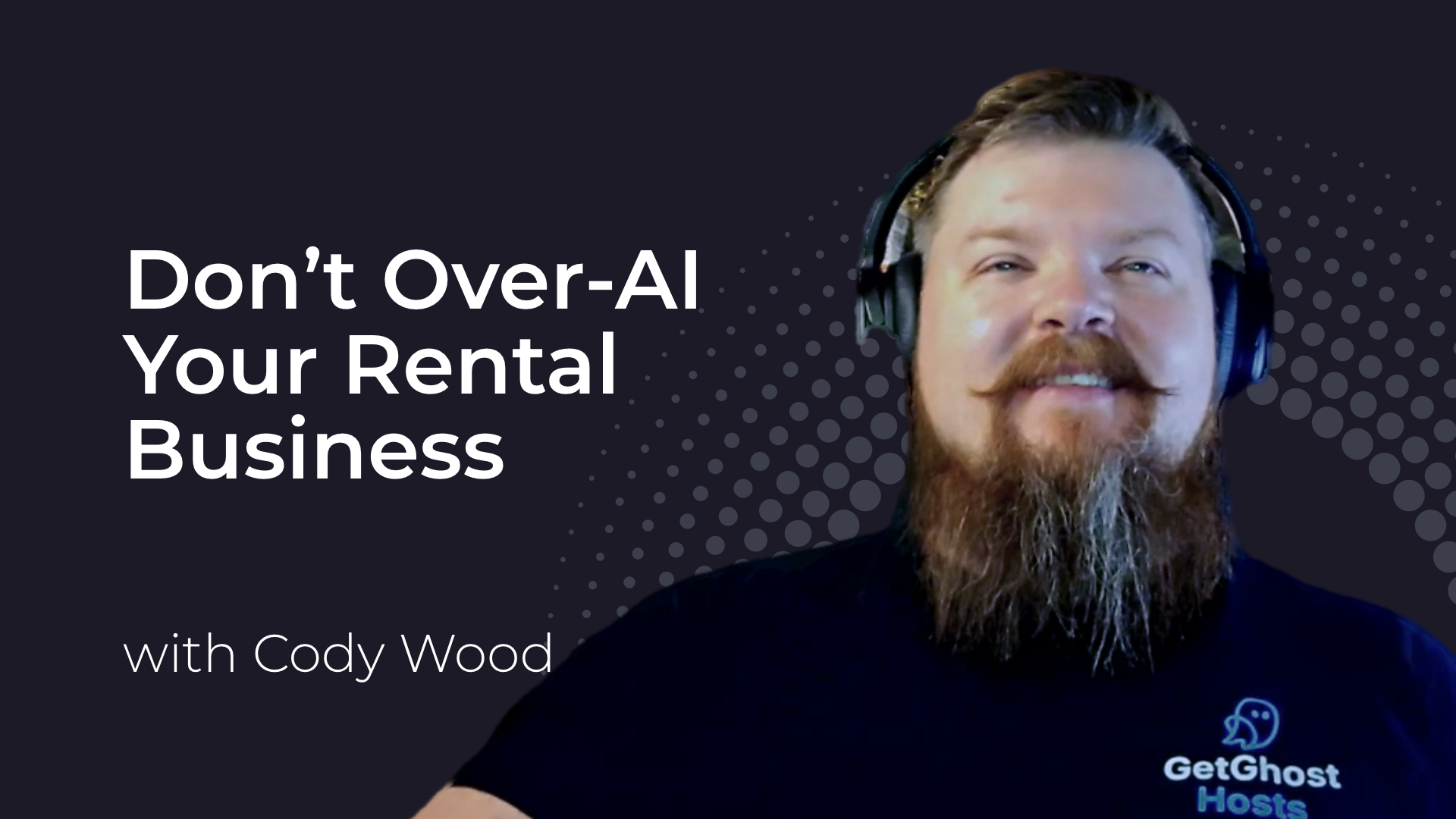
What 156 properties taught Cody Wood about running a better STR business
Ghost Hosts co-founder Cody Wood explains why growing from 75 to 156 properties, then cutting back to 60 while keeping the same revenue, changed how he thinks about scaling. He shares how operators can prune weak properties, build reliable vendor relationships, simplify their tech stack, and create systems that run without them.
Most operators measure growth by property count. Cody Wood did too, until he took a portfolio from 75 to 156 properties, then cut it back to 60 and kept the same revenue.
Cody is the co-founder of Ghost Hosts, a consultancy that helps STR operators fix their operations. Before that, he spent a decade in aerospace and defense manufacturing. He calls himself "a recovering engineer," and his lean, systems-first thinking shows up in everything he does.
Here's what he learned about pruning a portfolio, defining roles, building a tech stack that doesn't collapse under its own weight, and handling the kind of disaster that tests every one of your processes.
From a spare bedroom to a 156-property portfolio
Cody's STR career started during COVID, when hotels were closed and Houston was full of travelers who needed somewhere to stay. He rented out two spare bedrooms in his own house and hosted a few medical professionals while he was still working a 100-plus-hour engineering job with international travel.
A friend who ran an STR business needed help. After talking it through with his wife, Cody made what he describes as “a complete 180.” He joined a portfolio of 75 properties and, within eight months, they grew it to 156.
Then he did something most operators avoid: after about three and a half years, he and the owner reduced the portfolio to 60 properties. Revenue stayed the same.
What the 80/20 rule looks like in a real portfolio
During the growth phase, Cody says, they took on anything that came their way: “hotels, duplexes, tiny homes, RVs, you name it,” all scattered across the Texas triangle between Houston, San Antonio, Austin and Dallas.
The problem wasn't any single property. It was the cumulative drag: “what I realized was we were spending all this money and there isn’t an economics of scale in a local market. You have to have multiple teams, multiple costs, and you can’t negotiate pricing. At the same time, that shouldn’t be the only focus because really the end goal is that experience for the guests.”
How Cody decided what to keep
He evaluated each property and each client against a set of questions:
Is the property cash-flowing and easy to book?
Is the owner open to improvements when issues come up?
Is the owner an investor, a homeowner, or someone brand new who needs constant hand-holding?
Is the property within a 30-minute drive of the vendors already servicing the area?
Do I actually like working with this owner?
Investors who wanted a paycheck at the end of the month, in properties close to each other, turned out to be the best fit. Maintenance and cleaning costs dropped because the same teams could cover more doors.
His summary: "The vanity metric is how many properties you have. If you're not profitable, it doesn't matter."
Anchor properties matter
Cody makes a point that's easy to overlook. A property that grosses $250,000 a year and one that grosses $50,000 in the same location take about the same amount of work, a lot of the time. When you're opening a new market, you want anchor properties that can carry the upfront costs of vendors and trust accounting, not a handful of low earners that leave you bankrolling the operation.
Treat your vendors like part of the team
Cody calls vendor relationships "the backbone of your business," and says most operators spend their energy on owners and guests while neglecting the people who actually do the work.
His practical rules:
Require photos on every job. It was a condition of his agreements with vendors.
Give vendors what they need before they ask. Checklists, videos, and clear communication so the job is easy to do right.
Respect drive time. If a cleaner is within 30 minutes, they can cover the property. Beyond that, you need someone else. Also check whether a vendor is available 24/7 or only five days a week.
Refer your best vendors. When other operators needed a cleaner, Cody sent them to his guy, because he wanted to send that vendor business.
The trust runs both ways. Cody tells a story about a vendor who discovered one of his cleaners hadn't taken photos on a job. He told Cody not to pay for it, even though he didn't have to offer. "The amount of respect I had for that vendor, I never moved away from them," Cody says.
Solve the problem before the guest has it
Many operators treat a fast, polite reply as good hospitality. Cody argues the better goal is reducing the number of messages guests need to send in the first place.
He uses the Ishikawa diagram, also called a fishbone diagram, to work backward from a problem to its root cause. One of his clients' teams kept sending emails, texts and Slack messages about issues without ever finding out why they were happening.
The pattern is common. A guest can't find the coffee, or can't work out how the machine works. You answer the message and move on. But if you ask why the guest had the problem, you might find that the cleaner sets up the coffee station differently from property to property. Fix the setup and the guest doesn’t send the message in the first place.
"You're almost in a mindset of trying to reduce the number of messages your guests are sending you," Cody says, "by solving the problems before they ever step foot in your property."
The phases of an STR business
Cody sees a fairly predictable pattern as portfolios grow:
0 to 20 properties: You can usually scale without interruption. It's mostly you.
20 to 60 properties: You need to start hiring a few people.
60 to 100 properties: You have to build out a team.
100-plus properties: You need systems in place and be thinking in terms of departments e.g. the cleaning department, the maintenance department.
The risk at every stage is the same: the founder as the single point of failure. Cody describes a client who hadn't taken a day off in five years. Burned out, he and his brother needed a business that could run without them. Within a year of working with Cody, with teams and departments established, that client took a month and a half off to attend conferences and spend time with his family. The business kept running.
Define the role before you name it
Operations director. Guest experience lead. Cody has seen plenty of titles, and when he asks the people who hold them what the title means and how their success is measured, the answer is often "I don't know."
His approach starts with the problem, not the title:
Identify what you're trying to fix. Is this something you no longer have time for, or aren't good at?
List three to six things the person needs to do.
Attach a metric to each. For a sales role, that might be calls made, outreach completed, local agents and brokers met, properties viewed.
Check for role creep. A guest communication role that quietly picks up client communication and vendor support is really three roles under one title. The title and the metrics both need to change.
Information layers versus decision layers
With AI tools making it easy to build dashboards, Cody sees a new version of an old problem. People build beautiful reports with no requirement that anyone act on them.
He describes three layers of AI use:
The $10 task. Entry-level work, like what a VA might do. Mostly workflow, with minimal AI decision-making.
The report. AI surfaces what the data is saying, and a human decides what to do.
The decision layer. Someone is named as responsible for checking the report, taking action, and doing it on a set schedule.
Most operators, he says, are over-complicating the first layer by trying to run everything through AI, while skipping the accountability that makes the second layer useful. "That pretty dashboard within six months is going to be up on the shelf somewhere and you're never going to touch it again."
Keep your tech stack simple
Cody gives a small example of over-engineering: on a mastermind call, an operator described building an AI system to move vendor reports into Slack. Cody pointed out that Slack can generate an email address for each channel, so the report could simply be forwarded. The operator had no idea.
His concerns about complicated tech stacks:
Resale value. The more complex your back end, the harder it is for a buyer to run, maintain or rip out. Cody expects private equity buyers to eventually factor this into valuations.
Forgotten tools. Often a team member set up an onboarding process years ago, left, and the tool just sat there.
Unused capability. Tools evolve, but teams keep using them the way they did three years ago.
The napkin test
Cody's fix is simple. Map your process from booking to owner payout on a napkin, and note which tool touches each stage. Once you can see it, you'll find tools you don't use and overlap you didn't know about. He calls this reducing your tech load.
His question for any operator: "When's the last time you audited your PMS for accuracy?"
What a well-run STR business looks like from the inside
When Cody walks into a business, he looks for:
Documented SOPs that are assigned to departments and actively maintained, not tribal knowledge held by one person
A clear org chart where everyone knows who to contact for what
Clean financials, because revenue management, finances and operations are tied together, and he can't make operational decisions without seeing all three
He gives an example of what happens without that clarity. A guest experience team member asked about a discount by contacting the property manager, the CEO, and the client, instead of the revenue manager who looked after pricing. Everyone asked why they were being contacted, and what should have been a five-minute conversation took an hour and a half.
Regulation isn't the enemy
With his aerospace and defense background, Cody is comfortable in regulated environments, and he doesn't see incoming STR regulation as a threat to good operators because it’s “squeezing the average and the subpar operators out of the industry.”
His recommendations:
Have a good neighbor policy. Walk over with a plate of cookies, hand neighbors a business card, and tell them to call you day or night. You want them to call you before they call the regulators.
Get involved locally. Join or start a short-term rental alliance. Host meetups. Talk to city councils.
Treat safety as an operations problem. Fire extinguishers, first aid kits, working smoke and CO alarms, and decent lighting at night are the bare minimum, and they're easy to get right.
Safety is an area where the industry has work to do. Without a recurring check in your SOPs, a disabled alarm can stay disabled for a prolonged period of time. Guests shouldn't be less safe in a short-term rental than in a hotel, and a procedure for checking alarms between stays is the fix.
When the paperwork wins the claim
Cody has a story that shows why documented processes aren't busywork.
During the week of July 4th, a guest at a $2 million property that sleeps 30 and doubles as a wedding venue asked whether the team sold fireworks. They didn't, and the house rules prohibit them. The guest found some anyway, texted the owner, got a casual go-ahead, and set them off. Afterward they put the used fireworks in a trash can and rolled it into the garage, where it caught fire.
The fire department came, but the garage burned. Even worse, it was where they staged everything for their different Airbnbs. The whole property sustained smoke damage and was a total loss.
What happened next came down to preparation:
Cody’s team documented everything and built a Google folder with Ring video, staging records, and the rental contract
They contacted Airbnb right away and got AirCover involved
The guest admitted fault
Aircover awarded a $380,000 claim, and the AirCover team was surprised by how organized the documentation was
Key takeaways
Property count is a vanity metric. Profit per property and time per property are what matter. Cody cut from 156 to 60 properties and kept the same revenue.
Evaluate owners as well as assets. Investors with centralized properties are often easier to run than homeowners who need constant contact.
Respect your vendors. Drive time, clear checklists, required photos and referrals build the relationships your operations depend on.
Fix root causes, not symptoms. Use a fishbone diagram to work back from a guest problem to the process that created it.
Define roles by outcomes and metrics, not by clever titles.
Reports need owners. A dashboard without a named person, a check schedule and a required action is shelfware.
Audit your tech stack. Map booking to owner payout on a napkin, cut unused tools, and check your PMS data for accuracy.
Build a business that runs without you. If the founder can't take a weekend off, there’s a systems problem.
Talk to your neighbors and local officials. Good operators have little to fear from regulation.
Document everything. Photos, video, contracts and timestamps are what win claims.
Build the business that doesn't need a hero
Cody's core argument is that most STR problems are operations problems in disguise. Guest messages, owner calls, safety incidents and tech sprawl usually trace back to a process that was never defined, a role that was never clarified, or a document nobody has looked at in five years.
If you want a place to start, pick one. Run the napkin test on your tech. Ask your team what their title means and how they're measured. Check when your alarms were last tested. Or look at your portfolio and ask which 20% is paying for the other 80%. Whichever you pick, you'll learn something, and you'll probably free up some hours.
💡 Want to learn more about how technology can support safety and operational efficiency in property management? Discover Minut’s privacy-first sensor.