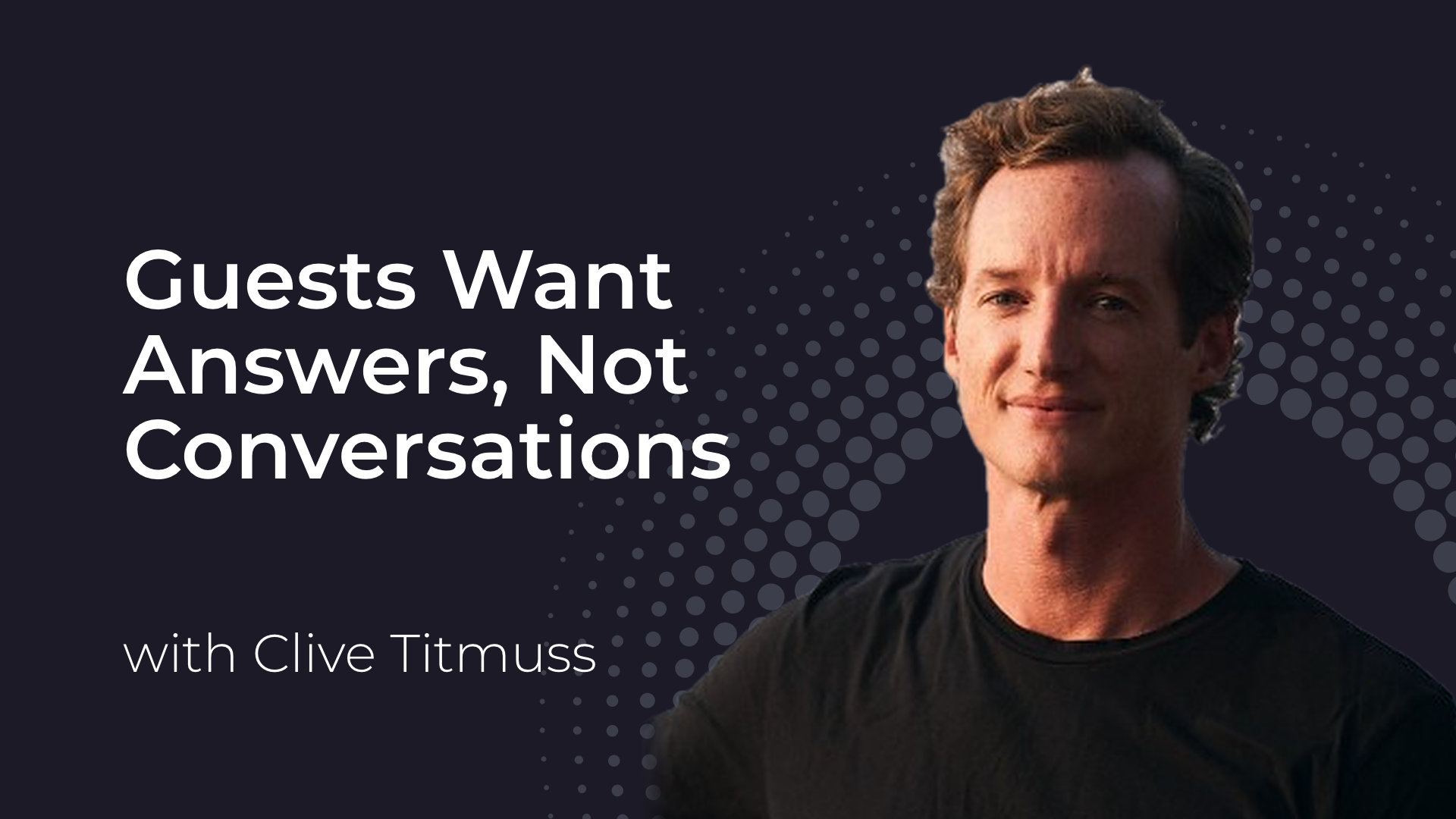
Why guests don't care if it's AI answering: lessons from an operator-turned-builder
After 20 years in London property, Clive Titmuss built Hello Hosty to tackle one of hosting’s biggest headaches: guest communication. He shares what it takes to automate replies without losing the human touch and where he sees opportunity in a changing rental market.
When a guest is standing outside in the rain and can't find the key code, they don't care whether the reply comes from a person, a bot, or a zebra. They want the door open. That one observation shapes how Clive, a London operator who went on to build the AI-powered PMS Hello Hosty, thinks about guest communication.
Clive was a recent guest on the Minute by Minut podcast to talk about what 20 years in London property taught him, how the short-term rental market has changed, and what it takes to automate guest messaging without making it feel automated.
From managing properties to building software
Clive spent years on the operator side, living with the same problems every property manager knows. Communication was the stubborn one. "I felt that there were certain obstacles that we were challenged to overcome," he says. His default approach to business is to systemize and automate wherever possible, but guest messaging resisted both, even with a full team.
Then generative AI arrived. Clive had been building his own tech already, and when the first large language models appeared, he paused what he was working on and tested one on his own guest conversations. The early version was clunky: a big prompt, copied and pasted across, but usable from a phone. Watching it respond to a guest convinced him of where this was going.
How the London market has changed
Clive has watched the London short-term rental market mature over the past 15 years. The big shifts:
Better stock. The quality of accommodation has improved significantly, which is good news for guests.
Fewer platforms. There used to be around 20 successful OTAs in regular use. Many have been absorbed or disappeared, leaving a handful of dominant players.
Mainstream awareness. When Clive started, mentioning Airbnb got blank looks. Now it's a household name.
More regulation. And more on the way.
Is London still a good place to start?
Clive's advice is to be strategic and not rely only on short-term lets. His own company handles short, medium, and long-term stays, and with the Renters' Rights Act, he expects the mid-term market in particular to shift in ways nobody can fully predict yet.
He also points to where the opportunity is heading: entire buildings with the right permissions already in place. A developer who has taken over a former hotel, for example, already has the use class for short-term rentals. That's a very different starting point from collecting individual flats across the city.
OTAs and direct bookings: you need both
Clive was early to direct bookings, but he's not an OTA sceptic. "Booking.com for a period was Google's biggest ad spend," he points out. No individual property manager can compete with that kind of reach.
His view is that the commission earns its keep, but leaving direct bookings open lets you capture the share of guests who'd rather book with you. "It's a delicate balance between the two."
Why guests aren't bothered about talking to an AI
When Hello Hosty first launched, the most common objection from property managers was that guests wouldn't want to talk to an AI. Clive's answer was simple: guests don't want to talk to you either. They want the information.
That objection has faded. A few things Clive has seen play out:
Most guests don't know they're talking to an AI. The assistant, Alina, replies natively through Booking.com, Airbnb, and other OTAs, as well as WhatsApp and SMS.
Guests who do realise are fine with it. Getting the Wi-Fi code instantly beats waiting for a person who might be asleep, on the school run, or having a bad day.
Reviews improve. Clive recalls a takeaway from a London industry conference: the number one factor in getting a good review is staff attentiveness. An assistant that replies at any hour scores well on that.
What a well-built AI assistant actually does
Plugging a generic chatbot into a rental business doesn't work. A tool built to answer FAQs on a website has no idea how to help someone who just got off a long-haul flight and can't find the lockbox.
According to Clive, a useful hospitality assistant needs three things.
1. Deep, specific training
Alina follows roughly 3,000 rules designed for short-term rental hospitality. It's not a single prompt sent to a language model. It's a tuned system that knows how to handle check-in problems, heating questions, access issues, and the rest.
2. Good property data
An assistant is only as good as what it knows about the property. Hello Hosty tackles this by asking five questions to generate a digital guidebook, then letting the property manager add detail over time. The assistant draws on that guidebook when guests ask questions.
3. A clear sense of its role
Alina is built to behave not like a property manager, but an assistant to the property manager. That’s an important distinction. It means she doesn't make authoritative calls she shouldn't, and she handles things the way a good team member would: deal with the 95-97% of messages that are routine, and escalate the rest.
Clive also builds in flexibility. Some managers are strict on check-in and check-out times, others are relaxed. Toggles in the dashboard let each operator set the assistant's behavior to suit their own style.
When the AI should hand over to a human
Escalation is the hard part of any AI messaging setup, and Clive's approach is simpler than you might expect.
The assistant tries to solve the problem first. If a guest says they can't find the hairdryer, Alina doesn't immediately alert the manager, she instead asks whether they've checked the drawers or the bedroom. Clive has seen guests reply with "found it" more than once.
Escalation happens when:
The same problem comes up more than once without being resolved
The issue is urgent
Trigger words appear, such as "urgent" or a mention of the property manager
When that happens, the property manager gets an SMS or email linking to the conversation, flagging that a guest needs attention.
This is also where operators with a poor AI setup go wrong. Clive's view is that many tools slap AI on top of a product without thinking it through. An assistant that only suggests replies, or doesn't have solid information about the property, ends up creating work instead of removing it.
Regulation and automation will grow together
Clive expects regulation and automation to become closely linked over the next year or so. In parts of mainland Europe, guest registration already involves submitting data to multiple authorities. Portugal is a good example, where doing that by hand would be close to a full-time job.
If London moves in a similar direction, data collection and reporting will need to be automated. Clive's attitude to the timing is relaxed: regulatory changes have a habit of being "kicked down the road," and when they do land, there's usually a lead time. His approach is to stay informed, respond when the rules are clear, and carry on with business as usual in the meantime.
How Clive decides what to build
With AI making it easy to add features, Clive resists building things just because they're possible. His test is user demand. Software, in his view, is "an organism that's evolving constantly," and the next feature is whatever the users are collectively asking for.
His process looks like this:
Listen to users and spot the problem they keep raising
Sketch a wireframe with the team
Take it back to users and ask how it fits their use case
Talk to service providers too, including cleaners, housekeepers, and maintenance staff, so it works for everyone who touches the software
A recent example is the team and members feature, including cleaning and maintenance schedules, which came out of that kind of consultation.
If he were starting again, Clive says he'd pick a course and hold it earlier, like sailing a ship in a straight line to save time and energy. He'd also build a stronger feedback process from day one. Today, AI-transcribed user conversations make it far easier to pull the core requests out of many calls.
Key takeaways
Guests want answers, not people. Speed and accuracy matter more than whether the reply is human.
Generic AI doesn't work for short-term rentals. An assistant needs niche training and detailed property data.
Escalation can be simple. Try to resolve first, then hand over on repeated issues, urgency, or trigger words.
Treat the AI as an assistant, not the manager. Let it handle the routine messages and flag the rest.
Fast replies help your reviews. Attentiveness is the biggest driver of good ratings.
Use OTAs and direct bookings together. Don't neglect either.
London still has opportunity. Look at building-level deals with the right permissions already in place.
Build what users ask for. Let demand decide the roadmap, not what's technically possible.
The bottom line
The most useful part of Clive's story is how ordinary the reasoning is. He didn't chase AI for its own sake. He had a recurring operational problem, saw a tool that could solve it, and kept listening to other operators to shape what he built.
If you're thinking about automating guest communication, start from the same place: which messages eat the most of your team's time, and which ones could be answered correctly at 2am without waking anyone. Get those right, set clear rules for when a human steps in, and the rest follows.
💡 Want to learn more about how technology can support safety and operational efficiency in property management? Discover Minut’s privacy-first sensor.