Noise isn’t just an inconvenience—it directly impacts sleep, guest experience, and ultimately your reviews.
A single night of disruption can turn a comfortable stay into a frustrating one, leaving guests tired, irritable, and far less likely to return or recommend your property.
In this article, we break down the most common sources of hotel noise, the real impact on guest satisfaction, and practical ways to reduce complaints.
Why noise complaints are so critical in hotels
Noise directly impacts guest comfort
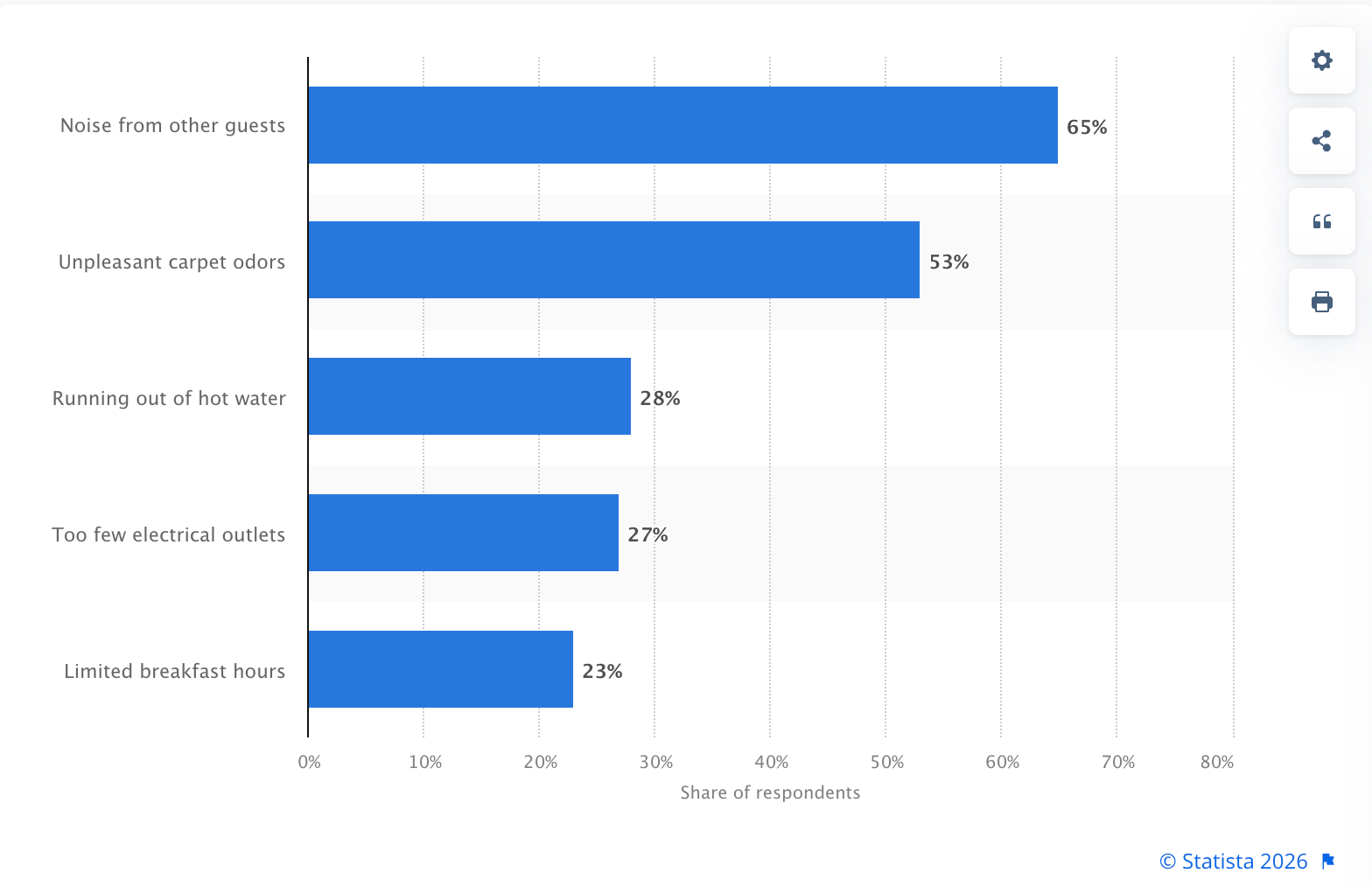
Fundamentally, hotels promise rest, privacy, and uninterrupted sleep. When late-night chatter or a thumping bassline cuts through walls, that core promise is broken. Research by Statista has found that “noise from other guests” is the most common complaint of hotel guests from the USA:
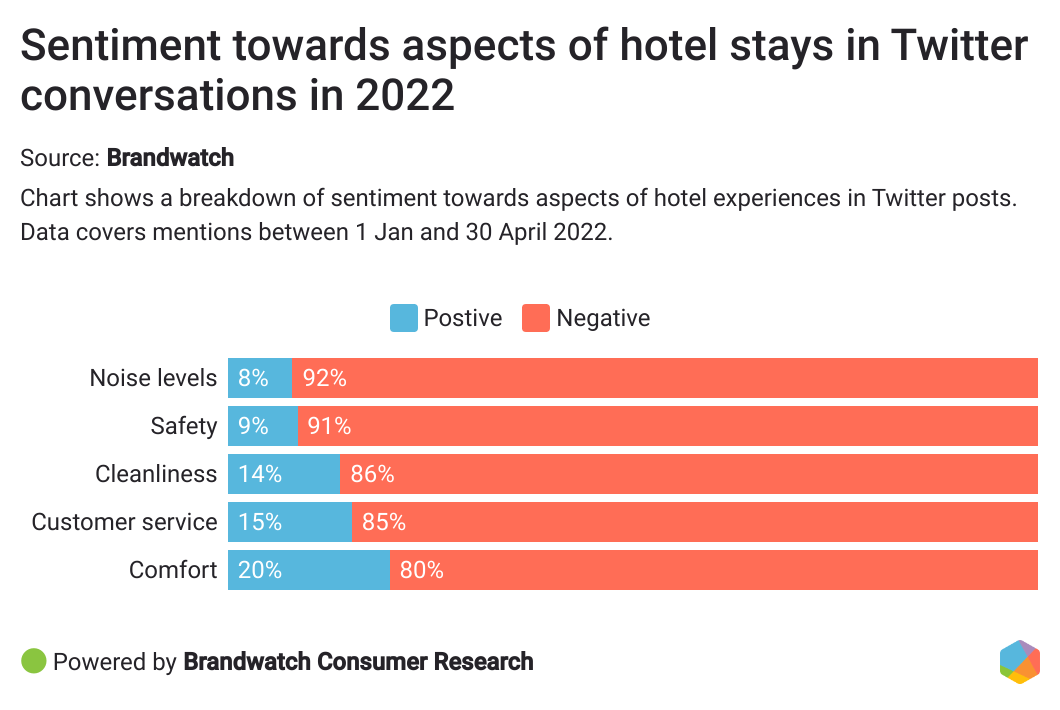
This shows that when a stay feels loud, guests talk about it publicly. As the above graph shows, noise is the most negatively discussed topic regarding hotels in the research, and it was further found that midnight was the peak for “negatively-categorized mentions.” That’s when guests will be trying to relax or sleep, which makes the disturbance a lot bigger than it likely would be earlier in the day.
Common sources of hotel noise complaints
Internal noise within the property
Internal sources are the main driver of guest complaints about hotel rooms. You’re already familiar with the culprits: guests returning late at night, hallway conversations, slamming doors, TV volume travelling through connecting doors, ice machines near rooms, and elevator hum.
External noise factors
Street traffic, nightlife districts, airport paths, deliveries, and construction next door are classic external drivers, and they’re particularly challenging for urban hotels in entertainment zones.
Structural and design issues
Thin wall partitions, gaps around doors, shared shafts, HVAC cycling, and plumbing stacks push sound from one room to another.
Operational gaps
If you don’t monitor quiet hours, take too long to respond to calls, or avoid enforcing policies, noise continues — and possibly ramps up. This is where hotel noise management often falters: teams address issues when the phone rings, rather than preventing the call.
How noise complaints impact hotel performance
Noise causing a poor stay can have a cascading effect:
Impact on guest experience: Sleep loss quickly becomes dissatisfaction. Guests wake up irritable, take coffee to meetings tired, and carry that feeling into their reviews. In hospitality management, this is a particular problem, because if it’s noisy, the rest of the stay can’t compensate.
Impact on online reviews: Quiet nights rarely get applause, but a 3 a.m. wake-up invites a mention, as the earlier Brandwatch research shows.
Impact on ratings: On platforms with ratings, your score is built as an average of your reviews. Even a single bad review can harm your rating, and multiple can drag it down significantly.
Impact on revenue and bookings: Lower ratings reduce conversion, because travellers are less likely to stay somewhere with recent bad reviews. That leads to fewer bookings, more cancellations, and fewer repeat stays.
Operational impact: Noise complaints chew up time and staff resources. Think night staff patrolling the floors, managers negotiating appeasements, and discounts and refunds to apologize for the frustrating stay.
Understanding the root cause of noise issues
Although you can’t necessarily eliminate all sources of noise, there are three important factors that help you stay on top of it:
Lack of real-time visibility: Hotel staff often won’t know a room is loud unless someone calls. This delays response and resolution.
Reactive vs proactive operations: Responding after a complaint means the damage is already done. Proactive teams detect sustained noise and try to address it before it disturbs other guests.
Inconsistent guest behavior management: Quiet hours posted in one place and skipped in another, or one room of noisy guests being spoken to but another room being left alone will lead to uneven outcomes. Without clear processes, two similar incidents get two different responses. Operational consistency is what turns intent into results.
Comparison: reactive vs proactive noise management
It’s easy to feel that noise is being “managed” because the phone is answered quickly. But you’re always working in recovery mode if you only act after a guest is complaining. Proactive hotel noise management catches issues early, prevents escalation, and stabilizes reviews and workload.
Let’s take a closer look:
Factor
Reactive approach
Proactive approach
Detection
After guest complaint
Real-time monitoring to detect sustained noise
Response time
Delayed (post-escalation)
Immediate (pre-escalation)
Guest impact
High (sleep already disrupted)
Minimal (issue contained early)
Staff effort
High (constant firefighting)
Controlled (structured playbook)
Risk of negative reviews
High
Reduced
Visibility into problem
Limited (only when reported)
Full visibility across rooms/floors
Consistency across rooms
Inconsistent
Standardized experience
Operational control
Low
High
Dependency on guests
High (complaints drive action)
Low (system-driven alerts)
Issue escalation
Frequent
Rare
Cost impact
High (refunds, comps)
Lower (prevention beats recovery)
Team coordination
Reactive and unplanned
Structured and predictable
The framing is important here: this isn’t just about quieter floors. It’s about controlling the guest experience and delivering the same standard in every room, every night.
How hotels can reduce noise complaints effectively
Set and communicate clear quiet hours
Define times that align with your market, then communicate them at booking, at check-in, and in-room. Spell them out in a friendly way and make the why clear. Setting measurable thresholds is even better because this creates a standard your team can reference.
Train staff to handle noise issues
Give the front desk and night team a simple escalation path, for example: first courtesy call, second knock with stated consequences, final action if needed. This way, they know exactly how to respond every single time.
Improve physical noise control
Door seals, sweep gaskets, soft-close hardware, and strategic room assignment do more than a thousand apologies. Clustering event blocks also reduces other guests being disturbed.
Monitor guest behavior consistently
This is where tech helps. Real-time detection of sustained noise gives your team time to act early. Over weeks, you’ll learn if particular rooms, floors, and nights create risk. That data drives better staffing and room allocation.
The role of noise monitoring systems in hotels
Real-time detection of noise events
Smart sensors measure decibel levels over time and alert only when sound is sustained above a threshold for a defined duration, distinguishing a door slam from a gathering. This reduces false alerts for your team, and means guests aren’t contacted for dropping a cup.
Enables faster response
Real-time notifications enable you to contact guests before the noise has a chance to disturb other guests. Automated messages to the guest help to enforce consistent enforcement, which is ideal if your team is too busy to contact the guest at that moment.
Helps maintain a consistent guest experience
When all rooms are watched the same way, you can protect sleep and the overall guest experience uniformly.
Reduces dependency on guest feedback
Because many guests never complain on-site, but may still post negative comments later, alerts keep you informed in the moment and help you act even when the phone stays quiet.
How Minut helps hotels manage noise proactively
Real-time noise monitoring without cameras
Minut monitors noise levels like a sound meter and never records audio or uses cameras. It’s privacy-safe by design, only capturing data from the environment.
Instant alerts for faster resolution
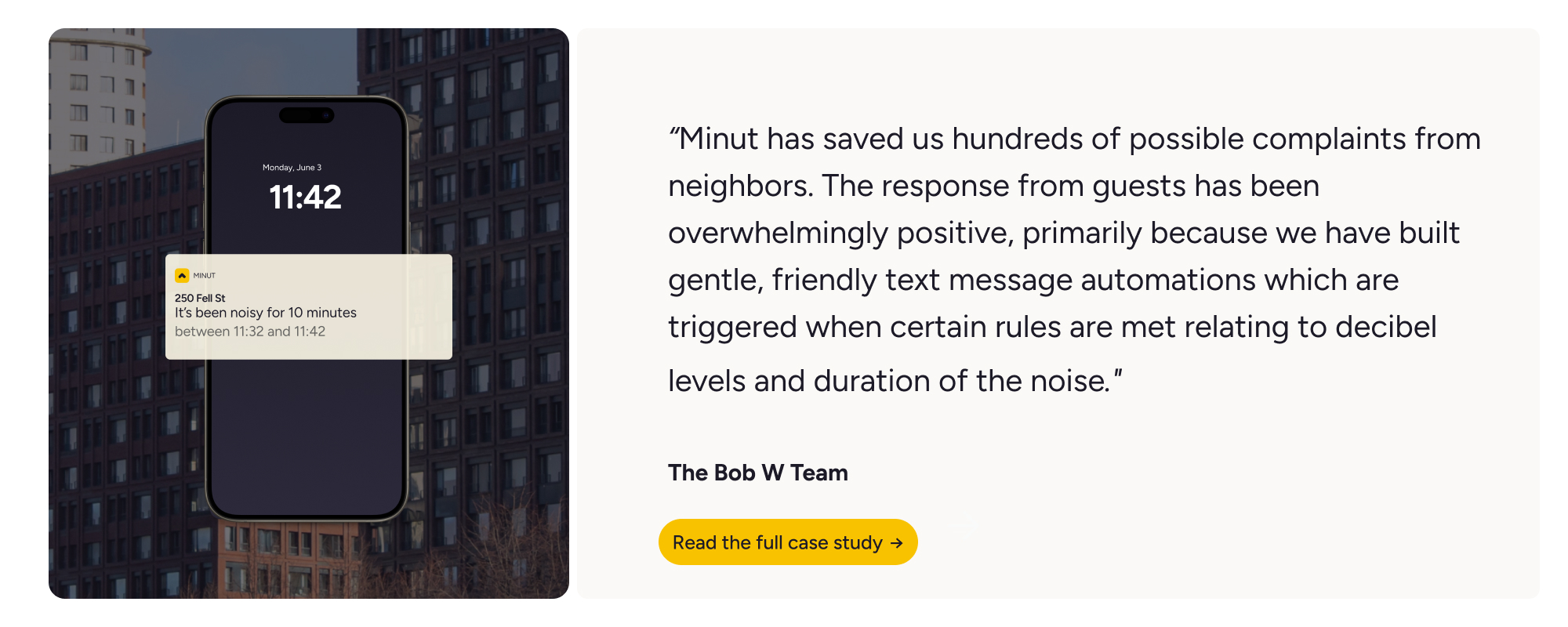
When sustained noise crosses your threshold, Minut alerts staff and can automatically send a friendly message to the room. Many guests are simply unaware of how loud they’re being, and that gentle nudge is all it takes.This early step is how to handle hotel noise complaints before they become public reviews.
Built for hotel operations
With multi-room visibility, a centralized dashboard, a timestamped event log, and integrations with platforms like Mews, Minut slots into existing workflows.
Final thought
Noise is the frustration that guests don’t forget, and it shows up in online reviews that shape your reputation and revenue. Relying on the phone to ring is a reactive approach that doesn’t attempt to stop the problem from occurring in the first place. The alternative approach is a proactive one: clear quiet-hour policies, trained staff, and real-time monitoring that empowers your team to step in before the noise levels have a chance to disturb other guests.
Do this well and you reduce complaints, protect your hotel reputation, and deliver the consistent guest experience your brand needs to grow.
Hotel noise complaints FAQs
How do noise complaints affect hotel reviews and ratings?
Noise is among the top reasons for negative reviews, which can lower your overall rating. In turn, this can lower travellers’ confidence in your brand, lowering bookings.
How can hotels reduce noise complaints from guests?
Start with clear quiet hours, targeted room assignment, quick response protocols, and standardized monitoring. To reduce noise complaints hotel teams can combine policy plus tech, using privacy-safe sensors that alert on sustained noise so staff can step in early.
Do noise complaints impact hotel rankings on booking platforms?
Yes, lower average ratings reduce conversion and visibility, which pushes rankings down.
How should hotel staff handle noise complaints effectively?
Staff should act fast and stay objective. Reference policy, and use an escalating enforcement path, such as a courtesy message, a firm warning with consequences, and final action if necessary.
Can noise monitoring systems help reduce hotel complaints?
Yes, systems that detect sustained elevated noise levels and send automated messages to guests can resolve issues before they escalate.





.png)



.png)