Acceptable decibel levels: noise limit and quiet hours guide for Airbnb and STR hosts
This article explains how noise limits affect short-term rentals, the varying acceptable decible levels for different times of day, and how hosts can prevent complaints using smart noise monitoring tools.
Most noise issues don’t start as serious problems. Usually it's as simple as music that runs longer than planned one night, followed by a neighbor who decides to complain. From there, things can escalate quickly into platform warnings, city citations, refunds, and negative reviews. In New York City alone, residents logged more than 610,000 noise-related 311 complaints in 2024, underscoring how central the issue has become to urban quality of life and to the way local governments approach enforcement.
This article will translate policy into practice for Airbnb and STR operators, clarify how “quiet hours rules” typically work, and show how privacy-safe monitoring helps you stay within the noise limits for rentals while elevating your guest experience.
Why acceptable decibel levels matter for Airbnb and short‑term rentals
Noise affects everyone beyond your front door. Platforms have responded with explicit anti-party and noise policies, and many cities have stepped up enforcement. Airbnb, for example, has combined a global party ban with machine-learning screening of high-risk reservations and targeted seasonal measures, reporting significant reductions in party reports after deployment. The company has also highlighted partnerships and free noise-sensor programs for hosts in select markets.
On the municipal side, enforcement is becoming more data-driven. New York City’s “noise camera” program captures license plates of vehicles exceeding a calibrated threshold and issues summonses, as part of a broader trend toward objective, technology-assisted compliance.
Acceptable decibel levels give hosts and property managers a common, defensible framework to align guest noise rules, house manuals, and STR noise policy with local expectations. They help you:
Prevent violations and poor reviews by catching noise before it escalates
Standardize quiet hours Airbnb guests understand and respect
Demonstrate vacation rental compliance with property noise guidelines that reflect local norms and global health benchmarks
What are acceptable decibel levels?
When we talk about acceptable decibel levels, we’re including health and comfort benchmarks, legal standards, and the operational realities of shared walls and neighborhoods. While specifics vary by city and building type, consistent patterns emerge.
Daytime vs nighttime decibel limits
Globally, health agencies and planning bodies seem to agree that nighttime noise should be significantly quieter than daytime to protect sleep. The World Health Organization’s environmental noise guidance, as summarized by the European Environment Agency, recommends long-term outdoor exposure targets around 53 dB for road traffic during the day and evening, and 45 dB at night to protect sleep.
In the United States, the EPA’s classic community noise benchmarks are often referenced in planning: 55 dB outdoors and 45 dB indoors to prevent interference and annoyance, and a 24-hour average of 70 dB to prevent hearing loss. Although these values aren’t enforceable on their own, they have influenced many local codes.
As a practical rule of thumb for residential contexts, many jurisdictions set nighttime dB noise limits between roughly 45–55 dB and daytime limits around 55–65 dB. Those ranges mirror the health-based guidance and are reflected in a wide array of local ordinances and enforcement practices.
Indoor vs outdoor acceptable decibel levels
Indoor conditions need to be quieter than outdoor levels, for lower stress as well as for more comfortable living and sleeping conditions. The EPA community benchmark of 45 dB indoors is a helpful anchor for acceptable dB levels in living and sleeping spaces.
Outdoor limits typically sit higher and are enforced at property lines or in receiving dwellings. Some codes use fixed caps by time of day, while others use relative standards like “X dB above ambient,” which can be particularly relevant in bustling tourist areas. For example, Los Angeles uses a “5 dBA over ambient” test for many residential equipment cases, with presumed nighttime ambient around 40 dBA in residential zones.
How decibel scales work
Most community and building codes rely on A-weighted measurements (dBA) to reflect human hearing sensitivity. The CDC’s overview explains A-weighting, time response settings, and the key metrics used in prevention and enforcement.
Consider this your “decibel chart” when explaining indoor expectations to guests and when calibrating a decibel monitor for your property.
Global decibel limits and quiet hours rules STR hosts should know
Quiet hours are among the most common and effective ways to prevent short-term rental noise. In many regions, the 10 pm to 7 am window is treated as nighttime, with stricter thresholds for amplified sound.
In the UK, councils can intervene on indoor night noise measured between 11 pm and 7 am if it exceeds a permitted level, including a trigger at 34 dBA or 10 dBA above the underlying level.
How Airbnb enforces noise rules
Airbnb’s anti-party policies and ML-based reservation screening are now a permanent part of hosting. The enforcement updates detail blocks or deterrents during high-risk holidays and campaigns designed to reduce disruptive events, along with sensor partnerships to support privacy-safe monitoring and quiet hours Airbnb enforcement.
Real examples of city noise ordinances
Across the U.S., acceptable decibel levels generally cluster near the health-based bands noted above, but measurements and definitions differ:
San Francisco sets interior nighttime limits of 45 dBA in sleeping and living rooms for fixed sources, with daytime at 55 dBA and additional “+5 dB over ambient” rules.
Colorado’s statewide residential standard is 55 dBA from 07:00–19:00 and 50 dBA from 19:00–07:00, with a 10 dBA daytime allowance for short-term events up to 15 minutes per hour.
Factors that affect what is considered an “acceptable” decibel level
Type of building
Apartments and terraces transmit structure-borne sound differently than single-family homes. Building codes for hotels and multifamily typically require minimum sound isolation between units, and operators often target even higher for premium comfort. These assemblies are the first line of defense when neighbors are close, but they don’t eliminate the need for measured behavior and monitoring.
Time of day
Nighttime thresholds are lower almost everywhere, and enforcement is often stricter.
Surrounding environment
A home in an entertainment district will have different ambient conditions than a cul-de-sac, which is why some codes use “above ambient” thresholds rather than fixed caps.
Guest behavior patterns
Groups, reunions, and celebrations can push noise past acceptable dB levels quickly, especially with amplified or bass-heavy music that carries through walls. Proactive guest messaging paired with a calibrated noise sensor device is the most reliable way to course-correct before a gathering becomes a complaint.
Signs noise levels are approaching problem territory
Certain patterns are early warnings that your listing is edging beyond acceptable decibel levels:
Repeated dB spikes in the evening that last several minutes
Sustained music or chatter that sits well above background for a continuous period, especially late at night
A gradual rise indoors after quiet hours begin, indicating growing activity
Neighbors contacting you directly or flagging a potential issue through the platform
An important step is to familiarize yourself with local rules and shape your STR noise policy accordingly, because most ordinances define not only an absolute dB threshold but also the measurement location and time averaging.
How to measure and monitor acceptable decibel levels
Use a privacy-safe noise monitoring device
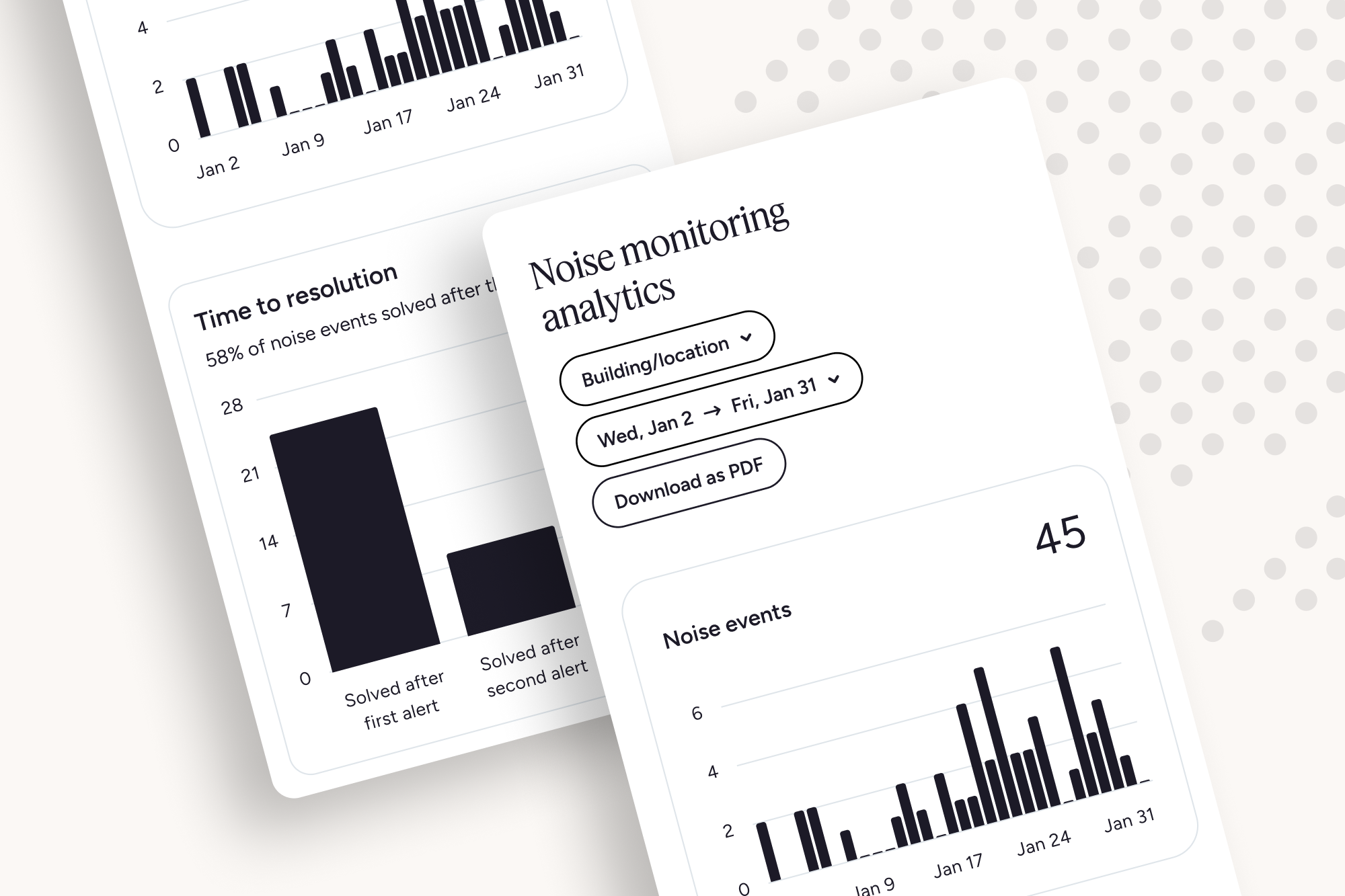
A privacy-safe noise monitoring device lets you maintain an objective standard without recording audio or collecting personal data. Minut’s sensor is built for this exact scenario: it monitors sound levels, identifies sustained noise events, and alerts you and your guests automatically so you can resolve issues quickly and discreetly. Read how our noise monitoring works.
Minut is a camera-free noise sensor device. It measures only sound levels, not conversations, and supports automated guest communication during quiet hours and rules windows so you can protect privacy while staying firmly within noise limits for rentals. If you’re standardizing property noise guidelines across a portfolio, add templates and automations so acceptable decibel levels are enforced consistently, 24/7.
Why “acceptable” readings differ inside vs outside
As noted earlier, indoor readings need to be lower to ensure comfort and compliance, which is why many laws reference measurements inside a receiving dwelling rather than at the source. For example, New York City’s nighttime standard for commercial music is measured inside nearby residences. Other cities specify the property line, a microphone height, and “slow” time response settings.
Why smartphone apps are inaccurate
Phone microphones and app settings are not calibrated for code enforcement. They vary significantly between devices and struggle with low-frequency content. For consistent, objective results, you need a calibrated decibel monitor approach, supported by clear policy and guest messaging.
Preventing noise complaints: best practices for Airbnb hosts
Begin with clarity. Publish guest noise rules in your listing and house manual, and define quiet hours Airbnb guests can follow at a glance. Set expectations on speaker use, outdoor spaces, and late-night gatherings. Then operationalize those rules with automation.
Here’s a simple escalation protocol many professional operators use:
Early warning: A noise monitoring device alerts you when levels approach your threshold for a sustained period, aligned with noise levels by time of day
Automated message: Guests receive a friendly reminder about house rules and quiet hours
Personal outreach: If noise persists, follow up via call or platform message
Guest removal as a last resort: In extreme cases or repeated violations, remove the guest to protect neighbors and comply with local laws
Acceptable decibel levels by scenario
Let’s translate policy into operational targets. The ranges below align with global health guidance and representative city standards, but always confirm your local noise ordinance before finalizing thresholds.
Acceptable decibel levels during the day
For living areas inside a residence, aim to keep short-term activities below roughly 55 dBA during the day, with brief peaks tolerable for normal living. This aligns with the EPA’s 55 dB outdoor benchmark for preventing interference and the general 55–65 dBA daytime bands in many cities.
Acceptable decibel levels at night
At night, shift to a quieter profile. Acceptable indoor decibel levels are commonly in the 40–50 dBA range to protect sleep and comply with local laws. WHO’s Lnight recommendation of 45 dB provides a useful health-based anchor, summarized in the EEA’s overview of environmental noise risks.
Acceptable decibel levels for gatherings
Socializing can push beyond acceptable dB levels quickly. Keep gatherings at conversational levels, mindful that normal conversation sits around 65–80 dB at the source, which could translate to disruptive indoor readings next door without good isolation. If you allow small get-togethers, pair clear guidance with an automated decibel monitor to catch sustained rises before neighbors do.
Acceptable decibel levels for apartment buildings
Be more conservative in higher-density buildings, especially at night. Where a city defines interior caps, adopt them directly into your STR noise policy. San Francisco’s 45 dBA interior night limit in sleeping and living rooms is a good example of how cities translate comfort into enforceable limits.
How Minut helps hosts stay within acceptable decibel levels
Minut makes acceptable decibel levels simple to set, track, and enforce, at scale and with privacy at the core. Here’s how:
Real-time noise monitoring: Minut detects sustained noise patterns, then notifies you with context so you can act before issues escalate. Our devices work indoors and outdoors, filtering out wind and other irrelevant background sounds to reduce false alerts.
Quiet hour alerts: You can define quiet hours rules by property or portfolio. Minut aligns automations with noise levels by time of day, so your guests get nudges only when they need them.
Guest messaging automation: Set friendly, branded reminders to trigger automatically when sustained levels rise above your thresholds.
Evidence for platform or neighbor disputes: If a neighborhood noise complaint is made, objective data can be extremely helpful at defusing tension. Minut’s historical logs provide a clear, privacy-safe record of noise patterns that can help resolve disputes and demonstrate good-faith compliance.
Reducing the risk of fines and penalties: You lower your risk by aligning monitoring with acceptable decibel levels and local dB noise limits. Where cities rely on interior measurements, having calibrated readings from a dedicated noise sensor device keeps you on the right side of enforcement (and on great terms with neighbors).
Final thoughts
Noise compliance is now a core part of hosting — literally, as many locations now make it mandatory. Understanding acceptable decibel levels protects guests, hosts, and neighbors while strengthening your standing with platforms and local authorities. With clear rules, thoughtful quiet hours, and a calibrated noise monitoring device, you can avoid most issues and resolve the few that remain in minutes.
Acceptable decibel levels FAQs
1) What are acceptable decibel levels at night?
Indoors, many operators aim for 40–50 dBA at night to support sleep and align with common enforcement ranges.
3) How can I monitor noise without violating privacy?
Use a privacy-safe decibel monitor that measures sound levels but not conversations. Minut is camera-free and collects only the data needed to enforce acceptable decibel levels.
4) Do cities have different decibel limits for short-term rentals?
Yes. Some cities apply general residential standards, while others include special provisions for amplified sound or use “plainly audible” tests at certain distances. San Francisco’s interior caps and Los Angeles’s “5 dBA over ambient” rule illustrate this variety.
5) What time do quiet hours start for most vacation rentals?
Most operators set quiet hours from 10 pm to 7 am to match common city frameworks and community expectations. The UK’s night noise enforcement reflects a similar nighttime lens.
6) Can guests be fined for breaking noise rules in a rental?
Fines are usually levied on the responsible party under local law, which can be owners, operators, or sometimes guests, depending on jurisdiction and the nature of the violation.





.png)


.png)
.jpeg)