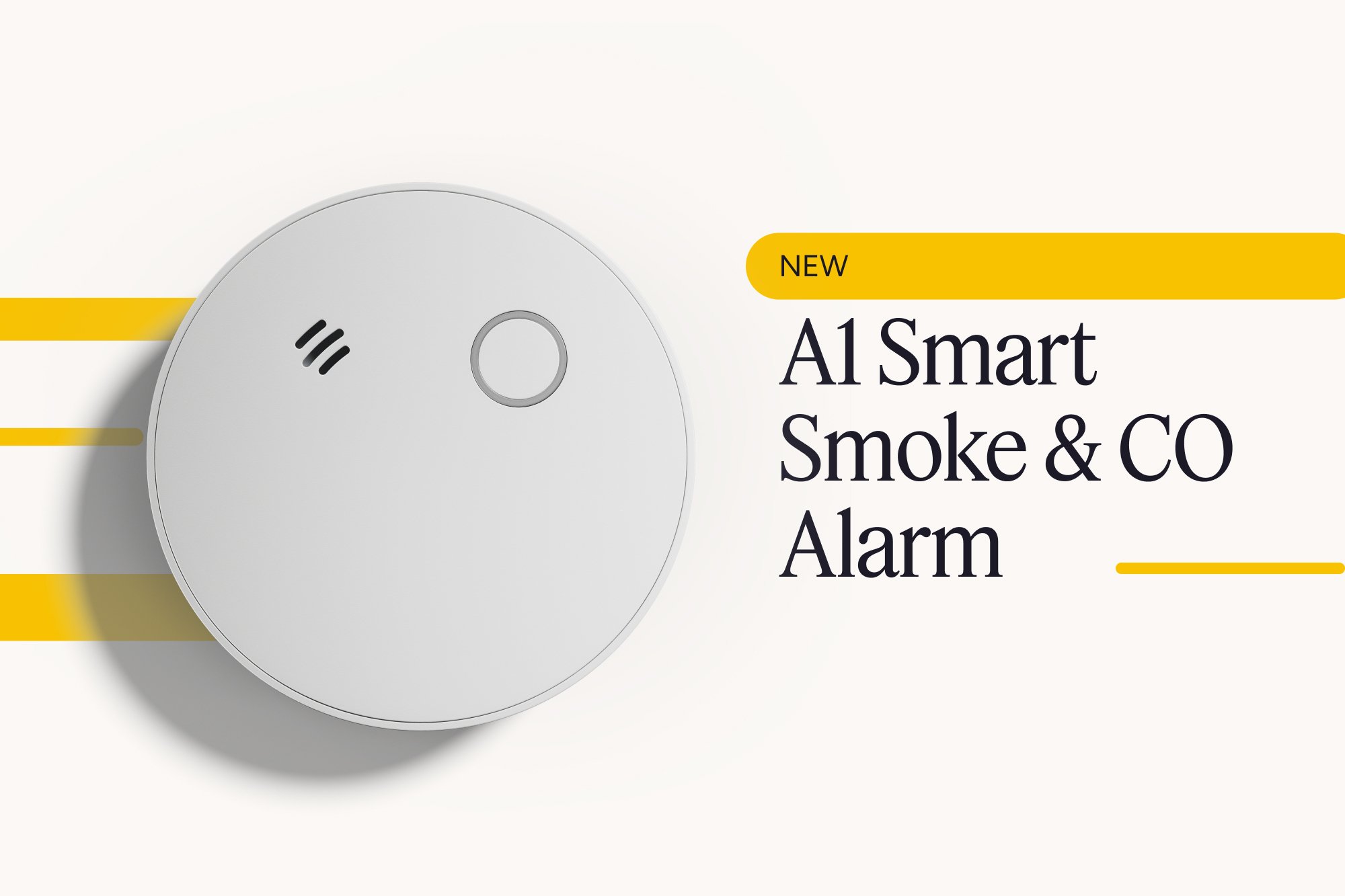
Airbnb safety tips: How to prevent guest incidents and risks
Safety tips for short-term rental hosts, including police-recommended measures like guest screening, clear house rules, and privacy-safe monitoring to prevent parties, noise complaints, and property damage.
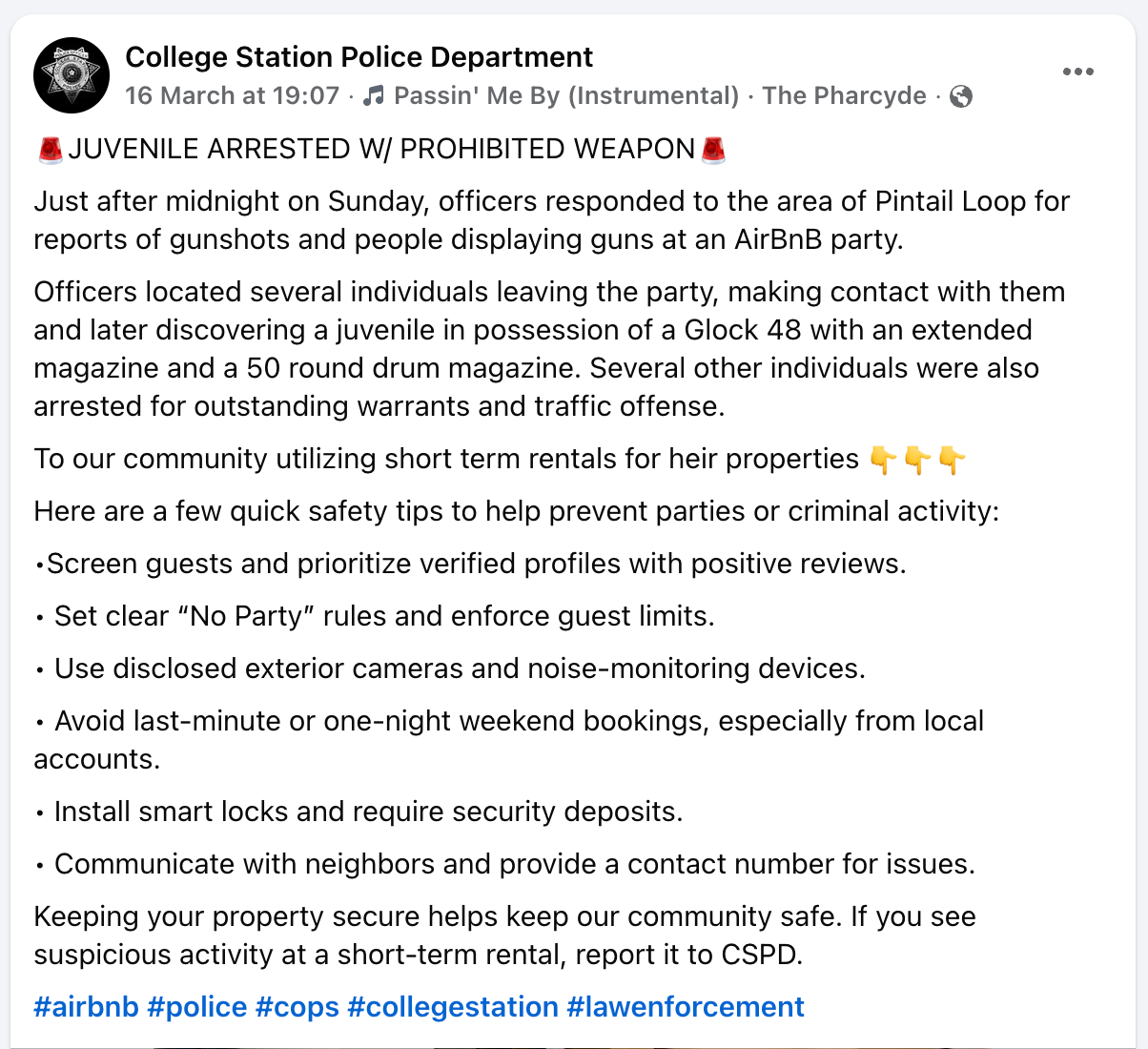
In March 2026, Texas’ College Station Police (CSPD) responded to gunshots and people displaying weapons at an Airbnb party, where they also found a juvenile in possession of a handgun with an extended magazine and a 50-round drum.
Afterwards, CSPD wrote about the incident on its official Facebook page, including suggested vacation rental safety tips to “help prevent parties or criminal activity.” Among the recommendations were “disclosed exterior cameras and noise monitoring devices” as well as enforcing guest limits.
Although incidents like this are rare, the suggestions from the police reinforce the importance of proactive monitoring to help reduce the risk even further, and to put you in a stronger position to intervene quickly if anything does happen.
The hosts who handle safety well have built systems that catch small problems early, communicate clearly, and make compliance easy for guests. These Airbnb security tips show you how.
Airbnb safety tips in brief
Most incidents aren't malicious, they happen because guests didn't know the rules or nobody intervened early enough. The best remedy to this is to set clear rules, communicate early, and monitor responsibly. Establish quiet hours and guest limits, share instructions and emergency details before arrival, and use privacy-safe property monitoring to catch issues like excessive noise before they escalate.
What law enforcement is telling hosts
The College Station PD's recommendations to STR hosts are practical and specific:
Screen guests and prioritize verified profiles with positive reviews
Set clear "No Party" rules and enforce guest limits
Use disclosed exterior cameras and noise-monitoring devices
Avoid last-minute or one-night weekend bookings, especially from local accounts
Install smart locks and require security deposits
Communicate with neighbours and provide a contact number for issues
Rather than being onerous expectations, experienced hosts typically implement most or all of these points over time. But it's particularly notable when it comes from law enforcement, as it highlights how effective seemingly small steps can be. Noise monitoring, in particular, used to feel like an optional extra, but it increasingly looks like standard practice.
Common safety risks Airbnb hosts face
Understanding the pattern of risks is the first step toward addressing them.
Unauthorized parties: Unapproved gatherings create the conditions for damage, noise complaints, and listing suspensions. Airbnb's global party ban has helped but platform-level measures don't replace host-level vigilance. Screening, clear rules, and monitoring remain essential.
Noise complaints and late-night disturbances: Noise is the most common trigger for neighbour escalation. Most of the time it's as innocent as guests losing track of volume, especially later in the evening. That's actually good news, because it means early intervention works, and the right nudge at the right moment resolves most situations before they become complaints.
Over-occupancy: When significantly more people are present than allowed, the risk of damage and noise rises quickly. Clear occupancy rules, communicated upfront and reiterated on arrival, are the first line of defence. Technology that flags unusual crowd levels gives you a heads up before anything escalates.
Property misuse: Issues like indoor smoking, unsafe appliance use, or improper use of hot tubs or fireplaces usually happen because guests weren't told clearly, not because they're trying to cause damage. Good pre-arrival instructions prevent most of it.
Lack of clear rules: Most infractions are entirely preventable. Guests who understand the rules are far more likely to follow them, and upfront clarity also becomes your fair basis for enforcement if you need it.
Airbnb safety tips every host should follow
Now that we’ve looked at the common risks, let’s explore some of the effective ways to mitigate them.
Set clear house rules
The most effective rules are clear and transparent. Ambiguity is where confusion arises, and how disputes can be ruled against you. The rules should include your quiet hours, visitor policies, smoking rules, and check-in/check-out expectations. Share them before booking, reiterate in confirmation messages, and keep a short, friendly version in your welcome guide. The goal is to make compliance easy, not to build a legal document. Clear Airbnb guest rules and house rules examples help guests tounderstand expectations before they arrive.
Prevent parties before they start
Mention no-party rules in the listing, in booking confirmations, and in a brief welcome guide. Repetition in this context isn't nagging, it's making sure guests actually see it. In addition to setting out your rules, you need a way to proactively monitor without relying on neighbors making complaints. Minut’s privacy-safe noise monitoring sends real-time notifications to hosts when sustained noise exceeds your defined threshold and can automatically message guests to ask them to keep it down.
Define guest limits clearly
Airbnb guest limit rules exist for practical reasons: fire code, egress safety, noise, as well as wear and tear. State your maximum in the listing and in pre-arrival communications so guests can plan appropriately. This is also where your insurance policy and local regulations should inform your decision, so ensure you’re aligned with both.
Improve guest communication
The best vacation rental safety tips start with timing. Communicate expectations before booking to avoid mismatches. Before arrival, share access, parking, and appliance instructions. During the stay, keep a responsive support channel open. Guests who feel looked after are more likely to reach out when something goes wrong rather than improvise.
Screen bookings carefully
As a first step, check the ratings and reviews of people who want to stay at your property. Beyond that, watch for last-minute local bookings (especially for large properties), vague or minimal profiles, and single-night weekend requests. Trust your instincts when something feels off.
Responding to incidents
Even with good systems in place, you'll occasionally need to respond to an active situation. The principle is the same as everything else here: early and calm beats late and reactive. If noise monitoring flags a sustained breach, an automated message is the first move. If that doesn't resolve it, follow up directly and personally before the situation escalates further. Keep your messages factual and non-confrontational: you're giving guests the opportunity to correct course, not starting a dispute. If a situation feels genuinely unsafe, that's a matter for local authorities, not a host. Then document everything with timestamps, messages, and monitoring logs so you're protected if a claim or dispute follows.
How technology helps improve Airbnb safety
Think of technology as a co-host that scales your attention without intruding on privacy. The right tools streamline short-term rental management, minimize manual oversight, and elevate compliance with local regulations.
Property monitoring
Proactive property monitoring lets you detect issues early, from sustained noise to more people being present than expected. The principle is simple: get notified when patterns change so you can investigate and resolve quickly.
Environmental monitoring
Temperature and humidity affect sleep, condensation, and mold risk. Keeping indoor climate in range is both a guest comfort win and a preventive maintenance move.
Occupancy awareness
Occupancy monitoring offers a privacy-safe read on crowd risk by assessing device signals in aggregate, without counting or identifying individuals. It’s a smart way to flag potential over-occupancy so you can follow up and reinforce Airbnb guest limit rules before noise or damage occurs.
Positioning Minut in your stack
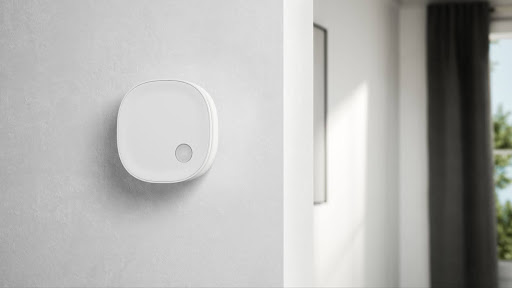
Minut’s sensor analyzes sound locally on the device and can automate outreach the moment a sustained noise event occurs. It also sends real-time notifications to the host, so you can intervene if necessary and keep an incidence log that can be used in a dispute.
Minut M3 sensor
Balancing safety and guest experience
The common themes with these recommendations are clarity and timing:
Guests value transparency and comfort
Neighbors value peace and quiet
Hosts value risk reduction and respect for their property
Privacy-first monitoring aligns with each of these and provides a strong balance between safety and experience. That balance is also compliance-friendly. Airbnb requires clear safety disclosures and local law adherence, and it provides a 24-hour safety line and Neighborhood Support team for community escalations, per the Airbnb host safety policy.
Conclusion
Safety is proactive, not reactive. The hosts who set clear rules, communicate early, and monitor responsibly don't just avoid incidents, they also build listings that guests recommend and platforms reward.
When local law enforcement is recommending the same tools you already have access to, it's a signal worth acting on. Define your guest limits, publish rules that people can follow easily, and use privacy-safe monitoring to catch noise or crowd risk before it becomes a problem.
Airbnb safety tips FAQs
What safety measures should Airbnb hosts have in place?
At minimum: Airbnb hosts should set clear house rules, defined guest limits, emergency information, and privacy-safe noise monitoring. These basics prevent most issues and fulfil your host responsibilities on the platform.
How can Airbnb hosts prevent parties at their property?
To prevent parties at an Airbnb, set expectations in the listing and pre-arrival messages, enforce guest limits, screen bookings carefully, and use noise monitoring guests are informed about in advance. Automated alerts and well-timed reminders de-escalate most situations before they become problems.
How do you handle noisy guests in an Airbnb property?
Proactively try to prevent noise by setting clear rules, and if guests become noisy you can send a prompt reminder and use automated messages when sustained noise crosses your threshold. Most guests comply once reminded, especially when the message arrives early rather than after the situation has already escalated.
Should Airbnb hosts set guest limits?
Yes, setting guest limits is important. Clear occupancy limits are essential for safety and property protection. They deter overcrowding, reduce damage risk, and keep your listing compliant with local regulations and your insurance policy.
How can hosts monitor their Airbnb without invading privacy?
Use privacy-safe solutions and disclose monitoring in your listing. Minut's on-device processing means sound analysis never leaves the sensor, and it never captures audio or video.


.jpg)




.png)