Noise monitoring has become standard practice for short-term rental operators, and two names come up repeatedly: Minut and NoiseAware. Both are privacy-friendly and purpose-built for STRs, but they take meaningfully different approaches to how they monitor, alert, and integrate with your operation. If you're deciding between them in 2026, here's what you need to know.
Minut vs NoiseAware: the short answer for 2026
If you only need basic noise alerts, NoiseAware is a solid pick. But for most Airbnb hosts and professional managers in 2026, Minut offers broader value: privacy‑safe noise and occupancy insights plus indoor climate monitoring, cigarette smoke detection, outdoor filtering that reduces false alarms from wind, automated guest messaging, and services that can call or dispatch help. In a head‑to‑head Minut vs NoiseAware comparison, Minut is the better all‑around choice for scalable, hospitality‑focused operations.
Minut vs NoiseAware at a glance
Both tools help you monitor noise without recording audio. The difference shows up in operational depth.
Feature
Minut
NoiseAware
Real-time noise alerts
Yes
Yes
Privacy-friendly
Yes
Yes
Occupancy insights
Yes
Yes (“CrowdControl”)
Indoor climate monitoring
Yes (temperature, humidity, mold risk)
No
Cigarette smoke detection
Yes
No
Outdoor monitoring approach
AudioID filters wind to cut false alerts
Weatherproof sensor paired to indoor hub
Battery expectations
Up to ~12 months per recharge
Outdoor batteries ~3–6 months
Multi-property management
Strong, hospitality‑first features
Moderate
Mobile notifications
Yes
Yes
Geographic availability
Works globally with a few exceptions
Primarily US and Canada
What this comparison means
Minut and NoiseAware both start in the same place: they alert you when noise stays too high for too long. That alone can help hosts step in before a situation escalates.
From there, the products separate. NoiseAware keeps the focus narrow, with noise monitoring and occupancy signals. Minut gives hosts more context around the stay, including indoor climate and cigarette smoke detection.
If you’re choosing the best noise monitor for Airbnb in 2026, your decision comes down to whether you want only a noise alarm or a wider lens on the stay.
Minut vs NoiseAware: feature comparison
Noise monitoring capabilities
Both platforms deliver real‑time alerts when noise stays above a chosen threshold, without recording conversations.
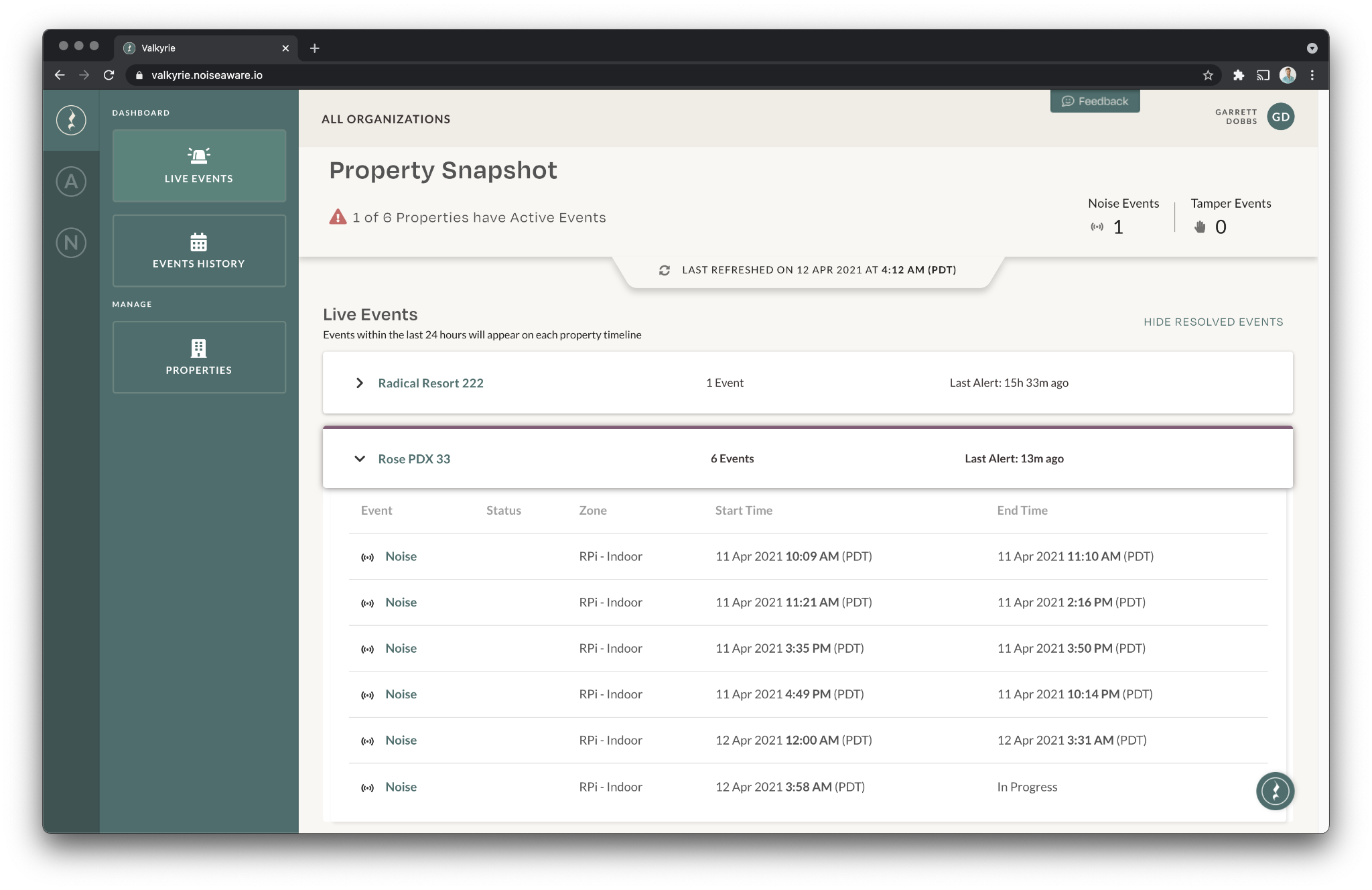
Image via NoiseAware
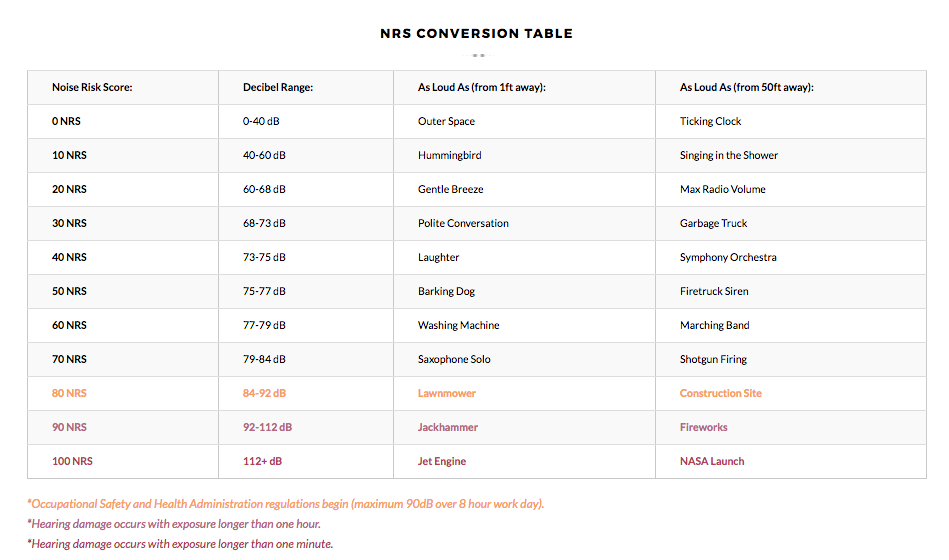
NoiseAware is built around contextual noise alerts. Its “Noise Risk Score” looks at both volume and duration, which helps hosts avoid reacting to every short spike. This is important because a dropped pan or a burst of laughter shouldn’t trigger the same response as a party happening after quiet hours.
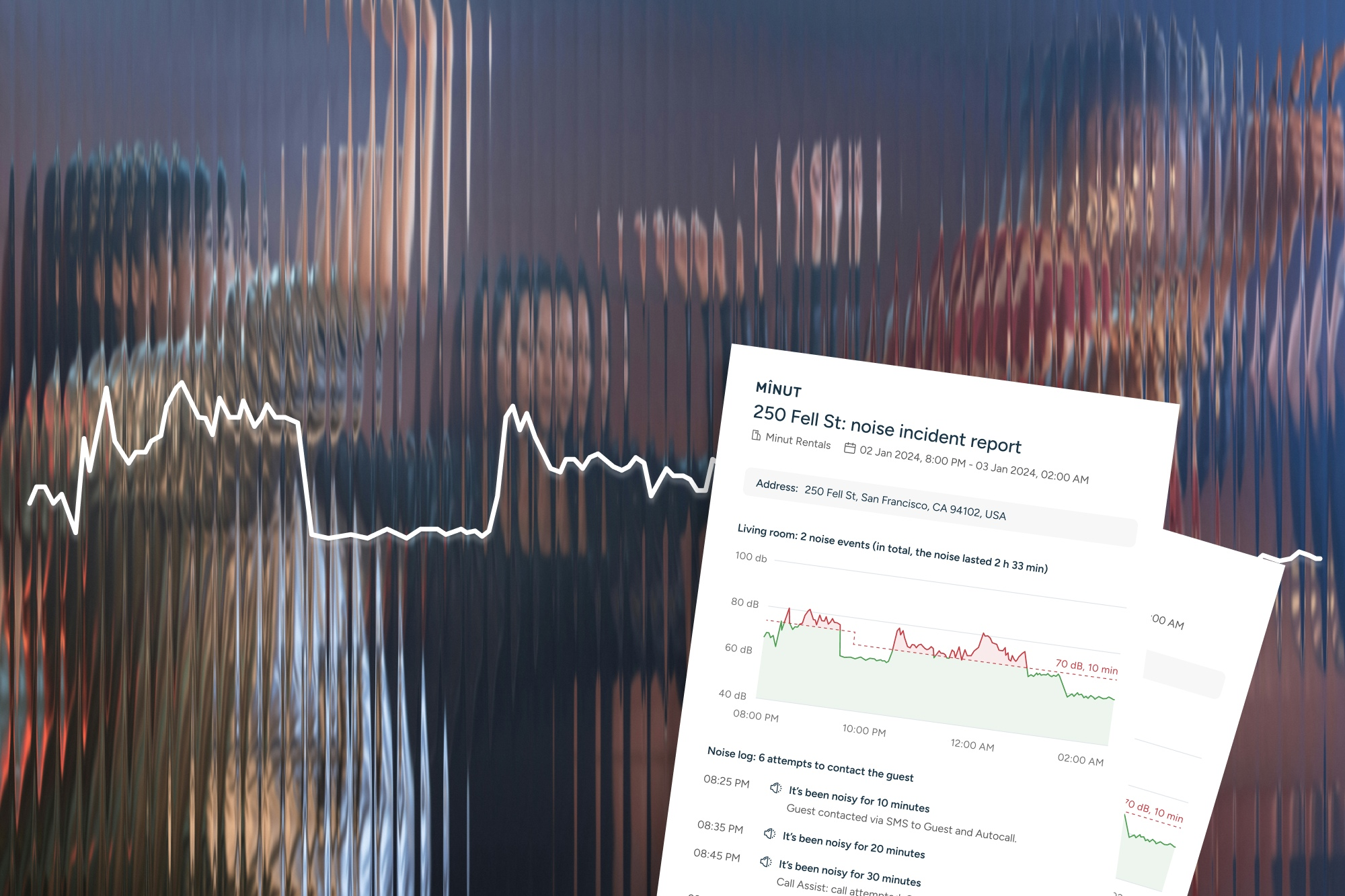
Image via Minut
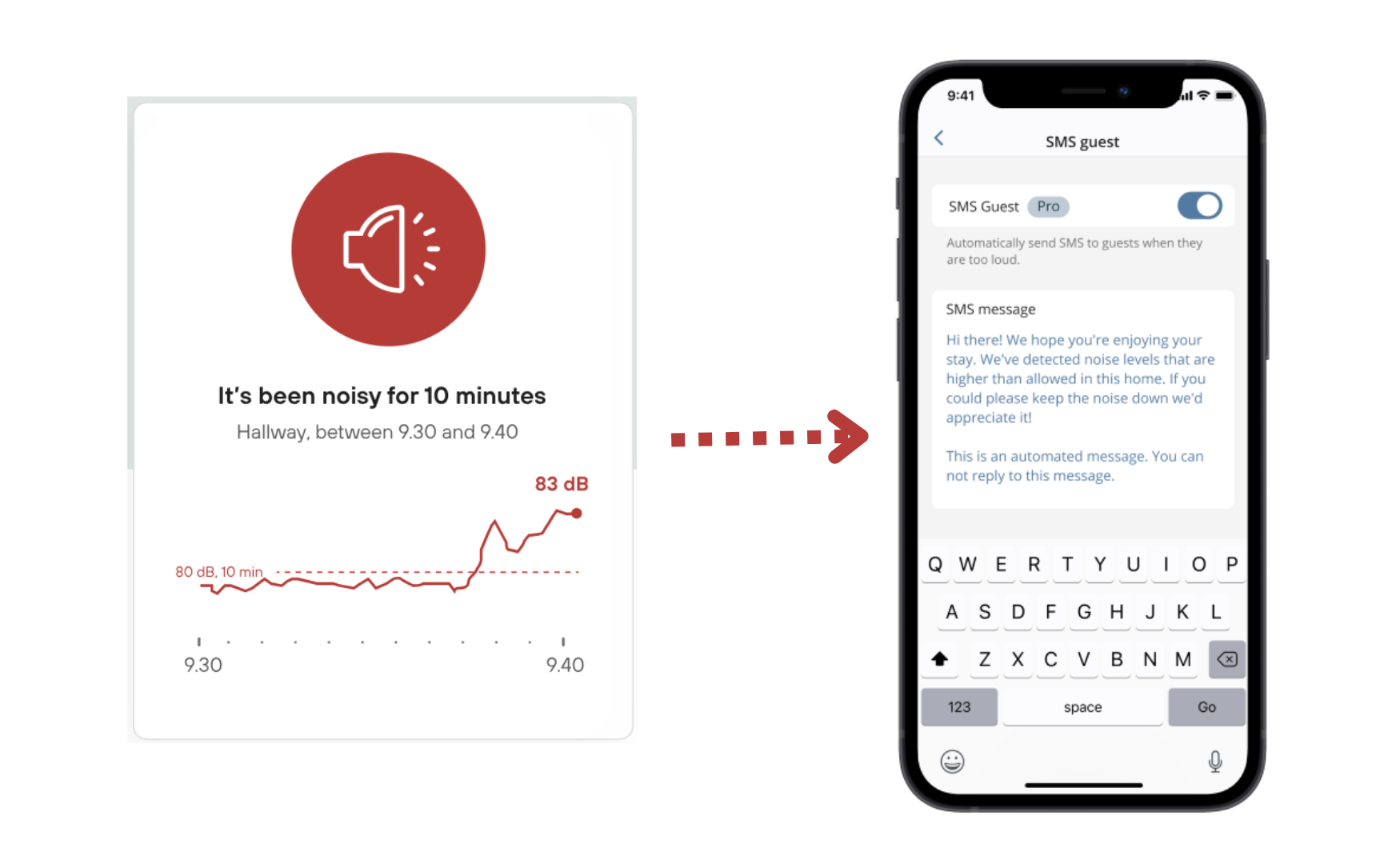
Minut also supports custom thresholds by time of day and property. The difference is what can happen next. When noise limits are exceeded, the platform can message the guest, trigger a visual or sound alert on the device, and even place an automated phone call to guests. For many hosts, this means fewer late-night interventions.
Escalation is useful when a text isn’t enough. Minut adds optional Call Assist and Guard Assist, where trained operators can step in to manage issues by phone or in person — particularly useful if you’re managing across time zones.
Privacy and guest experience
Both solutions are privacy‑safe by design, with neither using cameras or recording audio.
NoiseAware focuses on sound patterns, not the conversation itself. The device measures how loud the property gets and how long the noise lasts, then alerts hosts when levels cross the chosen threshold.
Minut follows the same privacy principle across a wider set of signals. Because it tracks levels, trends, and environmental signals rather than content, it fits the privacy expectations set by Airbnb and many municipalities. In practice, this improves guest experience: automated messages feel like a polite reminder rather than surveillance.
Occupancy and property insights
NoiseAware can tell hosts when a property may be getting crowded through its “CrowdControl” feature. Minut goes further by combining this occupancy awareness with noise, motion, and climate data, helping hosts spot signs of a party earlier.
Managers often connect these insights with automated messaging tied to their booking calendars and smart locks, which Minut supports through native Airbnb and PMS integrations.
Indoor climate and additional monitoring
Minut’s all‑in‑one sensor also tracks temperature, guest smoking, humidity, mold risk, and device tampering. For hosts, that means the same device can protect comfort, house rules, and property conditions.
NoiseAware focuses on noise and occupancy monitoring with automated guest messaging, which may be enough if you only want a straightforward Airbnb noise monitoring device.
Outdoor monitoring and false positives
Outdoor spaces create a unique challenge: wind, traffic, and distant music can trip thresholds even though guests aren’t making noise.
Minut’s solution to this is AudioID, which filters out background wind and environmental noise so that it only alerts when guest noise is the issue.
NoiseAware also monitors outdoor noise, but it requires a separate weather‑resistant outdoor sensor that must remain within 100-150ft of your indoor sensor.
Multi‑property management experience
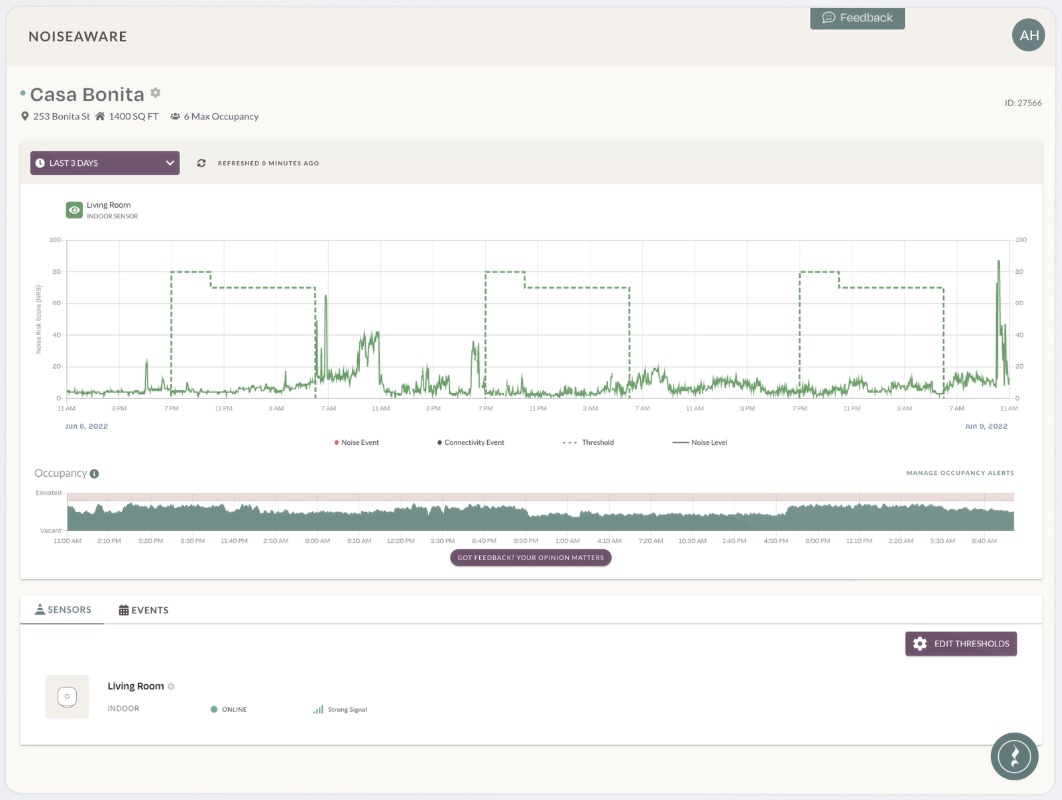
Both platforms have web and mobile dashboards that let you see each property at a glance.
Image via NoiseAware
NoiseAware works well if you want a simple view of noise and occupancy alerts.
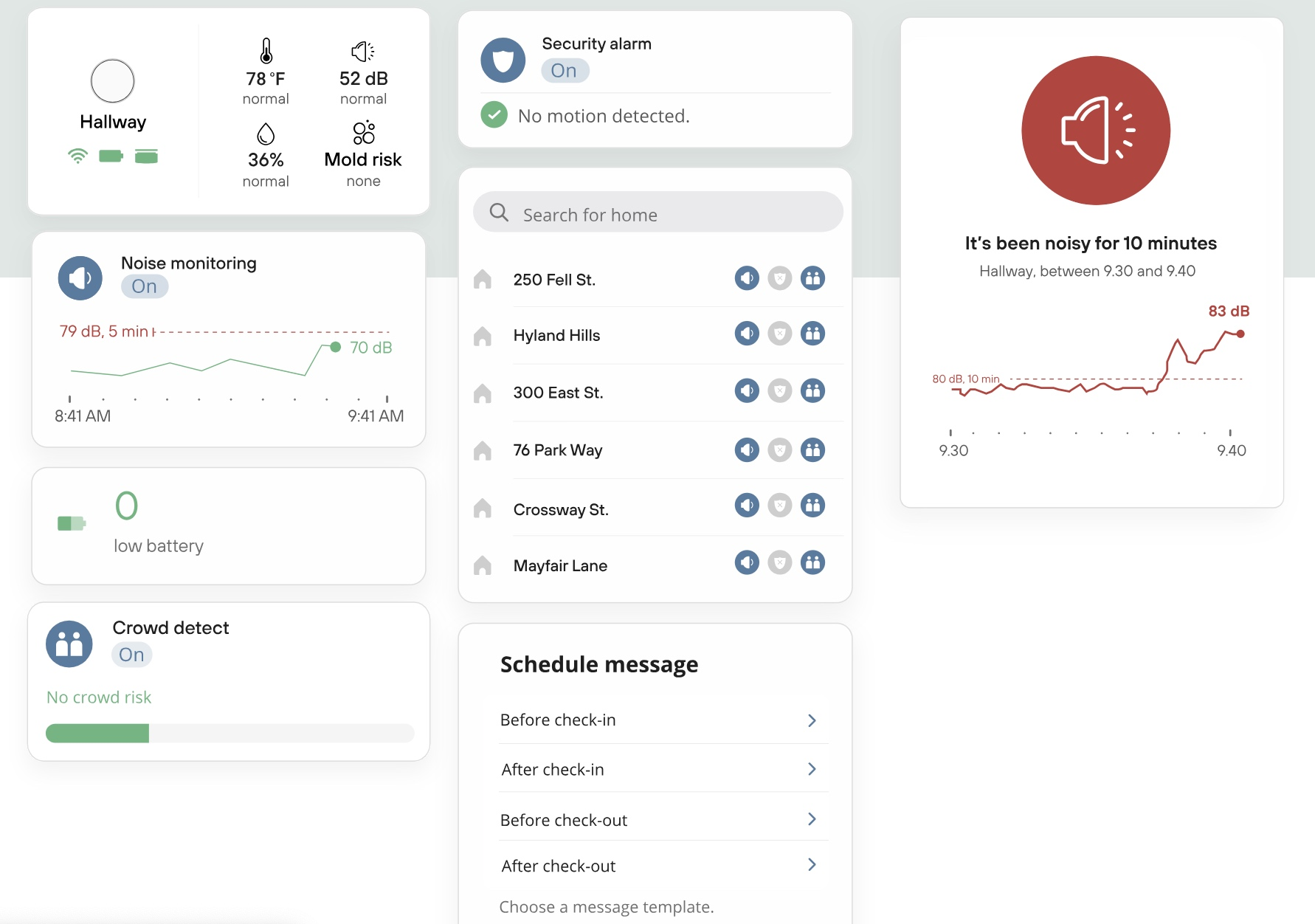
Image via Minut
Minut has a more comprehensive suite, with automation for guest communications, escalation services, and over 30 integrations with Airbnb, PMS systems, smart locks, and more. For end‑to‑end short‑term rental management, that consolidation saves hours and helps teams scale without increasing headcount.
Minut also has Tasks, a software solution that enables you to put operations on autopilot. Teams and jobs can be managed on a per-property basis from the app, and you can quickly see if a unit is ready for a guest to check-in, if a repair has been completed, and if a clean is up to your standards.
Pricing is another important difference between Minut and NoiseAware, especially for hosts managing several properties.
NoiseAware
Indoor and outdoor sensors: $99 one-off cost
Subscription: $15/month, billed annually at $180 (up to nine properties) and includes one indoor sensor per property
Custom pricing for larger portfolios
Minut
M3 sensor: $100 one-off cost
Subscriptions:
Starter: $5/month, billed annually at $60
Standard: $10/month, billed annually at $120
Pro: $15/month, billed annually at $180
Optional add-ons:
Water leak sensor: $25
Call Assist: $10/month/rental unit
Minut vs NoiseAware for different hosting needs
Best for single Airbnb hosts
For single-property hosts, NoiseAware’s simplicity will appeal if the main concern is loud guests. Minut is the better fit if you want the same device to cover more than noise, including climate and guest smoking.
Best for multi‑property managers
Minut has the stronger setup for hospitality teams, with its integrations, portfolio dashboard, automated messaging, escalation options, and Tasks. They make it easier to manage noise issues across a portfolio of properties without checking each one manually.
Best for luxury and premium rentals
Premium stays live and die by the guest experience. You want party prevention and guest comfort in one view. Minut’s indoor climate data, cigarette smoke detection, and AudioID outdoor filtering protect ambiance and relationships with neighbors. For teams standardizing across a brand, these extra signals make it easier to deliver consistent service at scale.
Minut’s Guest app also gives guests a stay that feels like home, with access to smart devices including smart locks and Ring doorbell and security cameras, as well as your digital guidebook.
Pros and cons of Minut vs NoiseAware
Minut
Pros
Broader vacation rental monitoring, including noise, occupancy, climate, cigarette smoke, and tamper alerts
Stronger fit for multi-property managers thanks to PMS integrations, automated guest messaging, and escalation services
Tasks and Messaging streamline your operations
Battery lasts up to a year between charges
Cons
May be more than some single-property hosts need
NoiseAware
Pros
Easy setup and clear dashboard
Indoor and outdoor sensor options
Straightforward pricing for up to nine properties
Automated guest messaging
Cons
Fewer features beyond noise and occupancy
Outdoor sensor requires a connection to indoor sensor
Minut vs NoiseAware: which one should you choose?
Choose Minut if…
You want broader property visibility in a single device: noise, occupancy, indoor climate, cigarette smoke, and security‑adjacent alerts
You manage multiple rentals and need automation that scales across Airbnb and your PMS
You prioritize guest experience and want privacy‑friendly monitoring with polite, automated outreach and optional professional escalation
Choose NoiseAware if…
You need basic noise monitoring only and prefer a focused tool
Your portfolio is concentrated where NoiseAware is officially available
Final recommendation
This Minut vs Noiseaware comparison shows both products can stop noise before it becomes a complaint. But for 2026, Minut’s all‑in‑one approach gives managers more context around each stay, produces fewer false outdoor alerts, helps hosts to deliver a consistent experience in every stay, and offers services that keep your team off the phone at midnight.
Minut vs NoiseAware FAQs
What is the difference between Minut and NoiseAware?
Both provide privacy‑friendly real‑time noise and occupancy alerts. Minut adds occupancy insights, indoor climate data, cigarette smoke detection, device tamper alerts, AudioID outdoor filtering, and escalation services.
Is Minut better than NoiseAware for Airbnb?
For managers who want more than noise alerts — such as occupancy awareness, indoor climate, and cigarette smoke detection — Minut is the stronger choice in 2026. If you only need simple noise alerts, NoiseAware is a solid option.
Which is more privacy‑friendly, Minut or NoiseAware?
Minut and NoiseAware are comparable in terms of privacy. Both measure noise trends without recording audio or using cameras.
Does Minut offer more features than NoiseAware?
Yes. Minut combines noise and occupancy with indoor climate monitoring, cigarette smoke detection, device tamper alerts, and optional Call/Guard Assist.
Which is better for vacation rental property managers?
Minut is the better choice for vacation rental property managers. Its hospitality‑focused integrations with Airbnb and PMSs, automated guest messaging, professional escalation services, and operational automations support portfolio‑level operations.
Can Minut and NoiseAware prevent Airbnb parties?
They reduce risk through real-time alerts and automated guest nudges, allowing hosts to intervene before things get out of hand.
Do Minut and NoiseAware record conversations?
No, Minut and NoiseAware are both privacy‑safe, measuring sound levels and trends without recording or listening to conversations.


.jpeg)



.png)


.jpg)