Smoking in hotels: why traditional no‑smoking policies aren’t enough
Smoking in hotels continues to create guest complaints, cleaning costs, and revenue loss. Learn why traditional no-smoking policies aren't enough and how hotels can prevent violations proactively.
Housekeeping opens the door and knows right away: someone smoked. The room was labeled as non‑smoking but the guest has already left, and the next arrival is due in four hours. Curtains, duvet, and HVAC hold onto the smell. You have to leave the room out of service, shuffle arrivals, comp a late checkout across the hall, and start odor remediation. You’ll charge a smoking fee, but it often doesn’t cover the cost of staff having to work overtime, room downtime, and a complaint that will live in your hotel reviews far longer than the charge in the PMS.
This article will explore why smoking can continue to be a problem in hotels even with no-smoking policies, and how to improve preventive measures that help you avoid the cost and inconvenience of cleaning rooms that guests have smoked in.
Hotels have more no‑smoking policies than ever. So why is smoking still a problem?
Over the last decade, smoke‑free hotels have become the default in many places. Policies sit on OTAs, are mentioned at booking, and appear on in‑room signage. Awareness isn’t the gap. Brand standards, corporate travel policies, and city ordinances all reinforce the same message. Lack of communication is the exception, not the norm.
But… rules don’t always influence guest behavior
Some guests still take their chances. It’s often late‑night smoking, a “just one cigarette by the window” moment. Visibility of the rules doesn’t equal compliance when the perceived risk is low and enforcement only lands after checkout. That’s why cigarette smoking in hotels persists even when the hotel smoking policy is crystal clear.
Enforcement often happens after the fact
The real challenge is timing. Most hotel smoking violations are discovered during room turnover, but by that point the odor has already started to settle into carpet, curtains, and other soft furnishings. You’re reacting rather than preventing. The guest has already left, and meanwhile, operations absorb the hit.
The cost of smoking violations
A $200 or even $500 smoking charge won’t make your room available for the night. Fees attempt cost recovery, but they don’t prevent the damage or the disruption. Here’s what a smoking violation can end up costing you:
Cost
Impact
Prevention-focused approach
Deep cleaning and odor remediation
Extra labor hours, ozone/hydroxyl treatment, repeat inspections
Before escalation
Room downtime
Room becomes out of service for hours, even days
Improved experience
Guest compensation
Refunds, relocation, comped breakfasts, upgrades
Reduced
Review impact
Public complaints that affect average score and future bookings
From policy enforcement to prevention: a new approach
Traditional hotel strategy: Most hotels start with the same toolkit of having their policies in booking flow, signage in rooms, a stated fee, and manual inspections. Although these are all necessary, none of them change the simple fact that most violations are discovered late.
Modern prevention strategy: Hotels are shifting toward earlier awareness, faster response, and incident documentation that reduces disputes. Privacy‑safe smoke detection for hotels provides the visibility needed to interrupt behavior before it becomes a problem.
Factor
Traditional enforcement
Prevention‑focused approach
Awareness
After violation (turnover)
During incident (real‑time alert)
Guest impact
Higher (odor carries to next stay)
Lower (intervene before transfer)
Cleaning costs
Higher (deep cleans, ozone, repeats)
Lower (shorter sessions needed)
Room downtime
More likely (out of order)
Less likely (room stays available)
Review risk
Higher (public complaints)
Lower (odor doesn't reach next guest)
What hotels should look for in a smoking prevention solution
Real‑time visibility
You need an alert during the incident, not at noon the following day. Look for smoke detection technology that timestamps events and supports quick outreach — this documented log helps you to support claims and enforce smoking fees.
Privacy‑friendly monitoring
Guest trust hinges on how you monitor. The right solution monitors the environment, not the guest. That means no cameras and no audio recordings, just environmental signals that indicate cigarette smoke and noise thresholds.
Scalability across multiple rooms
A solution for a single room isn’t useful if you manage multiple rooms. You want portfolio visibility and consistent rules across floors and buildings.
Integration into daily operations
Front desk and night audit need a clear path to respond. Alerts should route to the teams on duty, with templated outreach language and incident logging. Look for dashboards that show room status and event history so you can coordinate follow‑up without extra calls.
Also, ensure that any cigarette detection sensor complements, rather than replaces, your life‑safety smoke alarms. A cigarette smoke device doesn’t replace a code‑compliant smoke alarm. You need both, as each serves a different purpose.
How Minut helps hotels move beyond traditional no‑smoking policies
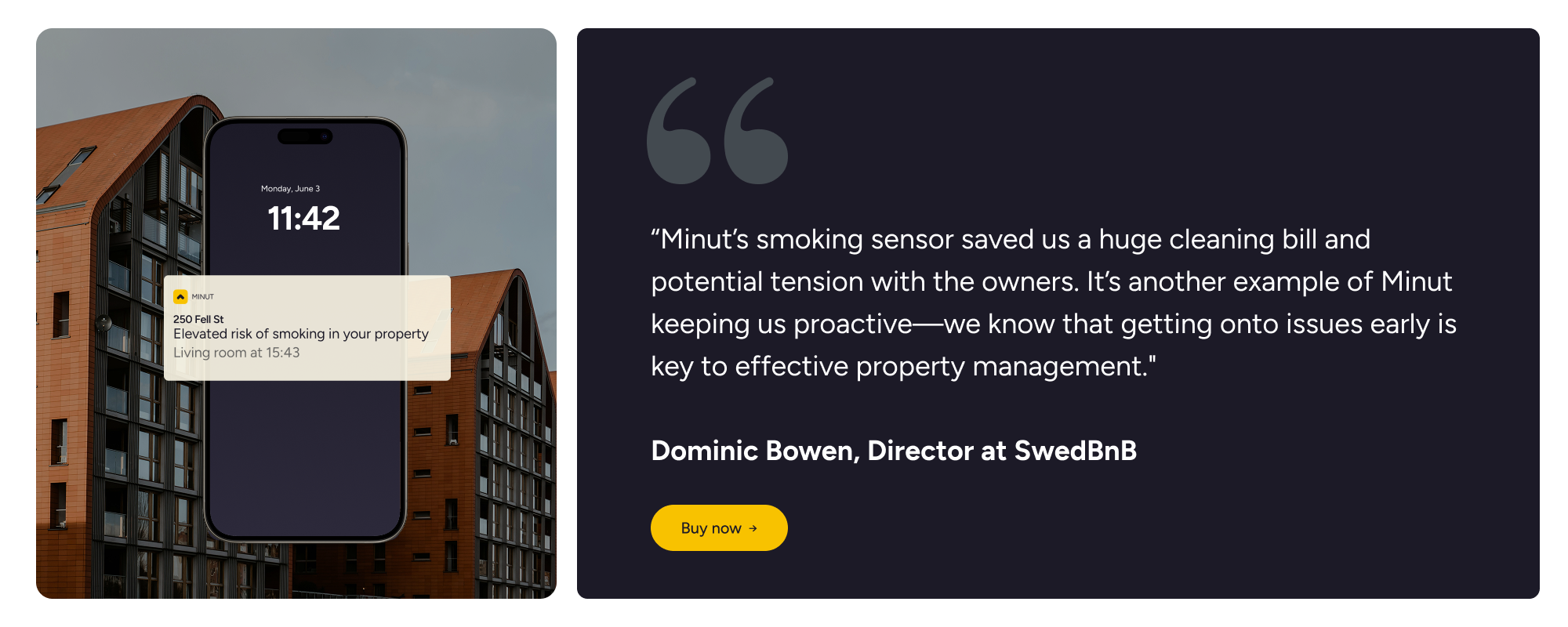
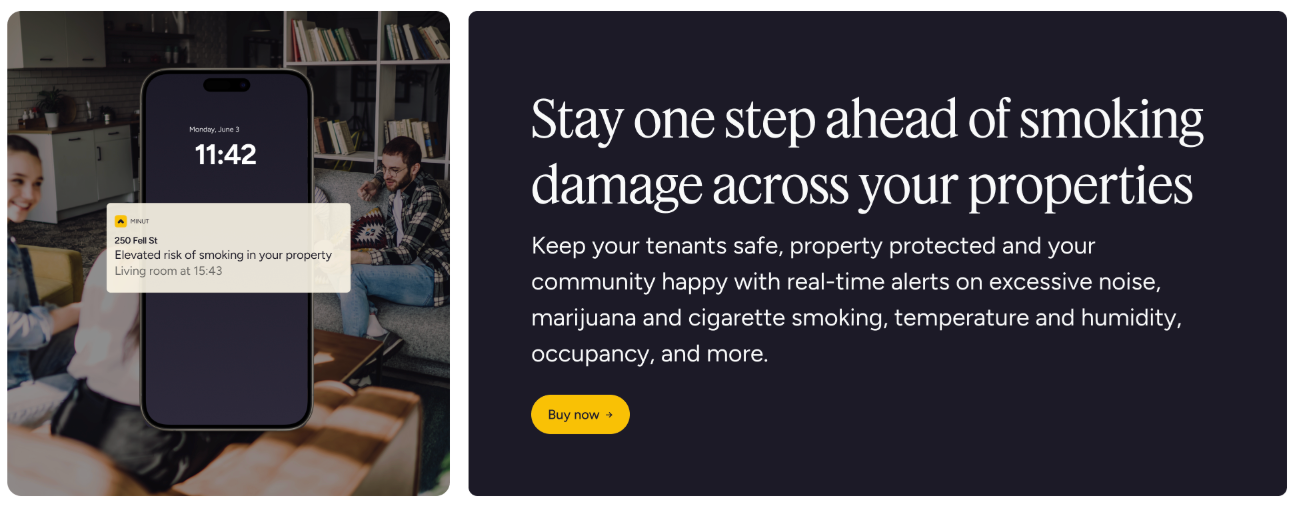
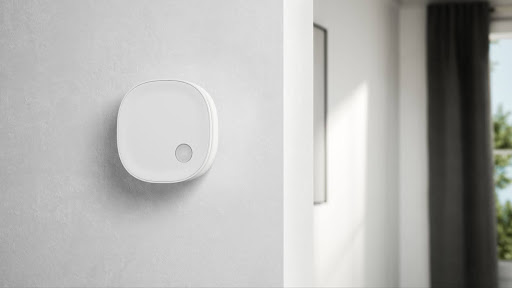
Minut’s approach is built for hospitality operations. The sensor monitors the environment and sends real-time alerts if it detects an elevated risk of cigarette smoke, without recording audio or video. It also measures decibel levels like a sound meter for noise control. That mix supports prevention across smoking and late‑night disturbances while respecting guest privacy.
Detect smoking events earlier
Minut’s cigarette detection is designed to identify and timestamp smoking activity while the guest is still in the room. That gives your team a chance to call, message, or visit with a gentle reminder of the hotel smoking policy and directions to outdoor areas.
Reduce room downtime and cleanup costs
When you shorten or stop a smoking session mid‑stay, you avoid the deep clean that turns a standard checkout into a mini project. Fewer soft goods need treatment, ozone windows are shorter, and room downtime shrinks — if any of these are needed at all.
Support better guest experiences
Cleaner rooms and quieter nights lead to better survey results and fewer public complaints. Prevention means the next guest never smells smoke, which protects brand standards and your ranking on OTAs. It also reduces neighbor‑to‑neighbor friction in aparthotels, where drift can affect adjacent units.
A practical smoking prevention checklist for hotels
Use this as a quick run‑through with your team. The goal is simple: shorten or stop the behavior while it’s happening and document the incident for policy enforcement.
Clear smoking communication: Put your hotel smoking policy in pre‑arrival emails, on OTA listings, and on a simple in‑room card. State the fee, the reason for the rule, and where they should go when they want to smoke.
Staff training: Give front desk and night audit a short script for in‑stay outreach. Keep it courteous and specific.
Incident documentation: Save timestamps, room numbers, and notes. Attach photos during turnover. Keep a central log to support disputed smoking fees and reduce chargebacks.
Room inspections: Add a quick smoke check to any “early clean” workflow when a guest departs ahead of schedule.
Guest education: Explain that the policy protects everyone’s stay, especially families and guests with respiratory issues. Include a reminder during check‑in when keys or digital codes are issued.
Real‑time monitoring: Use privacy‑safe cigarette detection in higher‑risk room types first, then scale.
Consistent enforcement: Apply fees consistently and pair them with documentation. Over time, this deters repeat offenders and supports fair policy enforcement.
Conclusion
Most hotels already run a tight hotel no‑smoking policy. The problem isn’t the wording on that policy, but a lack of insight into guest behavior. Smoking in hotels keeps happening because staff are unaware when it’s happening, so enforcement typically starts after checkout, when the odor and the damage are already there. That’s what drives room downtime, labor spikes, and public complaints.
Earlier awareness helps you get ahead. When you get real‑time awareness during the incident, you can contact the guest before the incident becomes a turnover problem. You also gain the timestamped record that supports claims and consistent policy enforcement. Add privacy‑friendly sensors that monitor the environment rather than the guest, and you’ve got a practical path to fewer smoking complaints in hotels, less odor remediation, and stronger reviews.
Smoking in hotels FAQs
Why is smoking in hotels still a problem?
Smoking in hotels can still be a problem because most detection is delayed. Policies and signage are visible to guests, but violations are usually only discovered during turnover. Real‑time alerts during the stay let teams intervene before odor spreads and before the next guest is affected.
How do hotels enforce no‑smoking policies?
Hotels state the rules at booking and check‑in, on signage, and stated smoking fees with incident documentation. Increasingly, they add privacy‑safe smoke detection for hotels to gain timestamped proof and earlier awareness, which strengthen policy enforcement.
Why do hotel smoking violations continue despite penalties?
Fees are reactive. If guests don’t believe they’ll get caught, fees are unlikely to influence their behavior. Earlier visibility and a quick, respectful outreach are what reduce cigarette smoking in hotels during the stay.
Can hotels detect cigarette smoke in guest rooms?
Yes, with the right tools. Privacy‑friendly sensors like Minut’s can detect and timestamp smoking activity without recording audio or video. That creates a clear signal for outreach and a record for fees or claims.
What is the best way to prevent smoking in hotels?
The best way to prevent smoking in hotels is to combine clear communication, designated outdoor options, and real‑time environmental monitoring. Early alerts let staff intervene, limit exposure, and document the event. This reduces odor remediation and protects the guest experience.