How to prevent smoking in rental properties without affecting guest experience
Learn how to prevent smoking in rental properties with clear rules, smart monitoring, and guest-friendly strategies that protect your space from damage.
You open the door after checkout, and it hits you. The stale odor of cigarettes. A faint yellowing on the drapes. Ash ground into the planter on the balcony. Now the clock starts: deep cleaning, ozone treatment, deodorizing the HVAC, and messaging your next arrival to push back check-in. What looks like a simple rule violation quickly becomes a recurring operational problem that eats into margins and guest satisfaction.
The reality is that smoking in rental properties isn’t just a housekeeping nuisance. It puts property value at risk and drags down occupancy, and it’s behind a disproportionate share of disputes and negative reviews. Preventing it takes more than a “no smoking” line in the listing. It takes clear rules and thoughtful guest guidance backed by real-time visibility that lets you intervene early without introducing friction or compromising privacy.
Why smoking in rental properties is a bigger problem than it seems
Smoking in rental properties is often underestimated because its damage compounds quietly. But even one incident can leave a residue that lingers through multiple stays, causing longer turnover times and a guest experience that takes the hit.
Long-term property damage
Nicotine and tar absorb into soft furnishings, paint, and porous surfaces. Over time, that residue discolors walls and ceilings and leaves the cigarette smoke smell rental property owners dread. It also rides the air through vents and returns, affecting HVAC coils and filters. The choice becomes deep cleaning and repainting or replacement.
Impact on guest experience and reviews
The lingering odor is not just unpleasant. It signals a lack of care and instantly devalues the stay in the eyes of the next guest. Sensitive travelers or families with children are especially averse to smoke exposure. Negative reviews and refund requests can follow, and repeat bookings become less likely. This is why smoking in a rental property is a reputation issue as much as it is an operational one.
Ongoing maintenance and operational costs
Even if you avoid repainting, you’ll face more frequent filter changes and deodorization treatments on top of longer turnovers. Over a season, the incremental minutes and materials add up and compound wider rental property maintenance challenges. That hidden downtime is what eventually pushes operators toward a property prevention system instead of one-off fixes.
Why traditional no-smoking rules often fail
It’s common to publish a strict rule and still end up dealing with smoke after checkout. Here’s why:
Guests ignore or misinterpret rules
Some travelers skim listings and house manuals. Others assume rules are flexible or that vaping and cannabis are exempt. Ambiguity creates room for rationalization. Clear, explicit wording that covers all forms of smoking helps, but it is only one layer.
Lack of real-time enforcement
Most hosts only discover issues after key return. That delay forces you into remediation instead of prevention. Without real-time visibility during the stay, even strong policies can fail.
Gap between policy and guest behavior
Rules exist, but they often aren’t reinforced at the right moments. Effective guest behavior management is about timely, friendly nudges that keep expectations top of mind.
Set clear and visible no-smoking policies
The right policy framework filters out unwanted behavior long before check-in.
Where to communicate the rules
Make your no-smoking policy rental property rules visible across the guest journey. State it in the listing, confirm it in the booking confirmation, and include it in pre-arrival messages. For platform stays, align with Airbnb smoking rules and reinforce them in the house manual. Airbnb encourages hosts to state their no-smoking policy clearly in multiple touchpoints and explain the consequences for breaking it.
How to write effective house rules
Keep your house rules simple, direct, and complete. Specify that smoking, vaping, and cannabis are not permitted indoors and clarify where outdoor smoking, if allowed, is acceptable. State the consequence for violations in a matter-of-fact tone. If you operate on Airbnb, ensure your Airbnb house rules smoking language matches the listing and any digital welcome book, and remember that evidence will be required if you need to file a claim.
Reinforcing rules during the stay
Guests respond well to friendly, non-intrusive reminders at check-in and the first evening. A short arrival message works well: “Just a reminder that the property is smoke-free indoors. If you need to smoke, please use the outdoor area and keep doors and windows closed.”
Many operators pair their no-smoking policy with quiet-hours guidance to set a respectful tone.
Improve guest communication without creating friction
Communication can reduce violations without adding pressure when it is timely and empathetic.
Setting expectations before arrival
Be explicit about what is and isn’t allowed, and where smokers can go instead. This is how you prevent smoking in rental property environments without managing every guest individually.
Using friendly and non-intrusive messaging
Your tone is important, and can be a factor in encouraging guests to comply with your rules. Swap warnings for appreciation and clarity. A short, scheduled message on arrival that restates the key dos and don’ts keeps rules visible without sounding controlling.
Understanding why violations happen lets you design them out.
Lack of designated smoking areas
When smokers don’t know where to go, they make their own plan. Clear, accessible, and comfortable outdoor options reduce temptation.
Convenience and weather factors
Nobody wants to stand outside in the cold rain or take long walks to the curb, and if they’re the only options then some guests will be tempted to light up inside. Make the compliant choice the easy one by providing more convenient options for guests to smoke outside even in bad weather.
Unclear property boundaries
In apartments and multi-unit buildings, clear signage helps guests understand whether balconies, courtyards, and shared areas are included in the no-smoking policy.
Provide practical alternatives for guests
Creating designated outdoor smoking areas
Where local rules allow, set up a small table and two chairs, place an ashtray, add an overhead covering to protect from rain, and add simple guidance in the house manual. Keep it as far from openings and neighbors as practical. Define quiet hours here, too, to keep peace.
Adding clear signage and instructions
A discreet, well-designed sign near the exit and in the welcome guide is usually enough. Visual cues like this support compliance by regularly reminding guests of expected behavior.
Why detection matters more than just rules
Most problems surface after checkout. The problem is that by then, odor has set into fabrics, and remediation takes hours. In multiunit buildings, neighbors might complain long before you discover the source.
Late discovery means deep cleaning, repainting, and lost revenue from downtime. It also creates disputes, as claims must be submitted fast and backed by evidence. On platforms like Airbnb, hosts need to submit documentation within 14 days through the Resolution Center, ideally with photos, invoices, and detector alerts.
How Minut helps detect and prevent smoking in rental properties
Policies need verification to work, and that’s where Minut comes in.
Smart smoking detection without cameras
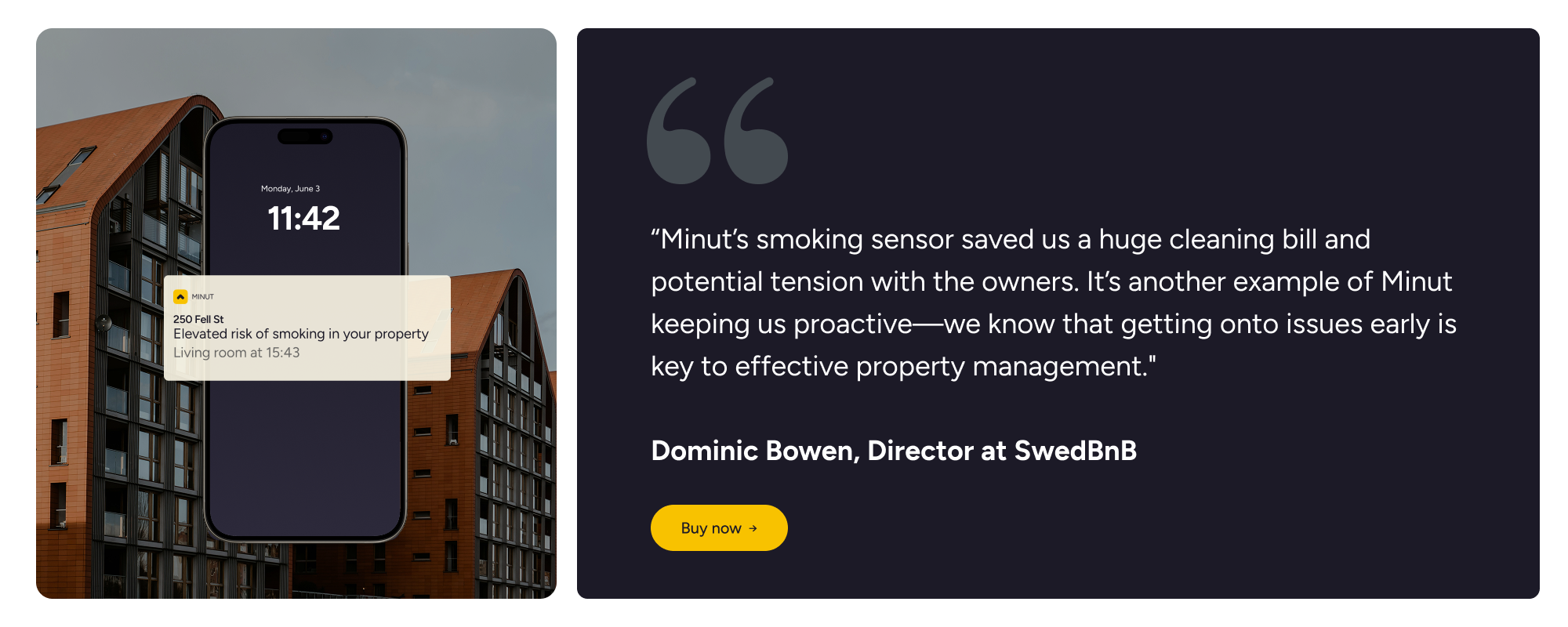
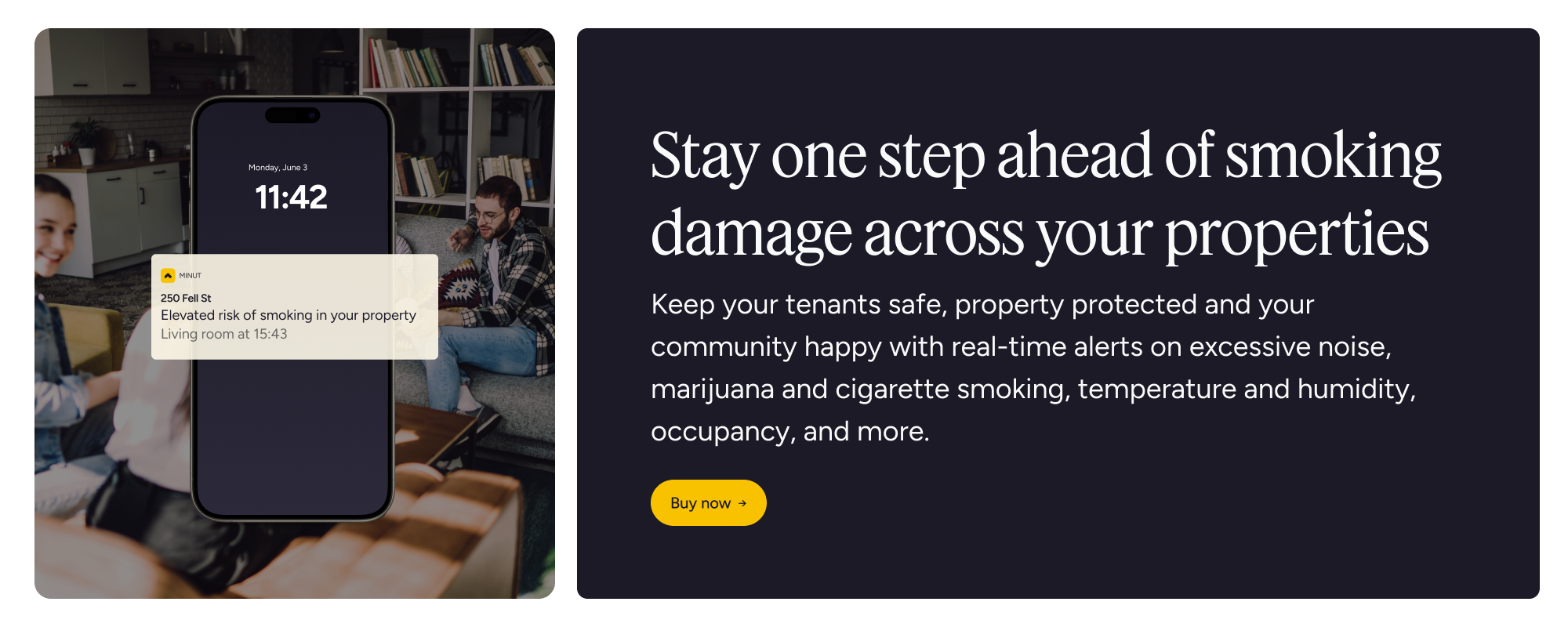
Minut delivers privacy-first smoking detection without cameras or audio recording. Our approach monitors environmental changes associated with guest smoking and alerts you in real time, so you can message guests early and protect the stay.
Powered by the Minut M3 sensor
The Minut M3 sensor measures indoor air conditions, temperature, humidity, and provides noise and occupancy insights that help you catch related risks like parties or over-occupancy. There is no audio or video capture. You get the signals you need, and guests retain the privacy they expect.
Easy setup and continuous monitoring
Installation is plug-and-play and takes minutes. Mount the device, connect it to the wireless network, and enable cigarette detection in the app. From there, Minut monitors without interrupting the guest experience.
Whether you manage one unit or one thousand, Minut supports multi-property oversight, incident reporting, and remote monitoring.
Why this matters for hosts
By combining clear rules and real-time data, you prevent damage earlier and take the pressure off your team, without negatively affecting guest experience. It’s a low-friction way to keep smoking in rental properties from derailing your schedule and reputation.
Connect smoking prevention with overall property monitoring
Smoking rarely happens in isolation. Party risks, sustained noise, and over-occupancy often travel together. A holistic view that includes smoke, noise, and occupancy strengthens deterrence and helps you focus staff where issues are most likely.
Minut’s property insights platform ties noise, occupancy, and environmental signals together, and pairing smoking detection with guest messaging and house rules mean you can nudge behavior quickly and fairly.
Rules without reminders or reinforcement are easy to ignore. Make sure your policy is visible and verifiable, especially if you need to enforce Airbnb smoking rules or building standards.
Acting only after checkout
Late action is expensive. Real-time alerts help you prevent guests from smoking indoors before odor and residue set in.
Being too restrictive
Overly punitive or confusing rules hurt the guest experience. Pair clear boundaries with practical alternatives and a respectful tone.
Ignoring early warning signs
Small hints like a faint odor or ash near the entry can point to a bigger issue. Train cleaners to flag issues promptly and use objective logs to document patterns.
Conclusion
Smoking in rental properties leads to property damage, lingering odor, staff overtime, and preventable disputes. Rules are important but insufficient on their own. Clear communication and proactive monitoring are how you protect both property and guest experience.
Minut’s privacy-first detection gives hosts real-time visibility without cameras or audio. That means you can act early, protect your guests’ experience, and keep your properties to a high-standard ready for the next stay.
Smoking in rental properties FAQs
Is smoking allowed in rental properties?
It depends on the owner or manager’s policy and local regulations. Most jurisdictions let landlords prohibit smoking, and courts have found no constitutional right to smoke in rented housing.
Can landlords ban smoking in a rental property?
Yes. Landlords typically have broad authority to adopt smoke-free policies as long as they are applied consistently and disclosed to residents. Municipalities may have additional rules for common areas or multifamily buildings.
Can no-smoking rules be enforced in rental properties?
Yes, especially when rules are clearly stated in leases and reinforced with signage and communication. Objective logs, such as privacy-first detector alerts, support fair enforcement. In multiunit settings, smoke-free policies are often necessary to protect nonsmokers because infiltration across units is common.
What happens if guests violate a no-smoking policy?
You can request reimbursement for extra cleaning and odor remediation when your rules are clearly stated and you have evidence. On Airbnb, file through the Resolution Center within 14 days and include photos, invoices, and any detector logs.
Can landlords charge extra fees if guests smoke in a rental property?
In short-term stays, hosts often assess additional cleaning fees after documented violations. In long-term leases, charges should align with lease terms and local law. Clear, upfront disclosure helps avoid disputes.
Is smoking allowed on balconies or common areas in rental properties?
Policies vary. Many buildings restrict smoking in some or all exterior common areas. In multiunit housing, smoke can drift through shared ventilation and windows, affecting neighbors. Clear signage and guidance are essential.
Do no-smoking rules need to be included in the rental agreement?
Absolutely. For effective enforcement, include the rule, where it applies, and the consequences in the lease or house rules. Reinforce with pre-arrival messages and onsite signage.
Can guests request a smoke-free rental property?
Yes, and demand is strong. Surveys show broad preferences for smoke-free buildings, particularly among families and those with chronic conditions. To meet this demand, publish your smoke-free status clearly in listings.









.png)