Smoking violations in multifamily properties: How to protect residents and enforce policies
See how multifamily property managers can reduce smoking violations, protect neighboring residents, and enforce smoke-free policies through proactive monitoring and consistent operations.
You can run a tight ship, draft a clear multifamily smoking policy, and still get the call: “Our hallway smells like cigarettes again.” In a single‑family home, that’s a complaint and a cleaning bill. But in an apartment building, it’s a community issue.
Smoke drifts through shared ventilation, sets off neighbor disputes, and leaves you enforcing rules in three directions at once: the source unit, affected neighbors, and common areas.
This article shows how to contain one incident before it spreads, respond fast without overburdening staff, and document everything in a way that stands up with insurers, HOAs, and counsel.
How to stop smoking violations in multifamily properties
Stopping people from smoking in a multifamily property takes more than having a no-smoking policy. This needs to be paired with privacy‑first apartment smoke detection in risk‑prone areas, and real‑time alerts connected to a graduated enforcement workflow.
Respond on the first alert with a friendly, documented notice, direct smokers to an outdoor option, and escalate consistently and predictably using timestamped evidence so the issue doesn’t spread to neighboring units or common spaces.
Why smoking violations in multifamily communities are different than in single‑family homes
In a single-family home, cigarette smoke is largely contained. In multifamily, shared walls, risers, and ventilation systems can quickly turn it into a building event. That’s why apartment smoking violations behave differently, and why apartment management needs tools that match the scale of community living.
Shared ventilation means smoke migration
Even in smoke‑free apartment communities, residents report smoke migrating into their homes. The American Lung Association reports that around half of residents in multi-unit housing that forbid smoking have experienced secondhand smoke in their home that’s traveled from elsewhere.
When smoke moves through shared ventilation or under doors into corridors, you have more than a rule breach, you have a building‑level air quality problem that can trigger multiple smoking complaints in apartments around the source unit.
Community living compounds the stakes
A single overnight incident can generate several tickets by morning: one from the floor above complaining of odor, one from the next‑door neighbor worried about their child’s asthma, and one from housekeeping for residue in the elevator lobby trash. Without fast, consistent responses, resident satisfaction can quickly drop, accompanied by accusations of uneven enforcement surface.
Fire risk scales with density
The fire risk from smoking is well‑documented. The US Fire Administration puts the national estimates for 2023 at 7,000 residential fires, 255 deaths, and $409 million in losses to smoking in U.S. homes. In a multifamily setting, a careless disposal in one unit can force a full‑building response, disrupt dozens of households, and complicate your insurance picture for years.
Why delayed responses make everything harder
When you answer a smoke complaint hours or days later, three things happen:
Evidence degrades. By the time a manager or courtesy officer reaches the floor, windows are open, fans are on, and you’re back to hearsay. That’s a weak position for lease enforcement. Systems that produce timestamped incident logs create a defensible record.
Conflicts escalate. When neighbors feel unheard, they’re likely to escalate to corporate, city hotlines, or social media.
Risk multiplies. Insurers expect “reasonable prevention.” If a known issue leads to a larger event, carriers may push back on claims or raise premiums.
Why consistent smoking policy enforcement is difficult
If enforcement were easy, you wouldn’t be reading this. The gaps are both operational and human:
Lack of proof
Without objective signals, you’re chasing smells and stories. That’s not real evidence, and it’s definitely not scalable, especially across larger portfolios. Timestamped environmental detections turn a vague complaint into a specific event — date, time, duration — you can address and document.
Uneven coverage and off‑hours
Most apartment management teams aren’t staffed 24/7. The late evening to early morning gap is when many apartment smoking violations happen. Automated, after‑hours coverage with real‑time alerts lets you intervene early, before odor spreads or damage occurs.
Privacy anxiety
Residents accept smoke‑free housing for their wellbeing, but often worry that “monitoring” crosses into surveillance. The fix is simple: use privacy‑first apartment smoke detection that measures the environment, not the person. Sensors should track airborne markers but never record audio or video.
Best practices to reduce smoking‑related complaints
Policies matter, but they only work when they’re visible, predictable, and ideally supported by neutral data. Here’s what that looks like on the ground.
Put the policy in the lease and make it workable: Spell out where smoking is allowed and not allowed: inside units, balconies, patios, garages, distance from doorways, etc. Include cannabis and vaping to avoid any disputes over ambiguity.
Use graduated, predictable enforcement: Start with a written warning, escalate to a fee, then to non‑renewal or termination if the behavior persists. Public health models back graduated enforcement as both practical and defensible, and the Michigan Department of Health and Human Services' (MDHHS) details a structure in a state health resource. Share the ladder in your move‑in documents so residents know what happens.
Reduce friction with a designated outdoor option: Some residents or their guests will smoke. Providing a well‑marked outdoor location away from windows and doorways can be an effective way to remove any temptation to smoke indoors.
Communicate early and often: Don’t make residents hunt for rules. Highlight smoke‑free housing in your welcome guide, post simple signs in common areas, and use seasonal reminders before windows close for winter. Consistency beats volume: two clear messages beat ten scattered ones.
Document like every incident could become a claim: Tie each incident to an action. Record time, unit, duration, and your follow‑up. Repeat issues should escalate predictably.
The right technology lets you monitor environmental data for policy compliance, without watching people or gathering any information that would identify them.
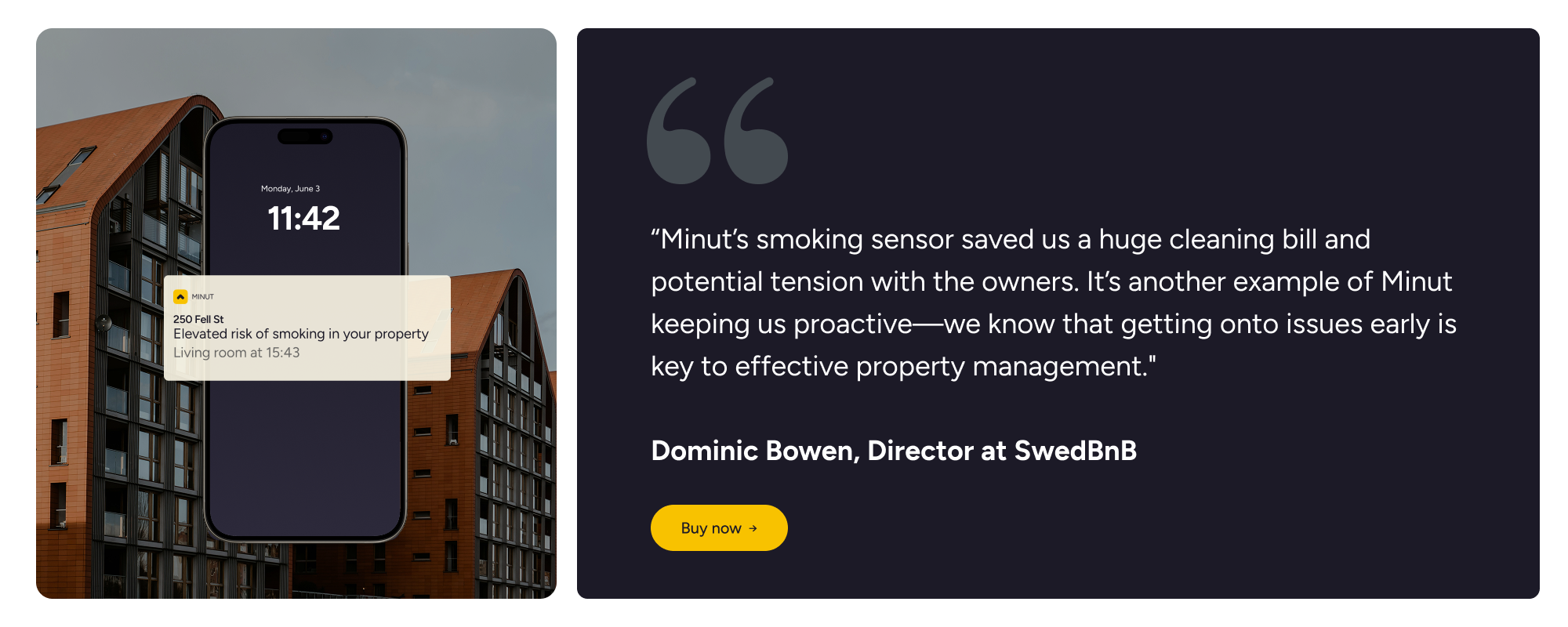
Some systems, like Minut, pair detection with automated messaging that resolves most incidents within minutes. The combination of real-time alerts, automated messaging, and timestamped event history helps you to prevent damage occurring in the first place, and provide evidence if a tenant tries to deny lighting up.
How Minut supports smoking policy enforcement across multifamily communities
Residents value privacy, and staff need simple tools that work at all hours. Minut was built with both in mind.
Privacy by design
Minut monitors the indoor environment, not the people. The sensor doesn’t have any cameras, doesn’t record any audio, and isn’t able to identify any people. Instead, it detects environmental markers, sends your team real-time notifications, and logs the event with a timestamp to give you objective proof of a policy violation.
Real‑time alerts and documented escalations
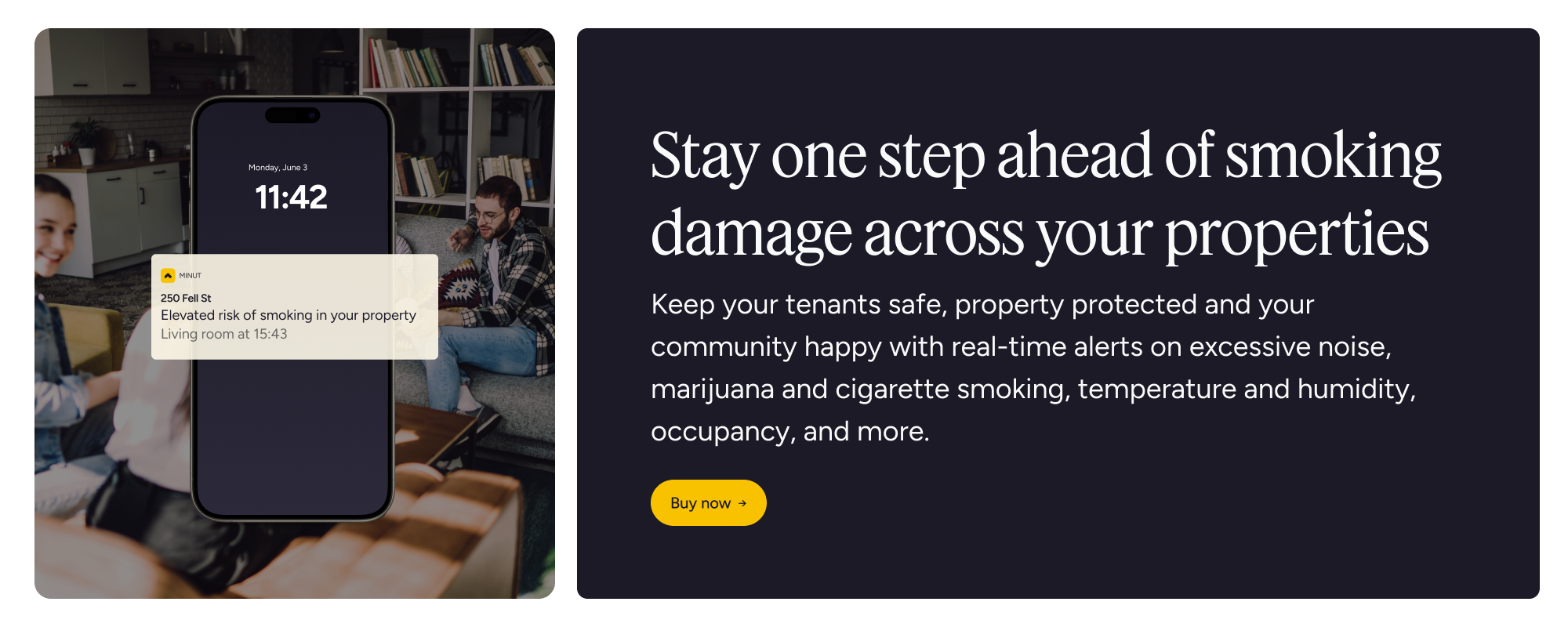
When the environment in a unit or corridor matches smoke activity, Minut can notify your team immediately. You can contact the resident with a friendly reminder or log the warning as the first step in your graduated ladder. Because every event is timestamped, you can attach logs to violation notices, HOA responses, or insurance files.
Hardware that fits apartments
Minut’s M3 sensor is discreet, alerts you if residents tamper with it, and is installed in minutes.
Minut M3 sensor
The implementation playbook
Here’s a practical rollout that avoids false starts and neighbor rumors.
Start with the hotspots
If you don’t have data yet, begin with the usual suspects: units with prior apartment smoking violations, areas where smoke migration was reported, and common areas where odor collects, like elevator lobbies and mail rooms. After 30 days, you’ll see patterns that guide the next placements.
Add clear, privacy‑first disclosures
In your lease or addendum, state that the community is smoke‑free, list locations where smoking is permitted and not permitted, and disclose the use of passive environmental sensors to detect smoke. Keep the language tight: the sensor doesn’t record conversations or video and exists to protect resident wellbeing and building safety.
Connect detections to your enforcement ladder
Create, and enforce, an escalation ladder. It could look like this:
First event: Send a courteous, templated reminder with time and location context and a map to the designated outdoor area.
Second event: Issue a written warning citing lease language and attach the timestamped log.
Third event: Apply the fee or pursue lease enforcement per your policy.
This isn’t about punishment. It’s about consistent smoking policy enforcement that prevents repeat behavior and protects the community.
Train your team
Your courtesy officers and on‑call managers should know three things: where incidents show up, what message to send first, and when to escalate. They need to know this process so enforcement is consistent whether you’re available or not, and whether the incident happens at 3 a.m. or 3 p.m. Keep scripts short, friendly, and precise. Most residents stop once they realize the building is serious and the record is objective.
Measure what matters and share wins
Track monthly trends: total incidents, median time to first response, percent resolved at the “friendly reminder” stage, and affected‑neighbor complaints per incident. When those numbers move the right way, tell residents. Real results build trust faster than slogans about smoke‑free communities.
Final thoughts
Smoking violations in multifamily properties aren’t a housekeeping annoyance. They’re a community‑wide operational challenge that touches resident wellbeing, apartment management, property operations, and liability.
When you monitor the environment, act on the first alert, and escalate with a timestamped record, you protect smoke‑free apartment communities without turning your buildings into surveillance spaces. That’s the balance residents expect and deserve.










.png)